


Introduction
Range anxiety is one of the most talked-about concerns among electric vehicle owners and buyers. Even in a premium luxury EV like the Cadillac Lyriq, knowing how to squeeze every mile out of a single charge can make a real difference — whether you’re commuting through the city or embarking on a long-distance road trip.
One question that comes up repeatedly among Lyriq owners and prospective buyers is: do the driving modes in Cadillac Lyriq offer different ranges or battery usages? The short answer is yes — but the full picture is more nuanced than a simple yes or no.
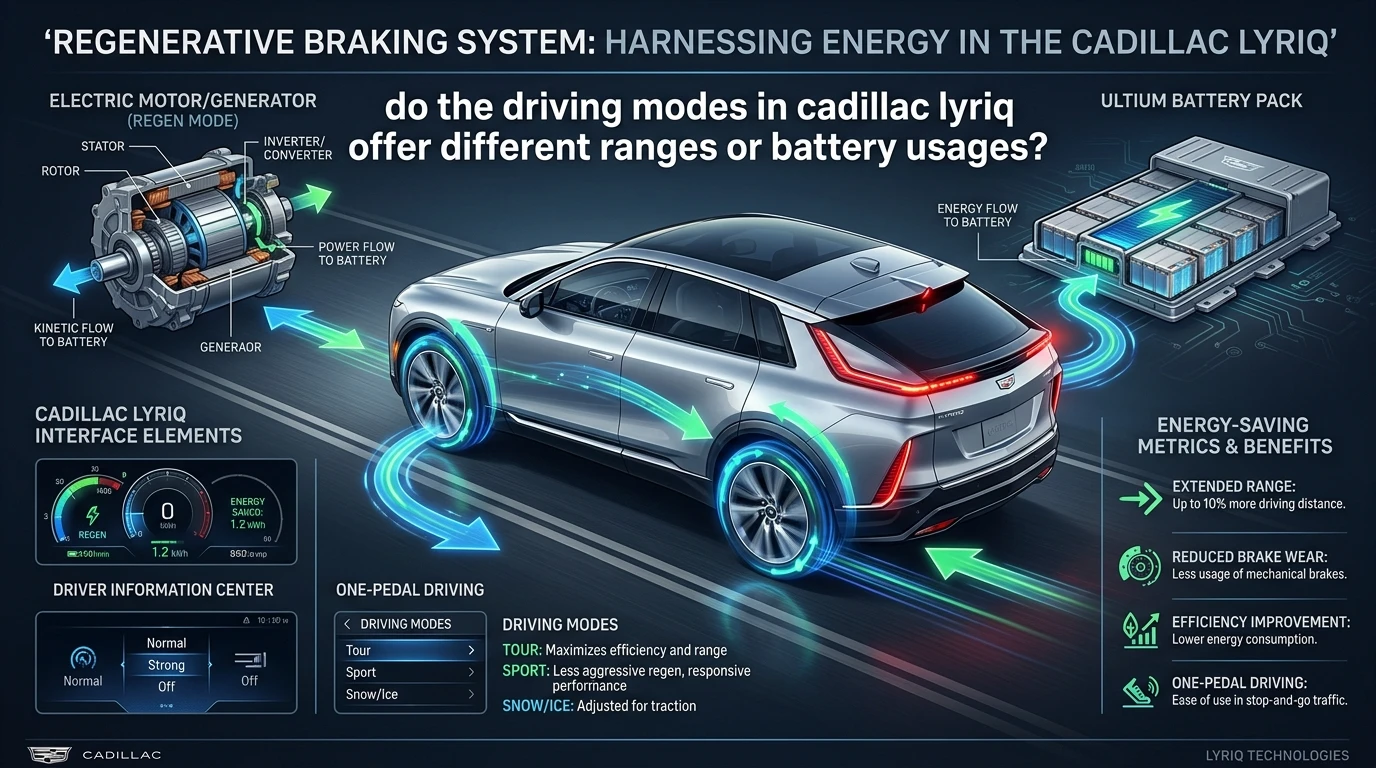
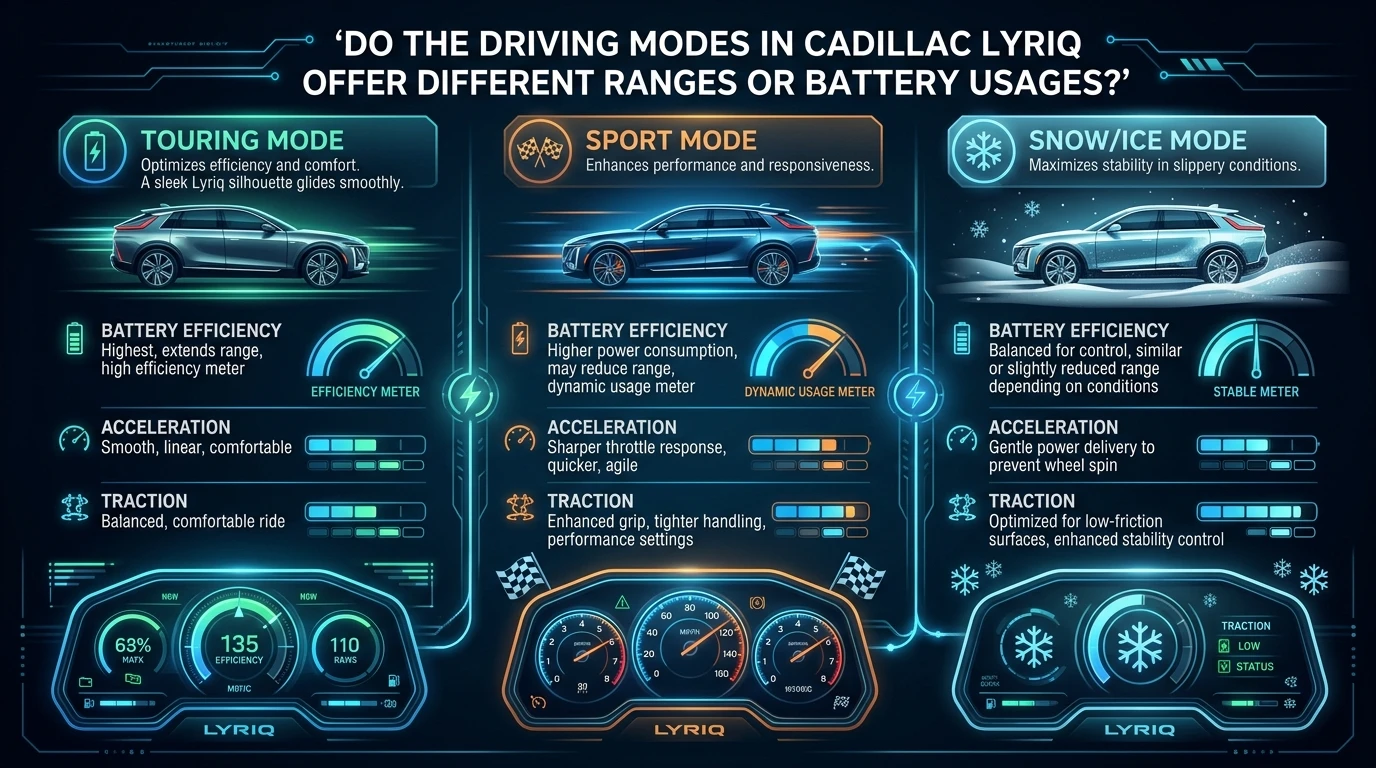
The Cadillac Lyriq comes equipped with multiple driving modes, including Touring, Sport, and Snow/Ice, each designed to change how the vehicle delivers power, handles acceleration, manages traction, and ultimately consumes energy from the battery. Understanding these modes not only helps you drive smarter but also empowers you to adapt your EV experience to every road condition and driving need.
In this guide, we’ll break down every driving mode in the Cadillac Lyriq, explain how each one affects battery consumption and real-world range, and share practical tips to help you optimize efficiency without sacrificing the luxury performance Cadillac is known for.
What Are Cadillac Lyriq Driving Modes?
The Cadillac Lyriq is built on General Motors’ Ultium platform, a next-generation EV architecture designed for intelligent energy management. One of the platform’s most user-friendly features is the selectable driving mode system, which lets drivers tailor the car’s performance characteristics to match their driving style, road conditions, and efficiency goals.
At the core of this system are three primary driving modes:
- Touring Mode — the default, balanced everyday mode
- Sport Mode — a performance-focused mode with sharper throttle response
- Snow/Ice Mode — a safety-oriented mode designed for slippery conditions
Each mode adjusts several vehicle systems simultaneously — including throttle sensitivity, steering weight, suspension (where applicable), traction control thresholds, and the regenerative braking system. All of these adjustments directly influence how much energy is drawn from the battery at any given moment.
How Driving Modes Work in an EV
In a traditional gasoline car, driving modes mainly affect transmission shift points and throttle mapping. In an electric vehicle like the Cadillac Lyriq, driving modes go much deeper. They modify:
- How aggressively the electric motor responds to accelerator input
- The intensity of regenerative braking (which recovers energy back into the battery)
- The distribution of power between front and rear motors (in AWD variants)
- Traction control sensitivity and stability management
Because the Lyriq’s electric motor can deliver its full torque almost instantaneously, managing how and when that torque is deployed is the key lever for controlling battery consumption.
Do the Driving Modes in Cadillac Lyriq Offer Different Ranges or Battery Usages?
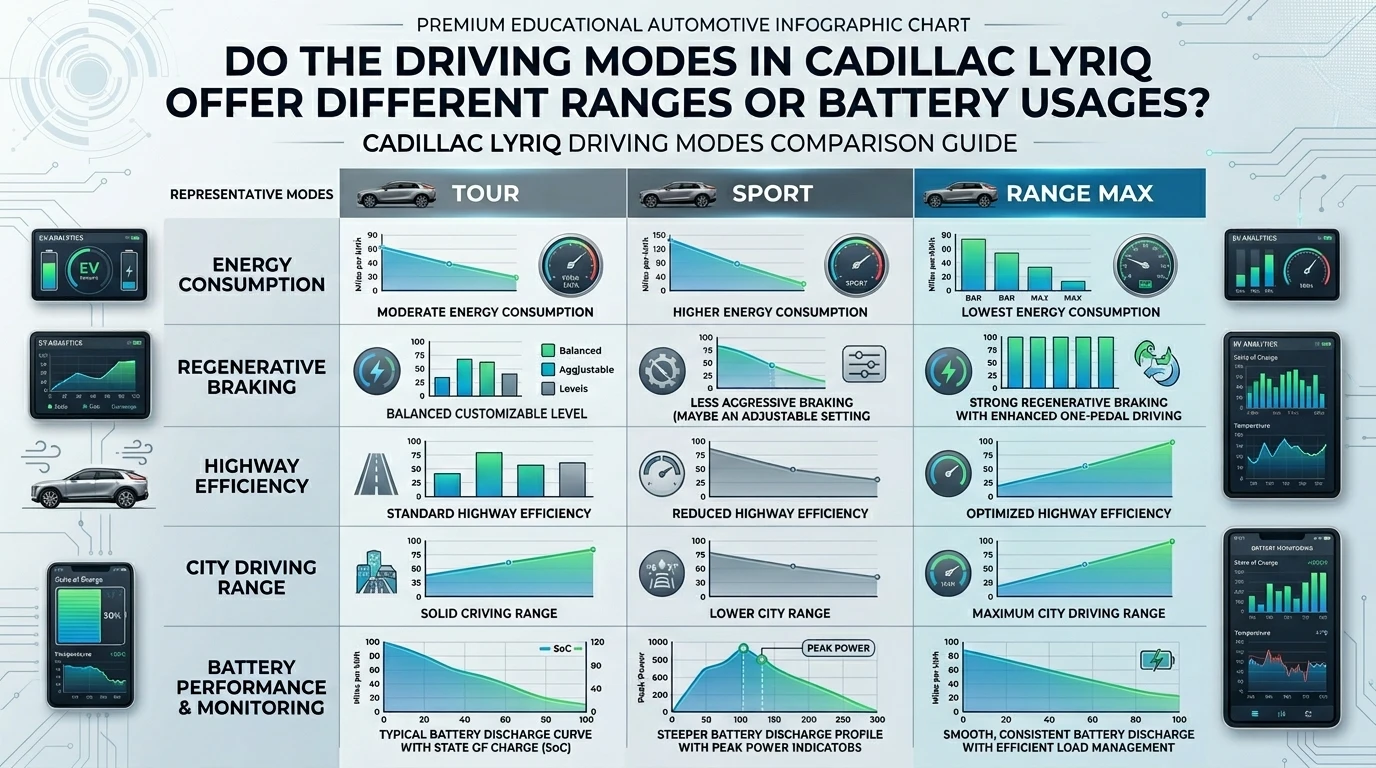
Quick Answer: Yes. The driving modes in the Cadillac Lyriq do offer measurably different ranges and battery usage levels. Touring Mode is optimized for balanced efficiency and is the best choice for maximizing everyday range. Sport Mode increases energy consumption due to sharper throttle response and more aggressive power delivery. Snow/Ice Mode prioritizes traction stability over efficiency, which can also reduce range. The degree of difference depends on your driving habits, road conditions, speed, and climate.
The EPA-estimated range for the 2024 Cadillac Lyriq is approximately 314 miles for the RWD single-motor variant and around 307 miles for the AWD dual-motor version. However, these numbers represent idealized testing conditions. Real-world range in each driving mode will vary.
Here is a straightforward overview of how each mode compares:
| Driving Mode | Energy Focus | Throttle Response | Regen Braking | Estimated Range Impact |
|---|---|---|---|---|
| Touring | Balanced efficiency | Moderate | Standard | Closest to EPA estimate |
| Sport | Performance | Aggressive | Standard/Firm | 5–15% reduction in range |
| Snow/Ice | Traction safety | Smooth/Limited | Adjusted | Moderate reduction |
These are approximate comparisons. Actual figures depend on speed, terrain, climate, and individual driving behavior.
Touring Mode Explained
Touring Mode is the Cadillac Lyriq’s default setting and is designed to strike the optimal balance between performance and efficiency. When you start the car, it automatically selects Touring unless you have saved a different preference.
In Touring Mode, the electric motor’s throttle response is calibrated for smooth, progressive acceleration. It does not feel sluggish — the Lyriq is a luxury performance vehicle after all — but the system avoids unnecessarily aggressive power draws that would rapidly discharge the battery.
Why Touring Mode Is Best for Range
- The throttle mapping prioritizes gradual acceleration over instant power surges
- Regenerative braking operates at a standard intensity, recovering meaningful energy during deceleration
- Steering feel is comfortable and light, reducing unnecessary driver fatigue on long drives
- The vehicle’s energy management system optimizes power flow between the battery and motor in real time
For daily commuters, highway cruisers, and anyone concerned about maximizing their Cadillac Lyriq range, Touring Mode is the recommended starting point.
Sport Mode Battery Impact
Sport Mode is where the Cadillac Lyriq reveals its performance credentials. Selecting Sport Mode sharpens the throttle response dramatically, making the car feel more urgent and responsive to accelerator input. Steering becomes heavier for a more connected feel, and in AWD variants, power distribution shifts to prioritize rear-wheel drive behavior for a sportier dynamic.
How Sport Mode Affects Battery Usage
The trade-off for this heightened performance is increased energy consumption. When the electric motor is instructed to deliver power more aggressively and more frequently, it draws more current from the battery. Even if your driving speed remains constant, the energy “spikes” created by sharper acceleration events add up over a journey.
Here are the key ways Sport Mode increases battery drain:
- Sharper throttle mapping means larger instantaneous current draws
- More aggressive acceleration from stops consumes significantly more energy per mile
- In AWD models, activating both motors simultaneously increases total energy usage
- The driver is psychologically encouraged to push the car harder, compounding consumption
Expect a range reduction of roughly 5–15% in Sport Mode compared to Touring, assuming similar driving conditions. On a spirited mountain drive with frequent acceleration events, the difference could be even more pronounced.
Sport Mode is ideal for those moments when driving pleasure is the priority — canyon roads, merging onto fast-moving highways, or simply enjoying a responsive drive. It is not the right choice if you are trying to stretch your charge on a longer trip.
Snow/Ice Mode Performance and Efficiency
Snow/Ice Mode is the Cadillac Lyriq’s safety-first driving configuration. It is designed for low-traction surfaces including snow-covered roads, icy pavement, and wet conditions where stability and controlled acceleration are more important than performance or efficiency.
What Changes in Snow/Ice Mode
- Throttle response becomes very smooth and gradual to prevent wheel spin on slippery surfaces
- Traction control thresholds are tightened significantly
- Power delivery is limited, especially during initial acceleration from a stop
- The stability management system intervenes more proactively to maintain vehicle control
Efficiency in Snow/Ice Mode
Snow/Ice Mode’s impact on range is mixed. On one hand, the limited throttle response means less aggressive power draws, which can theoretically be more efficient than Sport Mode. On the other hand, driving in cold weather — which is when you are most likely to use this mode — dramatically reduces battery performance regardless of the mode selected.
Cold temperatures slow the electrochemical reactions inside lithium-ion battery cells, reducing available capacity. Heating the cabin via the climate control system adds a further energy load. Combined with the energy demands of navigating slippery roads, real-world range in winter conditions can drop 20–40% compared to ideal summer conditions.
Snow/Ice Mode is not about maximizing range. It is about maximizing safety. Use it whenever road conditions demand it, and plan your charging stops accordingly.
How EV Driving Modes Affect Energy Consumption
At a technical level, the Cadillac Lyriq’s driving modes influence energy consumption through several interconnected systems.
Throttle Mapping and Power Draw
The most direct influence is throttle mapping. In an EV, the accelerator pedal does not control a fuel valve — it sends a signal to the motor control unit specifying how much torque is requested. Driving modes adjust how the motor control unit interprets those signals. A gentle pedal press in Sport Mode will command more torque than the same pedal press in Touring Mode.
Regenerative Braking Intensity
Regenerative braking is one of the most powerful tools for improving EV efficiency. When you lift your foot off the accelerator or apply the brakes, the electric motor runs in reverse as a generator, converting kinetic energy back into electrical energy stored in the battery. The Cadillac Lyriq’s different driving modes can adjust the intensity of this regeneration.
Higher regen intensity means more energy is recovered during deceleration — but it also means the car slows down more aggressively when you lift off the accelerator, which some drivers find uncomfortable in relaxed driving.
Power Distribution in AWD Models
In the dual-motor AWD Lyriq, driving modes influence how power is split between the front and rear motors. Running both motors simultaneously increases range capability and traction but also increases total power consumption. Sport Mode tends to engage both motors more aggressively, while Touring Mode may preferentially rely on one motor when full AWD capability is not needed.
Regenerative Braking and Battery Recovery
Regenerative braking deserves its own dedicated discussion because it is one of the most impactful features for real-world EV range — and one that is directly influenced by driving modes.
The Cadillac Lyriq offers adjustable regenerative braking through its drive mode selector and, on some trims, through dedicated paddle shifters on the steering wheel. Drivers can typically choose between:
- Low Regen — minimal slowdown when lifting off the accelerator; feels more like a traditional car
- Standard Regen — moderate energy recovery; the default in Touring Mode
- One-Pedal Driving — strong deceleration and energy recovery when lifting off the accelerator; can bring the car to a near-complete stop without touching the brake pedal
One-pedal driving, when used skillfully, can significantly improve urban range by recovering energy at every traffic light and speed reduction. Studies across various EV platforms suggest regenerative braking can recover 10–25% of the energy that would otherwise be lost as heat through conventional friction brakes.
For maximum Cadillac Lyriq range in city driving, practice smooth one-pedal driving in Touring Mode and plan your deceleration early to allow maximum regen time before stops.
Real-World Cadillac Lyriq Range Tests
EPA testing is conducted under controlled laboratory conditions that rarely match real-world driving. Independent real-world tests of the Cadillac Lyriq have generally shown strong results, with some variation depending on conditions.
Approximate Real-World Range by Scenario
| Driving Scenario | Estimated Real-World Range |
|---|---|
| City driving, Touring Mode, mild weather | 290–320 miles |
| Highway driving at 70 mph, Touring Mode | 260–290 miles |
| Sport Mode, mixed driving | 240–270 miles |
| Winter driving, cold temperatures | 180–230 miles |
| Highway at 80+ mph in any mode | 220–260 miles |
| One-pedal city driving, optimal conditions | 300–325 miles |
These are approximate ranges based on aggregated owner reports and automotive media testing. Your actual range will vary.
AWD vs RWD Efficiency Comparison
One of the most significant efficiency decisions in the Cadillac Lyriq lineup is the choice between the rear-wheel-drive single-motor configuration and the all-wheel-drive dual-motor configuration.
| Configuration | EPA Range | Power Output | Efficiency Trade-off |
|---|---|---|---|
| RWD Single Motor | ~314 miles | 340 hp | Best efficiency, excellent for dry conditions |
| AWD Dual Motor | ~307 miles | 500 hp | Slightly lower range, superior traction and performance |
The difference in EPA range between RWD and AWD is relatively modest — approximately 7 miles. However, in real-world driving, the gap can widen when AWD is actively engaged in demanding conditions. If maximizing range is your top priority and you live in a mild climate, the RWD Lyriq is the more efficient choice.
For buyers in regions with harsh winters or those who regularly drive on challenging terrain, the AWD version’s superior traction and stability may be worth the small efficiency trade-off.
Best Driving Mode for Maximum Range
If you want to get the absolute most range out of your Cadillac Lyriq on any given charge, the following combination is your best approach:
- Select Touring Mode as your default driving mode
- Enable maximum regenerative braking (one-pedal driving where available)
- Maintain speeds between 55–65 mph on highways — aerodynamic drag increases exponentially above 65 mph
- Pre-condition your battery and cabin while still connected to the charger in cold weather
- Minimize aggressive acceleration from stops
- Limit climate control to necessary settings
- Keep tires inflated to the recommended pressure
Touring Mode, combined with smooth, anticipatory driving habits, consistently delivers the closest real-world range to the EPA estimate.
Highway vs City Driving Efficiency
Interestingly, EVs like the Cadillac Lyriq often achieve better efficiency in city driving than on highways — the opposite of most gasoline vehicles. This is because regenerative braking recovers significant energy during the frequent stops and slow-downs of urban traffic.
| Driving Environment | Key Efficiency Factor | Lyriq Advantage |
|---|---|---|
| City / Urban | Frequent stops, low speeds | High regen recovery, stop-and-go efficiency |
| Highway (55–65 mph) | Steady speed, low regen | Aerodynamic efficiency, consistent power draw |
| Highway (75+ mph) | High aerodynamic drag | Significant range reduction |
| Mixed suburban | Moderate stops, moderate speed | Balanced efficiency |
The Cadillac Lyriq is particularly well-suited to urban and suburban driving, where its regenerative braking system can do meaningful work. On high-speed highway journeys, plan for approximately 15–20% lower range than the EPA estimate.
Climate Control and Battery Drain
Heating and cooling the Cadillac Lyriq’s cabin is one of the biggest non-driving energy draws on the battery. Unlike gasoline engines that generate waste heat as a byproduct, electric motors are highly efficient and produce relatively little heat. This means the Lyriq must generate cabin heat electrically, which consumes battery energy.
Climate Control Energy Impact
- Air conditioning in summer: Can reduce range by 5–15% depending on ambient temperature and intensity settings
- Cabin heating in winter: The most energy-intensive scenario; can reduce range by 20–40% in very cold weather
- Seat heaters and steering wheel heaters: Much more efficient than cabin heating; using them instead of cranking up the HVAC can meaningfully reduce energy consumption
- Pre-conditioning: Warming or cooling the cabin while still plugged in to the charger preserves battery range for driving
The Cadillac Lyriq supports remote pre-conditioning via the MyCadillac app. This is one of the most effective and underused tools for winter range preservation.
EV Driving Habits That Improve Range
Beyond driving mode selection, your individual habits behind the wheel are the single biggest variable in Cadillac Lyriq efficiency.
Top 10 Range-Improving Habits
- Accelerate smoothly and gradually from stops — avoid jackrabbit starts
- Use regenerative braking proactively — anticipate stops and lift off early
- Maintain highway speeds between 55 and 65 mph whenever possible
- Pre-condition your battery and cabin before departing on cold mornings
- Use seat heaters instead of full cabin heat in mild cold weather
- Keep tires at the manufacturer-recommended pressure — under-inflation increases rolling resistance
- Plan routes that avoid unnecessary elevation gain where possible
- Remove unnecessary cargo weight — heavier vehicles use more energy
- Use Eco-focused climate settings when the weather allows
- Monitor your real-time energy consumption display and adjust accordingly
Charging Efficiency and Battery Health
How you charge your Cadillac Lyriq also influences its long-term range and battery health.
Key Charging Tips
- For daily use, charge to 80% rather than 100% — this reduces stress on lithium-ion cells and preserves long-term capacity
- Use 100% charge only when you need the full range for a specific journey
- Avoid regularly depleting the battery below 10% — deep discharges accelerate degradation
- DC fast charging (Level 3) is convenient for road trips but generates more heat in the battery; frequent exclusive use of fast charging can accelerate degradation compared to Level 2 home charging
- The Cadillac Lyriq supports DC fast charging at up to 190 kW, enabling relatively fast charging stops on road trips
Charging Speed Comparison
| Charging Level | Power | Time to 10–80% (Approx.) |
|---|---|---|
| Level 1 (120V home outlet) | ~1.4 kW | 40–60 hours |
| Level 2 (240V home charger) | 11.5 kW | 7–8 hours |
| DC Fast Charge (Level 3) | Up to 190 kW | ~38 minutes |
Cadillac Lyriq Energy Management System
The Cadillac Lyriq’s energy management system operates continuously in the background, optimizing power flow between the battery, motor(s), regenerative braking system, and onboard electronics. This intelligent system is a key reason the Lyriq achieves competitive range figures for its class.
Key features of the energy management system include:
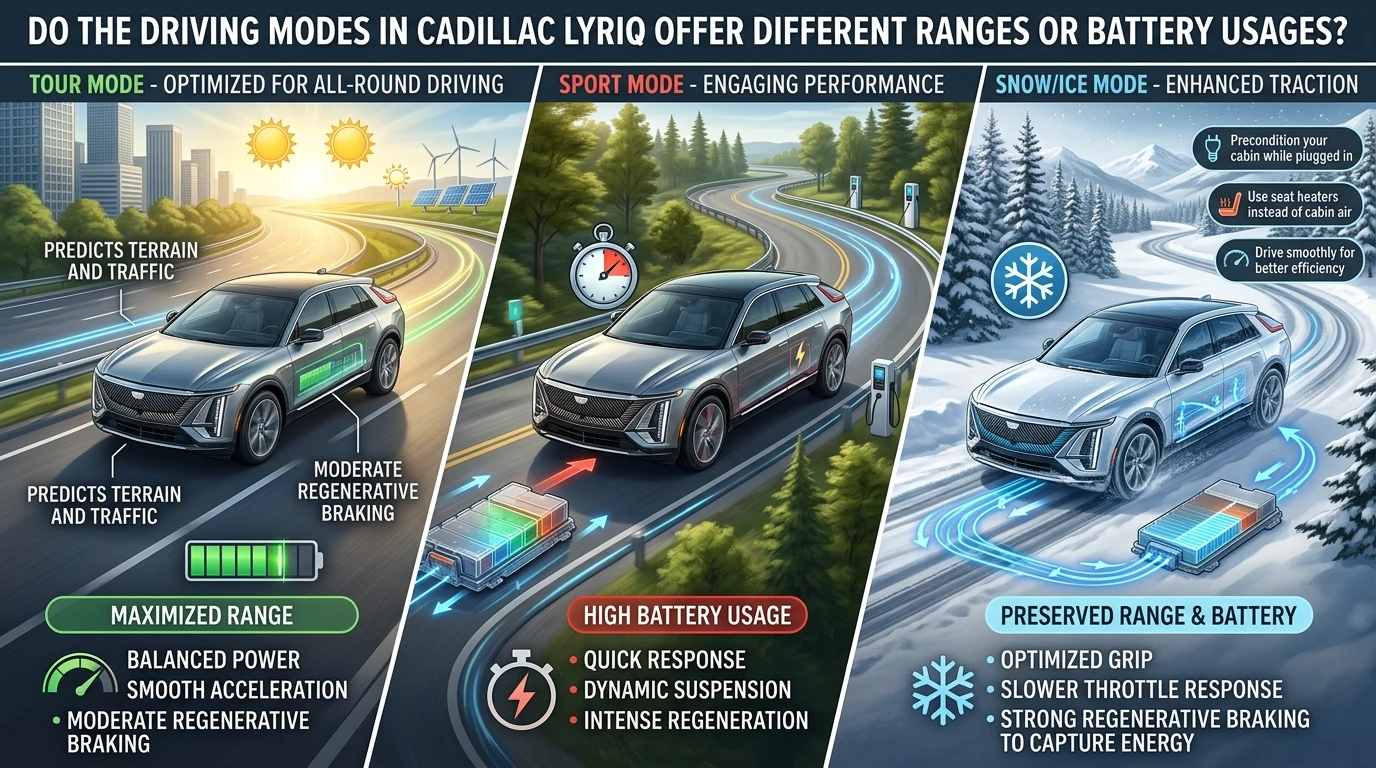
- Predictive energy routing — the system anticipates driving demands and pre-conditions the battery temperature for optimal performance
- Thermal management — active battery heating and cooling maintains the cells in their optimal temperature range, preserving both performance and longevity
- Real-time efficiency coaching — the Lyriq’s driver information center provides live feedback on energy usage, helping drivers understand the impact of their behavior
- Route-based optimization — when navigation is active, the system can adjust power delivery and pre-condition the battery for upcoming grades or charging stops
This behind-the-scenes intelligence means that even in Sport Mode, the system is working to minimize unnecessary energy waste while still delivering the performance the mode promises.
Comparing Cadillac Lyriq to Other Luxury EVs
How does the Cadillac Lyriq’s driving mode system and efficiency stack up against key competitors?
| Vehicle | Starting Range | Performance Mode Range Impact | AWD Available | Regen Braking |
|---|---|---|---|---|
| Cadillac Lyriq RWD | ~314 miles | ~5–15% reduction | Yes (dual motor) | Adjustable |
| Tesla Model Y Long Range | ~320 miles | ~10–15% reduction | Yes | Adjustable / One-pedal |
| BMW iX xDrive50 | ~324 miles | ~10–20% reduction | Standard | Adjustable |
| Mercedes EQS SUV 450+ | ~305 miles | ~10–15% reduction | Yes | Adjustable |
| Audi Q8 e-tron | ~285 miles | ~10–20% reduction | Standard | Adjustable |
The Cadillac Lyriq performs competitively in this segment, with excellent range for its price point and a well-designed driving mode system that gives drivers meaningful control over efficiency and performance. It is particularly strong in Touring Mode efficiency and benefits from General Motors’ extensive investment in the Ultium battery platform.
Common EV Battery Myths
There are several persistent myths about EV battery performance that can cause confusion for Cadillac Lyriq owners.
Myth 1: Sport Mode Permanently Damages Your Battery
False. Using Sport Mode regularly does not cause permanent battery damage. It increases energy consumption per mile, which means more frequent charging — but the chemistry of the cells is not harmed by delivering higher power outputs within the design limits of the system.
Myth 2: You Should Always Charge to 100%
Not quite. For daily driving, charging to 80% is better for long-term battery health. Lithium-ion cells experience more stress at the very top and bottom of their charge range. Save 100% charges for when you genuinely need the full range.
Myth 3: Regenerative Braking Always Extends Range Dramatically
Regenerative braking is genuinely beneficial, but it is not magic. At highway speeds with few deceleration events, regen contributes relatively little. Its biggest benefit is in city driving with frequent stops.
Myth 4: Colder Climates Permanently Reduce EV Range
Cold weather reduces available range temporarily — but properly maintained EV batteries in good health recover their capacity when temperatures return to normal. Long-term range loss due to cold is not permanent in most cases.
Long-Distance EV Travel Tips
Road-tripping in a Cadillac Lyriq requires a slightly different mindset than in a gasoline vehicle, but with good planning it is entirely practical.
- Plan charging stops using a route planner that accounts for real-world range in your expected driving conditions
- Use Touring Mode for highway segments to maximize range between charges
- Aim to charge to 80% at fast chargers on the road — charging is fastest between 10% and 80% and slows significantly above 80%
- Pre-condition your battery while charging in cold weather to improve efficiency on the next leg
- Drive at 65 mph rather than 75–80 mph when range is a concern — the aerodynamic difference is substantial
- Use the Lyriq’s navigation system to route through available DC fast chargers
- Plan for a charging stop every 200–240 miles in real-world highway conditions to maintain comfortable buffer
Future EV Software Optimization Trends
The Cadillac Lyriq, like most modern EVs, is designed to receive over-the-air (OTA) software updates that can improve performance, add features, and enhance energy efficiency without requiring a dealership visit.
General Motors has committed to ongoing OTA update capability across its Ultium platform. Future updates to the Lyriq could potentially include:
- More refined driving mode calibrations based on real-world usage data
- Improved thermal management algorithms that better adapt to weather conditions
- Enhanced one-pedal driving behavior and regen braking customization
- Smarter navigation-integrated range optimization
- New driving mode options that further customize the balance between performance and efficiency
This software-defined vehicle architecture means the Cadillac Lyriq you buy today can genuinely become more capable and efficient over time — a meaningful advantage over traditional vehicles.
EV Driving Mode Comparison Tables
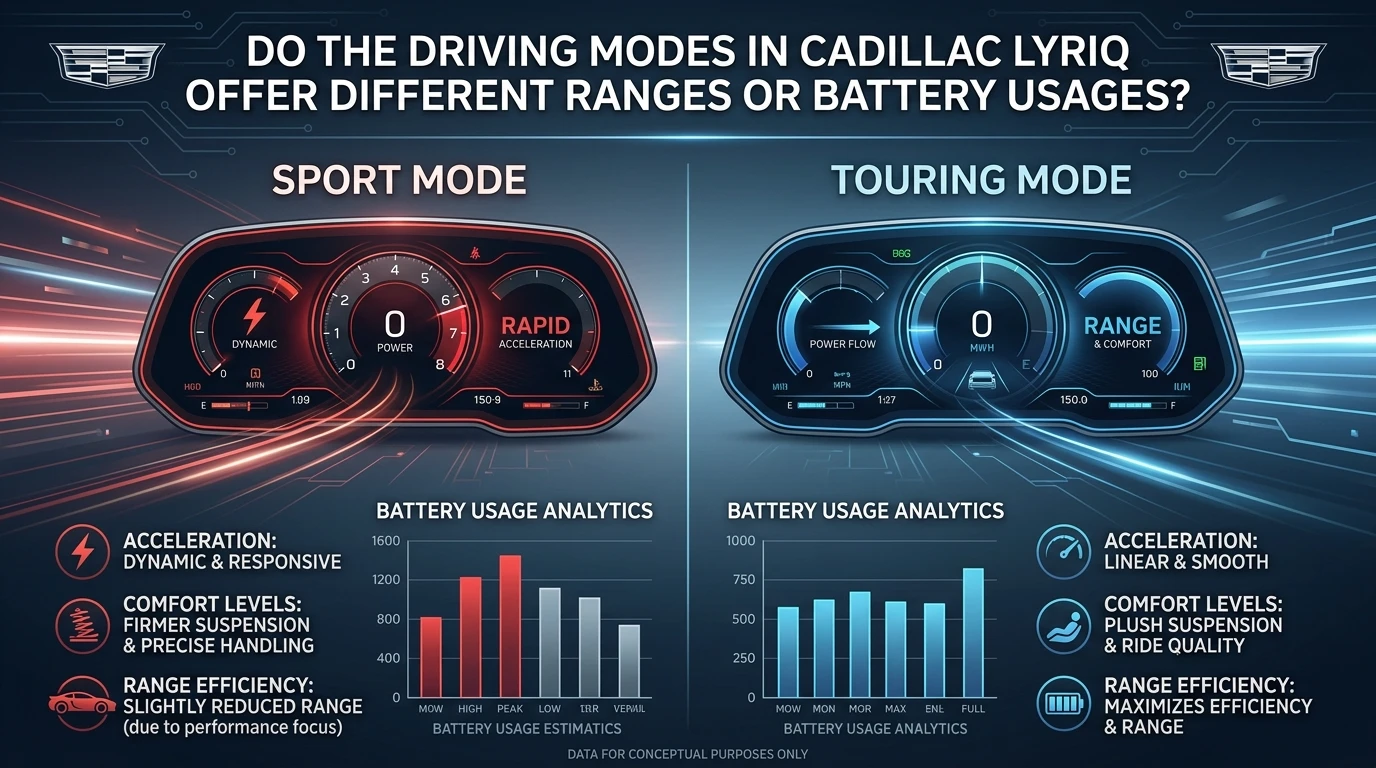
Touring vs Sport vs Snow/Ice Mode
| Feature | Touring | Sport | Snow/Ice |
|---|---|---|---|
| Throttle Response | Moderate | Aggressive | Smooth/Limited |
| Steering Feel | Light | Firm | Standard |
| Traction Control | Standard | Performance | Maximum |
| Regen Braking | Standard | Standard/Firm | Adjusted |
| Range Impact | Best | Reduced 5–15% | Moderate reduction |
| Best Use Case | Daily driving | Spirited driving | Winter/wet roads |
AWD vs RWD Range
| Configuration | EPA Range | Best Driving Mode | Range in Sport |
|---|---|---|---|
| RWD Single Motor | ~314 miles | Touring (310+ miles) | ~265–285 miles |
| AWD Dual Motor | ~307 miles | Touring (300+ miles) | ~255–275 miles |
Highway vs City Battery Usage
| Scenario | Energy Efficiency (mi/kWh) | Regen Benefit | Best Mode |
|---|---|---|---|
| City, low speed | 3.5–4.5 | High | Touring |
| Mixed suburban | 3.0–3.8 | Medium | Touring |
| Highway 65 mph | 2.8–3.2 | Low | Touring |
| Highway 75+ mph | 2.2–2.7 | Very Low | Touring |
Regenerative Braking Levels
| Regen Level | Deceleration Feel | Energy Recovery | Best Scenario |
|---|---|---|---|
| Low | Coasts freely | Minimal | Highway cruising |
| Standard | Moderate slow-down | Moderate | Mixed driving |
| One-Pedal | Strong deceleration | High | City driving |
Battery-Saving Strategies
| Strategy | Range Benefit | Difficulty | Recommended? |
|---|---|---|---|
| Use Touring Mode | High | Easy | Yes |
| Pre-condition in cold | High | Easy | Yes |
| Reduce highway speed | High | Moderate | Yes |
| Maximize regen braking | Medium | Moderate | Yes |
| Use seat heaters vs HVAC | Medium | Easy | Yes |
| Maintain tire pressure | Low-Medium | Easy | Yes |
| Charge to 80% daily | Battery health | Easy | Yes |
FAQ Section
Do Cadillac Lyriq driving modes affect battery usage?
Yes. Each driving mode modifies how the electric motor delivers power, which directly affects how quickly the battery is discharged. Touring Mode is the most efficient, Sport Mode increases consumption due to more aggressive power delivery, and Snow/Ice Mode adjusts power delivery for safety rather than efficiency.
Which Cadillac Lyriq mode gives the best range?
Touring Mode consistently delivers the best real-world range. It balances smooth power delivery with standard regenerative braking to maximize energy efficiency across all driving conditions.
Does Sport Mode reduce Cadillac Lyriq range?
Yes. Sport Mode increases throttle sensitivity and power delivery, which results in higher energy consumption per mile. Expect approximately 5–15% less range in Sport Mode compared to Touring Mode under similar driving conditions.
How does Touring Mode work in Cadillac Lyriq?
Touring Mode is the default setting that balances performance and efficiency. It calibrates throttle response for smooth, progressive acceleration, uses standard regenerative braking, and optimizes power distribution between the motor and battery for everyday driving comfort.
What is Snow/Ice Mode in Cadillac Lyriq?
Snow/Ice Mode limits throttle response and tightens traction control to prevent wheel spin on low-grip surfaces like snow or ice. It prioritizes vehicle safety and stability over performance or energy efficiency.
How can I improve Cadillac Lyriq battery efficiency?
Use Touring Mode for daily driving, maximize regenerative braking, drive at moderate highway speeds, pre-condition the cabin before departing in cold weather, keep tires properly inflated, and use seat heaters instead of full cabin heating in mild cold conditions.
What driving mode saves the most battery?
Touring Mode saves the most battery. For additional efficiency, combine Touring Mode with one-pedal driving (maximum regenerative braking) and smooth, anticipatory acceleration habits.
How does regenerative braking work in Cadillac Lyriq?
When you lift off the accelerator or apply the brakes in the Cadillac Lyriq, the electric motor runs as a generator, converting the vehicle’s kinetic energy back into electricity that is stored in the battery. This reduces wear on friction brakes and meaningfully extends range, especially in city driving.
Is Cadillac Lyriq good for long-distance driving?
Yes. With its EPA-estimated range of up to 314 miles (RWD) and support for DC fast charging at up to 190 kW, the Cadillac Lyriq is well-suited for long-distance travel. Proper route planning with charging stops every 200–240 miles makes cross-country trips practical.
What affects EV battery range the most?
The biggest factors are driving speed (aerodynamic drag increases sharply at higher speeds), ambient temperature, climate control usage, driving aggressiveness, and overall vehicle load. Driving mode selection is one adjustable factor among several.
Does climate control reduce EV range?
Yes, significantly. Cabin heating in cold weather is the most energy-intensive use of non-driving battery power, potentially reducing range by 20–40%. Air conditioning in summer reduces range by a smaller but still noticeable 5–15%.
How does AWD affect Cadillac Lyriq range?
The AWD dual-motor Lyriq has an EPA range of approximately 307 miles compared to 314 miles for the RWD single-motor version. Running both motors increases power consumption. In aggressive driving with full AWD engagement, the range gap between configurations can widen beyond the EPA difference.
How far can the Cadillac Lyriq drive on one charge?
Under EPA test conditions, the RWD Lyriq achieves approximately 314 miles. Real-world range typically falls between 260–320 miles depending on driving mode, speed, weather, and climate control usage.
What is the difference between Sport and Touring Mode?
Touring Mode offers balanced efficiency and comfortable acceleration suited to everyday driving. Sport Mode sharpens throttle response and increases performance at the cost of higher energy consumption. For range, Touring wins. For driving engagement, Sport wins.
Conclusion
So, do the driving modes in Cadillac Lyriq offer different ranges or battery usages? Absolutely yes — and understanding how each mode works puts you firmly in control of your driving experience and your energy budget.
Touring Mode is your everyday ally for maximizing real-world range. Sport Mode is a rewarding but energy-intensive choice best saved for spirited driving occasions. Snow/Ice Mode prioritizes your safety over efficiency and should be used without hesitation whenever road conditions demand it.
Beyond mode selection, your personal driving habits — how smoothly you accelerate, how well you use regenerative braking, how you manage climate control, and at what speeds you cruise — have an enormous impact on how far your Lyriq takes you on a single charge.
The Cadillac Lyriq represents one of the most compelling luxury EVs available today, combining genuine performance, long range, intelligent energy management, and the promise of continued improvement through over-the-air software updates. Armed with the knowledge in this guide, you are well-positioned to get the most out of every charge.
Take the Next Step
Ready to experience the Cadillac Lyriq for yourself? Visit your nearest Cadillac dealer for a test drive and ask specifically about driving mode customization and charging options in your area. If you already own a Lyriq, explore the MyCadillac app to set up remote pre-conditioning and monitor your real-time energy usage — two simple steps that can make a noticeable difference in your daily range.
Have questions about your specific driving patterns and how they might affect range? Drop them in the comments below or join the growing Cadillac Lyriq owner community online to share experiences and tips with fellow Lyriq drivers.
Disclaimer: Range figures cited in this article are based on EPA estimates and aggregated real-world owner data as of 2024. Actual range will vary based on driving habits, weather, terrain, vehicle load, and individual battery health. Always consult official Cadillac documentation and your vehicle’s owner manual for authoritative specifications.