

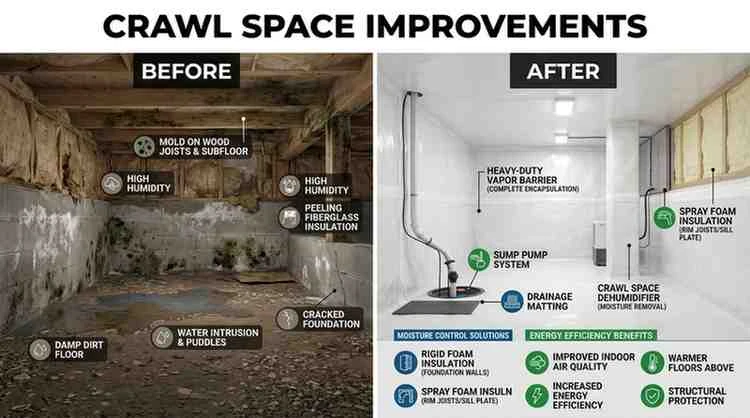
Most homeowners never think about their crawl space until something goes wrong — a musty smell drifting through the floorboards, an unusually high energy bill, or worse, a structural inspector delivering bad news. Yet the crawl space beneath your home plays an enormous role in your indoor air quality, energy efficiency, and the long-term structural health of your property.
Crawl space improvements are not just a contractor upsell. They are a proven way to reduce moisture damage, prevent mold growth, lower heating and cooling costs, and protect the foundation of your home for decades to come. Whether your crawl space is showing early warning signs or you simply want to be proactive, this guide covers everything you need to know — from encapsulation and insulation to waterproofing, dehumidifiers, and professional repair options.
What Are Crawl Space Improvements?
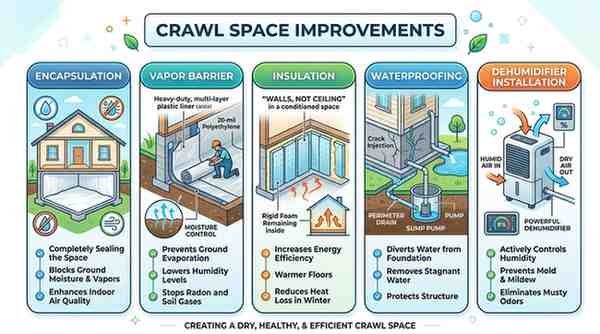
Crawl space improvements refer to a broad range of upgrades designed to protect, seal, insulate, and maintain the space between your home’s ground floor and the soil beneath it. These upgrades can include encapsulation, waterproofing, vapor barrier installation, insulation upgrades, drainage systems, dehumidifiers, and structural repairs.
The goal is simple: to create a clean, dry, controlled environment that supports the structural integrity of your home and contributes to healthier indoor air quality and better energy efficiency.
Crawl spaces vary significantly depending on your home’s age, climate zone, foundation type, and local soil conditions. A crawl space in a humid southeastern climate will face very different challenges than one in a dry southwestern region. That is why crawl space improvements are not one-size-fits-all — they need to be matched to your home’s specific conditions.
Signs Your Crawl Space Needs Attention
Many homeowners do not realize there is a problem until damage has already progressed. Being able to identify early warning signs can save you thousands of dollars in repairs.
Watch out for these common warning signs:
- A persistent musty or earthy odor inside your home
- Cold floors during winter months, even with heating on
- Higher-than-normal energy bills with no obvious cause
- Visible mold or mildew on floor joists or wooden beams
- Warped or soft sections in your hardwood or laminate flooring
- Standing water or excessive dampness after rainfall
- Increased presence of insects like termites, centipedes, or wood lice
- Rust on metal components such as pipes, HVAC ducts, or fasteners
- Sagging insulation falling away from the floor above
- Cracks appearing in drywall, baseboards, or door frames
If you notice one or more of these signs, it is wise to schedule a professional crawl space inspection before conditions worsen. Some problems, particularly structural ones, need to be addressed by qualified contractors.
What Is Crawl Space Encapsulation?
Quick Answer: Crawl space encapsulation is the process of sealing the entire crawl space — walls, floor, and sometimes the ceiling — with a thick, continuous vapor barrier to prevent moisture from entering the space from the ground or through the foundation walls.
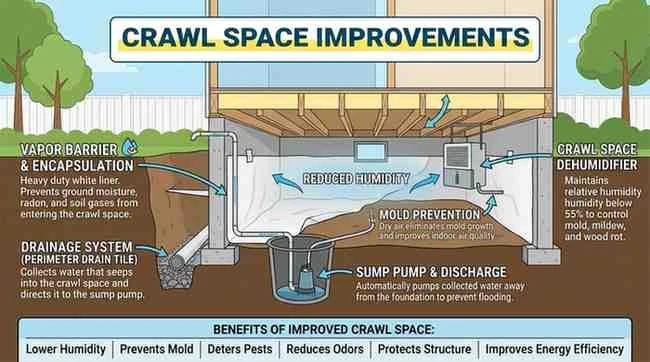
Encapsulation essentially converts your crawl space from an open, vented environment into a sealed, conditioned space. When done correctly, it dramatically reduces moisture levels, prevents mold growth, improves indoor air quality, and can lower your energy costs by reducing the load on your heating and cooling system.
What Does Encapsulation Typically Include?
- A heavy-duty polyethylene vapor barrier installed on the floor and walls (usually 10 to 20 mil thickness)
- Sealing all vents, gaps, and penetrations in the foundation walls
- Installing a drainage system or sump pump if standing water is present
- A crawl space dehumidifier to maintain target humidity levels
- Insulation of the foundation walls (rather than the floor joists above)
- A conditioned air supply to keep the space from getting too dry or too wet
Encapsulation is considered one of the most effective single crawl space improvements a homeowner can invest in, particularly in humid climates. However, it should always follow a thorough inspection to ensure no active water intrusion or structural issues are left unaddressed first.
Crawl Space Moisture Control Explained
Moisture is the single biggest threat to any crawl space. It enters from multiple sources: rising ground moisture through the soil, water vapor diffusing through concrete walls, condensation forming on cold pipes and surfaces, and groundwater intrusion during heavy rain or flooding.
Left unchecked, excess moisture leads to wood rot, mold, pest infestation, degraded insulation, and compromised structural integrity.
How Moisture Enters Your Crawl Space
- Ground evaporation: Moisture evaporates naturally from the soil beneath your home and rises into the crawl space.
- Foundation wall seepage: Water migrates through porous concrete or block walls during or after heavy rain.
- Condensation: Warm, humid air entering through vents contacts cool surfaces and forms condensation.
- Plumbing leaks: Even small leaks from pipes running through the crawl space add significant moisture over time.
- Poor grading: If the ground around your foundation slopes toward the house, rainwater flows toward the foundation rather than away from it.
Moisture Control Solutions
Effective moisture control usually involves a combination of approaches rather than a single fix:
- Install a continuous vapor barrier across the crawl space floor
- Seal foundation wall vents if switching to a closed crawl space system
- Improve exterior drainage and grading around the foundation
- Install a sump pump system if water intrusion is recurring
- Add a dehumidifier rated for the volume of your crawl space
- Insulate pipes to prevent condensation
Waterproofing Solutions for Crawl Spaces
Crawl space waterproofing goes a step further than basic moisture control — it is designed to actively manage water that enters or threatens to enter the space during rain events or from rising groundwater.
Interior Waterproofing Systems
Interior drainage systems are installed along the perimeter of the crawl space floor. They channel water that seeps through the walls or floor into a collection channel that drains into a sump pit. A sump pump then removes the water from the home.
This approach does not stop water from entering but manages it efficiently so it cannot cause damage.
Exterior Waterproofing
Exterior waterproofing involves excavating around the foundation and applying a waterproof membrane or coating to the outside of the foundation walls. While highly effective, it is significantly more expensive and disruptive than interior systems.
Sump Pump Systems
A sump pump is often a critical component of any waterproofing system. It sits in a pit below the crawl space floor and automatically pumps water out of the home when the water level rises.
For homes in flood-prone or high-rainfall areas, a battery-backup sump pump is strongly recommended to ensure operation during power outages.
Drainage Matting
Drainage matting — also called dimple mat — is placed on the crawl space floor beneath the vapor barrier. It allows any water that does enter the space to flow freely toward the drainage channel rather than pooling beneath the barrier.
Best Insulation Options for Crawl Spaces
Proper insulation is a key element of energy efficient crawl space improvements. The right choice depends on whether your crawl space is vented or sealed, your climate, and your budget.
Fiberglass Batt Insulation
Fiberglass batts are the most common and affordable option. They are installed between the floor joists above the crawl space. However, fiberglass absorbs moisture and can sag or fall out over time, reducing its effectiveness. It is better suited for vented crawl spaces in drier climates.
Rigid Foam Board Insulation
Rigid foam panels (EPS, XPS, or polyisocyanurate) are installed against the foundation walls in a sealed crawl space. They offer excellent moisture resistance, do not sag, and provide a high R-value per inch of thickness. This is often the preferred option in encapsulated crawl spaces.
Spray Foam Insulation
Spray polyurethane foam can be applied directly to foundation walls and between floor joists. It provides an air seal as well as insulation, making it highly effective at blocking both heat transfer and moisture. Closed-cell spray foam also acts as a vapor barrier. It is the most expensive option but offers superior performance.
Mineral Wool (Rockwool)
Mineral wool batts resist moisture better than fiberglass and offer good fire resistance. They can be used in floor joists or, with proper support, against foundation walls.
Vapor Barriers and Sealed Crawl Spaces
A vapor barrier is a plastic or foil sheet installed on the crawl space floor to block ground moisture from evaporating into the space above. In a fully encapsulated system, the vapor barrier also runs up the foundation walls and is sealed at all seams and penetrations.
Vapor Barrier Thickness
- 6 mil polyethylene: The bare minimum; adequate only for lightly damp, vented crawl spaces
- 10 to 12 mil: A good mid-range option for most residential crawl spaces
- 20 mil reinforced: The industry standard for full encapsulation systems; far more durable and puncture-resistant
The Sealed Crawl Space Advantage
Building science research, including studies supported by the U.S. Department of Energy, consistently shows that sealed crawl spaces outperform vented crawl spaces in humid climates. Vented crawl spaces allow warm, humid outdoor air to enter and condense on cooler surfaces, creating persistent moisture problems. A sealed, conditioned crawl space keeps humidity under control year-round.
How Crawl Spaces Affect Indoor Air Quality
The air in your crawl space does not stay there. Due to the “stack effect” — a natural airflow pattern where air moves from lower to higher levels in a building — as much as 40 to 60 percent of the air on your home’s first floor may originate from your crawl space.
This means that mold spores, radon gas, pest droppings, dust, and chemical off-gassing from the soil can all make their way into the living areas of your home through gaps in the subfloor.
What Crawl Space Air Carries Into Your Home
- Mold and fungal spores from wood rot or damp surfaces
- Volatile organic compounds (VOCs) from soil gases
- Radon — a naturally occurring radioactive gas that is a leading cause of lung cancer
- Allergens from pest activity, including droppings and shed skins
- High humidity that worsens respiratory issues like asthma
Improving your crawl space with encapsulation, sealing, and proper ventilation is one of the most impactful steps you can take for your family’s indoor air quality.
Mold Prevention and Humidity Reduction
Mold can begin growing in crawl spaces when relative humidity levels exceed 60 percent and organic material — like wood — is present. Crawl spaces are ideal breeding grounds because they are dark, often humid, and rarely disturbed.
How to Prevent Mold in Your Crawl Space
- Keep relative humidity below 55 percent using a dehumidifier
- Install a continuous vapor barrier to block ground moisture
- Seal all foundation vents in a closed crawl space system
- Fix any plumbing leaks promptly
- Ensure proper exterior drainage directs water away from the foundation
- Schedule annual crawl space inspections
Crawl Space Mold Remediation
If mold is already present, it must be professionally remediated before encapsulation or insulation is installed. Encapsulating over active mold simply traps it and allows it to continue damaging structural components out of sight. Remediation involves removing contaminated material, treating affected surfaces with antimicrobial solutions, and ensuring all moisture sources are resolved.
Crawl Space Ventilation Systems
There are two main schools of thought on crawl space ventilation: vented crawl spaces and sealed (unvented) crawl spaces. The best approach depends on your climate zone, home design, and local building codes.
Vented Crawl Spaces
Traditional building practice calls for foundation vents that allow outside air to circulate through the crawl space, theoretically removing moisture. This works reasonably well in dry climates but can actually worsen moisture problems in humid climates where the outdoor air itself is moisture-laden.
Sealed Crawl Spaces with Mechanical Ventilation
Modern building science increasingly favors sealing crawl spaces and conditioning them as part of the home’s overall HVAC system. A small supply of conditioned air keeps the space dry and within safe humidity ranges. This is often combined with a dedicated crawl space dehumidifier for best results.
Crawl Space Exhaust Fans
In some situations, exhaust fans are installed to draw moist air out of the crawl space and expel it outside. This can help in mildly damp spaces but is not a substitute for a full moisture control system.
Foundation Protection and Structural Repair
Moisture damage in a crawl space rarely stays in the crawl space. Over time, it works its way into the structural components of your home.
Common Structural Problems Linked to Crawl Space Moisture
- Wood rot: Prolonged exposure to moisture causes floor joists, beams, and sill plates to decay. This can lead to soft, bouncy floors and eventually structural failure.
- Termite damage: Damp wood attracts termites. By the time visible damage appears, significant structural harm may already have occurred.
- Settling and shifting: Saturated soil beneath the foundation can shift, causing the foundation to settle unevenly and crack.
- Beam and joist failure: Severely deteriorated structural members may need to be sistered (reinforced with new lumber alongside the old) or replaced entirely.
Foundation Stabilization Solutions
When crawl space moisture has contributed to foundation movement or cracking, more significant repairs may be needed:
- Helical piers or push piers to stabilize a settling foundation
- Carbon fiber straps to reinforce bowing foundation walls
- Crawl space jacks or support posts to restore floor level
- Mudjacking or polyurethane foam injection to lift settled concrete slabs
These structural repairs should always be performed by licensed foundation repair contractors. A thorough inspection is essential before any repair plan is determined.
Energy Efficiency Benefits of Crawl Space Upgrades
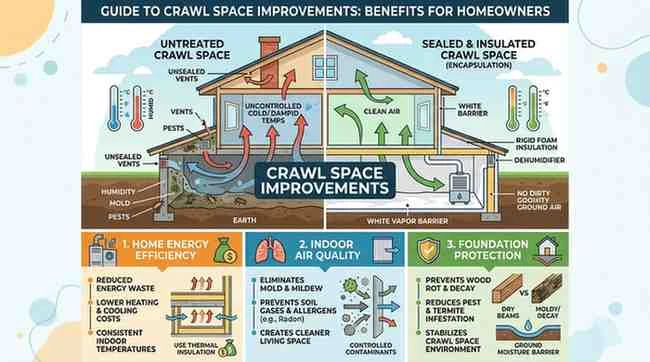
An uninsulated, leaky crawl space is one of the biggest sources of energy loss in a home. Conditioned air escapes through the subfloor, while cold ground air chills your floors and forces your heating system to work harder.
How Crawl Space Improvements Save Energy
- Air sealing reduces drafts and prevents conditioned air from escaping through the subfloor
- Wall insulation in a sealed crawl space eliminates thermal bridging through the foundation
- Vapor barriers and dehumidifiers reduce the latent load on your HVAC system by keeping humidity in check
- Sealed vents prevent cold outside air from penetrating the crawl space in winter
Homeowners who complete full crawl space encapsulation frequently report improvements in how evenly their home is heated and cooled, reduced HVAC run times, and lower monthly utility bills. The exact savings will vary depending on your home’s size, climate, and starting conditions.
Crawl Space Dehumidifiers Explained
A crawl space dehumidifier is a purpose-built unit designed to operate in the challenging conditions of a crawl space — low temperatures, high humidity, and limited space. Unlike portable consumer dehumidifiers, crawl space units are designed for continuous operation and typically drain automatically via a condensate pump or gravity drain.
How to Choose the Right Crawl Space Dehumidifier
- Capacity: Measured in pints per day. Match the unit’s capacity to your crawl space square footage and existing moisture levels.
- Operating temperature range: Some units struggle in low temperatures. Choose a unit rated for operation at temperatures as low as 33°F (1°C) if you live in a cold climate.
- Energy Star certification: Energy-efficient models cost less to operate over their lifetime.
- Automatic drainage: Essential for an unattended crawl space. The unit should drain via a hose to a sump pit or floor drain.
- Built-in humidistat: Allows the unit to cycle on and off to maintain your target humidity level rather than running continuously.
Target humidity level: Most crawl space professionals recommend maintaining relative humidity between 45 and 55 percent year-round.
DIY vs. Professional Crawl Space Repairs
Some crawl space improvements are well within the abilities of a motivated homeowner. Others require professional expertise, specialized equipment, and in some cases, licensed contractors.
What Homeowners Can Often DIY
- Installing a basic 6 to 10 mil vapor barrier on the crawl space floor
- Adding insulation batts between floor joists (in a vented crawl space)
- Installing a portable or plug-in dehumidifier
- Improving exterior drainage and grading around the foundation
- Cleaning out debris, old insulation, or minor pest evidence
What Should Be Left to Professionals
- Full crawl space encapsulation with thick reinforced barriers
- Interior drainage system installation
- Sump pump installation and waterproofing systems
- Mold remediation and treatment
- Spray foam insulation application
- Structural repairs including sistering joists, foundation piers, or wall stabilization
- Radon mitigation systems
Attempting to encapsulate over active mold, standing water, or structural damage without professional assessment is a common and costly mistake. When in doubt, get an inspection first.
Average Crawl Space Encapsulation Costs
Crawl space improvement costs vary widely depending on the scope of work, crawl space size, existing conditions, local labor rates, and materials selected. The following ranges are general estimates only — always get multiple quotes from local contractors for your specific situation.
| Improvement Type | Estimated Cost Range |
|---|---|
| Basic vapor barrier (6 mil, DIY) | $150 – $500 |
| Professional vapor barrier installation | $1,000 – $3,000 |
| Full encapsulation (10–20 mil barrier + sealing) | $3,000 – $8,000 |
| Crawl space dehumidifier (installed) | $1,000 – $2,500 |
| Interior drainage system + sump pump | $2,500 – $7,000 |
| Spray foam insulation (walls) | $3,000 – $10,000 |
| Mold remediation | $1,500 – $6,000+ |
| Structural joist repair (sistering) | $1,500 – $5,000+ |
| Full crawl space renovation (all systems) | $8,000 – $25,000+ |
These ranges are broad because every crawl space is different. A small, relatively dry crawl space needing only a vapor barrier and dehumidifier will cost far less than a large, water-damaged space requiring drainage, structural repair, and full encapsulation.
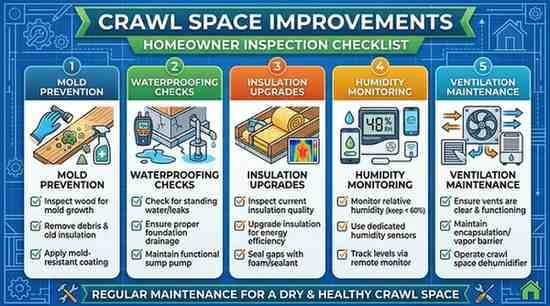
Crawl Space Maintenance Checklist
Once your crawl space improvements are in place, ongoing maintenance is essential to protect your investment.
Annual Crawl Space Inspection Checklist
- Inspect the vapor barrier for tears, punctures, or displacement
- Check all seams and taped joints for separation
- Inspect foundation walls for new cracks, efflorescence (white mineral deposits), or seepage
- Test the sump pump by pouring water into the pit to confirm it activates
- Check and clean the sump pump intake screen
- Inspect the dehumidifier filter and clean or replace as needed
- Verify the dehumidifier drainage line is clear and draining properly
- Check floor joists and beams for signs of new moisture damage, staining, or soft spots
- Look for pest activity — droppings, tunnels, or damage
- Check pipe insulation for deterioration
- Test crawl space exhaust fans if installed
- Confirm that exterior grading still slopes away from the foundation
After Heavy Rain or Flooding
- Inspect for standing water inside the crawl space
- Check whether the sump pump activated and removed water
- Look for any displacement or shifting of the vapor barrier
- Check the drainage channel for blockages
Common Crawl Space Problems Homeowners Face
Understanding the most frequent crawl space problems helps you know what to look for and when to act.
Standing Water: Often caused by poor grading, a failing sump pump, or heavy groundwater intrusion. Requires immediate attention to prevent damage.
Mold Growth: Typically the result of persistently high humidity, often above 60 percent for extended periods. Requires remediation and humidity control.
Sagging Insulation: Fiberglass batts absorb moisture and fall from between floor joists over time, eliminating their insulating value and contributing to moisture problems.
Pest Infestation: Damp, dark crawl spaces attract wood-destroying insects, rodents, and other pests. Moisture control and sealing entry points are the primary defenses.
Condensation on Surfaces: Common in vented crawl spaces during summer months when warm, humid air contacts cooler pipes, ducts, or surfaces.
Wood Rot: A slow-developing but serious problem that weakens floor joists, beams, and sill plates. Early detection is critical.
Radon Gas: Radon enters through soil and can accumulate in sealed crawl spaces if not properly ventilated. Test for radon if you live in a high-risk area and consult a certified radon mitigation professional.
How to Choose Crawl Space Contractors
Finding the right contractor for crawl space work is important — this is a specialized field, and not all waterproofing or general contractors have the specific expertise needed.
What to Look For in a Crawl Space Contractor
- Proven experience specifically with crawl space encapsulation and waterproofing
- Licensing and insurance appropriate for your state and the type of work involved
- References from recent customers in your area
- A detailed written estimate that breaks down materials and labor
- Warranty coverage on both materials and workmanship
- Familiarity with your local climate conditions and building codes
Questions to Ask Before Hiring
- Do you offer a free crawl space inspection?
- What thickness and brand of vapor barrier do you use?
- What is included in your encapsulation process?
- How do you handle active mold or structural damage discovered during the work?
- What warranty do you provide, and what does it cover?
- Are you a certified installer for the products you use?
Get at least three quotes from different companies. Be cautious of contractors who pressure you into an immediate decision or offer unusually low prices that seem too good to be true.
Crawl Space Comparison Tables
Crawl Space Improvement Options Compared
| Improvement | Avg. Cost | Moisture Protection | Energy Benefit | DIY Feasible | Best For |
|---|---|---|---|---|---|
| 6-mil vapor barrier | $150–$500 | Basic | Minimal | Yes | Dry, vented spaces |
| 12-mil vapor barrier | $800–$2,000 | Moderate | Low | Possible | Moderately damp spaces |
| Full encapsulation (20 mil) | $3,000–$8,000 | High | Moderate–High | No | Humid climates |
| Spray foam (walls) | $3,000–$10,000 | High | High | No | Sealed crawl spaces |
| Fiberglass batt insulation | $500–$2,000 | Low | Moderate | Yes | Vented, dry spaces |
| Rigid foam board (walls) | $1,500–$4,000 | Moderate–High | High | Possible | Sealed crawl spaces |
| Interior drainage + sump | $2,500–$7,000 | Very High | Low | No | Wet, flood-prone areas |
| Crawl space dehumidifier | $1,000–$2,500 | High (humidity) | Moderate | Possible | All encapsulated spaces |
| Mold remediation | $1,500–$6,000+ | N/A (repair) | N/A | No | Mold-affected spaces |
Vented vs. Sealed Crawl Space: Which Is Better?
| Factor | Vented Crawl Space | Sealed Crawl Space |
|---|---|---|
| Moisture control | Poor in humid climates | Excellent |
| Energy efficiency | Lower | Higher |
| Mold risk | Higher | Lower |
| Air quality impact | Moderate–Poor | Good |
| Installation cost | Lower | Higher |
| Maintenance | Moderate | Low–Moderate |
| Climate suitability | Dry climates | Humid and mixed climates |
| Building code acceptance | Widely accepted | Increasingly required |
Crawl Space Insulation Comparison
| Insulation Type | R-Value per Inch | Moisture Resistance | Cost | Durability | Best Placement |
|---|---|---|---|---|---|
| Fiberglass batt | R-3.1 – R-3.4 | Poor | Low | Fair | Floor joists (vented) |
| Mineral wool batt | R-3.0 – R-3.3 | Good | Moderate | Good | Floor joists |
| Rigid foam (EPS) | R-3.6 – R-4.2 | Excellent | Moderate | Excellent | Foundation walls |
| Rigid foam (XPS) | R-5.0 | Excellent | Moderate–High | Excellent | Foundation walls |
| Closed-cell spray foam | R-6.0 – R-7.0 | Excellent | High | Excellent | Walls and rim joists |
| Open-cell spray foam | R-3.5 – R-3.7 | Poor | Moderate | Good | Interior applications only |
Frequently Asked Questions
What are the best crawl space upgrades?
The most impactful crawl space upgrades are full encapsulation with a heavy-duty vapor barrier, a crawl space dehumidifier, and an interior drainage system if water intrusion is present. For energy efficiency, adding rigid foam insulation to the foundation walls in a sealed crawl space is highly effective. The best combination for your home depends on your climate, existing conditions, and budget.
How do crawl space improvements help a home?
Crawl space improvements protect your home in multiple ways. They reduce moisture, which prevents mold growth and wood rot. They improve indoor air quality by stopping damp, contaminated air from rising into living areas. They reduce energy bills by creating a thermal barrier and reducing HVAC load. They also protect your foundation and structural components from long-term moisture damage.
What is crawl space encapsulation?
Crawl space encapsulation is the process of sealing the crawl space with a thick polyethylene vapor barrier covering the floor and walls, combined with sealing all vents and openings. The goal is to create a dry, controlled environment that prevents moisture from entering from the ground or foundation walls.
How much does crawl space encapsulation cost?
Full crawl space encapsulation typically costs between $3,000 and $8,000 for most residential homes. However, costs vary significantly based on crawl space size, existing moisture conditions, the thickness of the barrier used, and whether additional systems like drainage or dehumidifiers are included. Always obtain multiple quotes from licensed local contractors.
Do crawl space upgrades improve air quality?
Yes. Because air moves upward from the crawl space into living areas through the stack effect, improving the crawl space directly improves indoor air quality. Reducing mold, moisture, pest activity, and soil gas infiltration all lead to cleaner, healthier air inside the home.
How can I reduce moisture in my crawl space?
The most effective moisture reduction strategies include installing a vapor barrier, encapsulating the crawl space, sealing foundation vents, improving exterior drainage around the foundation, installing a sump pump if water intrusion is present, and running a dedicated crawl space dehumidifier to maintain safe humidity levels.
What causes mold in crawl spaces?
Mold in crawl spaces is caused by persistently high humidity — typically above 60 percent relative humidity — combined with organic material like wood. High humidity stems from ground moisture evaporation, poor drainage, condensation, and inadequate or absent vapor barriers. Mold can also enter through foundation vents that allow humid outdoor air inside.
Is crawl space insulation worth it?
Yes, crawl space insulation is generally worth the investment. Properly installed insulation reduces heat loss through the floor in winter, reduces cooling loads in summer, and can meaningfully lower energy bills. The return on investment depends on your home’s current energy performance and your local climate. In most cases, the annual energy savings help recover the cost over several years.
Should crawl spaces be sealed?
In humid and mixed climates, current building science strongly supports sealing crawl spaces rather than venting them. Sealed crawl spaces consistently show better moisture control, lower mold risk, and improved energy efficiency. In dry climates, vented crawl spaces can work adequately. Check your local building codes, as requirements vary by region.
What is the best vapor barrier for crawl spaces?
For full encapsulation, a reinforced polyethylene barrier of at least 12 to 20 mil thickness is recommended. Twenty-mil reinforced barriers are the industry standard for long-term encapsulation systems — they are more durable, puncture-resistant, and hold up better over decades of use compared to thin 6-mil sheets.
How do crawl spaces affect energy efficiency?
An unsealed, uninsulated crawl space allows cold air to penetrate the floor during winter and adds humidity load during summer, both of which increase HVAC energy consumption. Proper encapsulation and insulation reduce heat transfer through the floor, reduce HVAC runtime, and lead to more consistent indoor temperatures.
Can crawl space upgrades prevent structural damage?
Yes. Moisture is the primary driver of structural damage in crawl spaces — it causes wood rot, attracts termites, and can destabilize the soil beneath a foundation. By keeping the crawl space dry and well-sealed, you significantly reduce the risk of progressive structural damage over time.
When should a crawl space be repaired?
A crawl space should be repaired as soon as problems are identified. Early signs include musty odors, high humidity, visible mold, cold floors, pest activity, or standing water. Delaying repairs allows problems to progress and typically makes them far more expensive to fix.
Do crawl space dehumidifiers work?
Yes, crawl space dehumidifiers are highly effective when properly sized and maintained. They are particularly important in encapsulated crawl spaces where other moisture sources have been controlled but residual humidity remains. A properly sized, continuously operating dehumidifier can reliably maintain humidity below 55 percent.
What are signs of crawl space moisture problems?
Signs include musty odors in the home, cold floors, visible mold or efflorescence on walls, sagging or wet insulation, rust on metal components, condensation on pipes and ducts, pest activity, and standing water after rain. Any of these warrant investigation.
How often should crawl spaces be inspected?
Crawl spaces should be inspected at least once per year, ideally in spring after winter and before summer humidity peaks. Additional inspections are recommended after any significant storm, flooding event, or if you notice any warning signs inside the home.
What insulation works best under homes?
In sealed crawl spaces, rigid foam board or closed-cell spray foam on the foundation walls provides the best performance. In vented crawl spaces, mineral wool batts offer better moisture resistance than standard fiberglass. The best choice depends on your crawl space type, climate, and budget.
Can crawl spaces increase energy bills?
Yes. A poorly sealed, uninsulated crawl space allows conditioned air to escape and unconditioned outside air to infiltrate, forcing your HVAC system to work harder and consume more energy. Addressing crawl space air sealing and insulation is one of the most effective ways to reduce energy waste in a home.
How do professionals waterproof crawl spaces?
Professional waterproofing typically involves installing an interior drainage system along the perimeter to collect water, directing it to a sump pit, and pumping it out with a sump pump. This is combined with sealing the crawl space and installing a vapor barrier. In some cases, exterior waterproofing or drainage corrections may also be recommended.
What are common crawl space repair methods?
Common repairs include sistering damaged floor joists, replacing rotted sill plates, installing support posts or crawl space jacks for sagging floors, mold remediation and treatment, vapor barrier installation or replacement, sump pump installation, and drainage system construction. Structural repairs require licensed contractors with foundation or structural repair experience.
Conclusion
Your crawl space is far more than a forgotten, empty space under your home. It is a critical part of your home’s performance, health, and structural integrity. Neglecting it allows moisture, mold, pests, and cold air to undermine everything above it — from your floors and walls to your family’s health and your monthly energy bills.
Crawl space improvements, whether a basic vapor barrier upgrade or a full encapsulation and waterproofing system, are an investment that pays dividends over the life of your home. They protect your structural components, improve indoor air quality, reduce energy waste, and give you peace of mind that the foundation of your home is sound.
Every home and crawl space is different. Conditions vary by climate, home age, foundation type, and soil characteristics. That is why a professional inspection is always the recommended starting point — it gives you an accurate picture of what your crawl space actually needs and prevents you from spending money on solutions that do not match your specific problem.
Whether you are a homeowner noticing the first signs of a moisture problem, a property manager maintaining a portfolio of homes, or a contractor helping clients protect their investment, the information in this guide provides a solid foundation for making smart, informed decisions about crawl space care.
Take the Next Step: Protect Your Crawl Space Today
If you have noticed any of the warning signs described in this guide — musty odors, cold floors, rising energy bills, or visible moisture — do not wait for the problem to worsen.
Here is what to do right now:
- Schedule a professional crawl space inspection from a certified local contractor
- Request a detailed assessment that covers moisture levels, insulation condition, structural integrity, and drainage
- Obtain multiple written quotes before committing to any repair or improvement work
- Ask about warranty coverage, the materials to be used, and the contractor’s experience with encapsulation and waterproofing specifically
- Consider starting with high-impact improvements — encapsulation, moisture control, and dehumidification — and building from there
A dry, sealed, well-maintained crawl space is one of the smartest investments you can make in your home. Start today, and your home — and your family — will be better for it for years to come.
Note: Costs, product recommendations, and technical details in this article are provided for general educational purposes. Crawl space conditions vary significantly by home, region, and climate. Always consult a licensed professional for an assessment tailored to your specific property.