



Introduction
One of the most common questions from international professionals, researchers, artists, and entrepreneurs pursuing a U.S. work visa is whether the O-1 visa is employer sponsored — and the answer is not as straightforward as it seems.
Unlike the H-1B visa, which ties you directly to a single employer, the O-1 visa has a more flexible sponsorship structure. It can be filed by an employer, a U.S.-based agent, or even a foreign employer working through a U.S. agent. That flexibility makes it uniquely powerful — but also confusing for first-time applicants.
This guide breaks down exactly how O-1 employer sponsorship works, who qualifies, what evidence you need, how long the process takes, and what common mistakes can derail an otherwise strong application. Whether you are a software engineer, startup founder, academic researcher, filmmaker, or athlete, this is the complete O-1 visa sponsorship resource you have been looking for.
What Is an O-1 Visa?
The O-1 visa is a nonimmigrant work visa issued by USCIS (U.S. Citizenship and Immigration Services) to foreign nationals who have demonstrated extraordinary ability or extraordinary achievement in their field. It is designed for individuals who have risen to the very top of their profession — not necessarily world-famous, but genuinely recognized as elite within their industry.
There are two primary categories:
- O-1A — for individuals with extraordinary ability in science, education, business, or athletics
- O-1B — for individuals with extraordinary achievement in the arts, motion picture, or television industries
The O-1 visa is issued for an initial period of up to three years and can be extended in one-year increments. Unlike the H-1B, there is no annual cap or lottery system, which makes it a highly attractive option for top-tier professionals who need predictability in their immigration timeline.
Is O-1 Employer Sponsored?
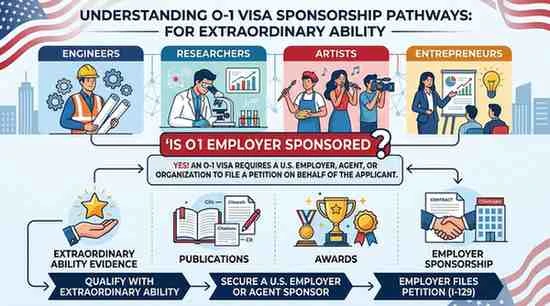
Quick Answer: Yes, the O-1 visa is employer sponsored — but not exclusively by a traditional employer. The petition must be filed by a U.S.-based petitioner, which can be an employer, a U.S. agent, or a foreign employer acting through a U.S. agent. An individual cannot file the O-1 petition on their own behalf.
This is one of the most misunderstood aspects of the O-1 visa. Many applicants assume that because the O-1 focuses on individual achievement, they can self-petition like an EB-1A green card applicant. That is not the case for the O-1 nonimmigrant visa.
Here is the key rule: You need a petitioner. That petitioner acts as your sponsor for the duration of the visa. They are responsible for filing Form I-129, paying the associated USCIS fees, and attesting to the terms of your employment or engagement in the United States.
However — and this is important — the petitioner does not have to be a traditional corporation or HR department. An agent can file on behalf of multiple employers, which gives O-1 visa holders significant flexibility to work for more than one entity while on a single visa.
How O-1 Visa Sponsorship Works
The sponsorship process for an O-1 visa involves three main parties:
- The Beneficiary — the foreign national with extraordinary ability (that is you)
- The Petitioner — the employer or U.S. agent who files the petition
- USCIS — the government agency that reviews and adjudicates the petition
The petitioner submits Form I-129 (Petition for a Nonimmigrant Worker) along with a detailed evidentiary package that documents your extraordinary ability, describes the specific job or engagement you are being brought to the U.S. for, and includes supporting documentation such as recommendation letters, awards, publications, and media coverage.
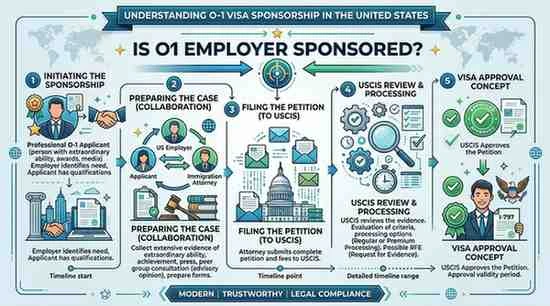
Once USCIS approves the petition, you can either apply for the O-1 visa stamp at a U.S. consulate abroad (consular processing) or, if you are already in the U.S. on another valid status, request a change of status.
Employer vs Agent Sponsorship
Understanding the difference between employer sponsorship and agent sponsorship is crucial when planning your O-1 strategy.
Employer Sponsorship
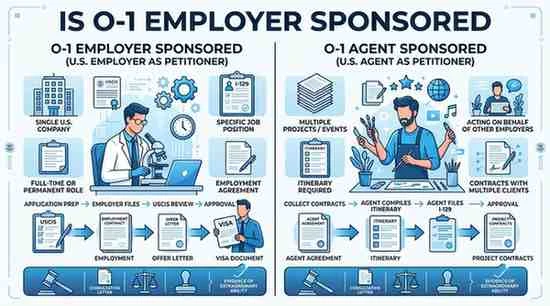
When a specific U.S. company files the O-1 petition directly, that company is your employer-sponsor. You work for that company under the terms defined in the petition. If you want to change employers, a new petition must be filed by the new company.
This model works well for:
- Employees at tech companies, research institutions, universities, hospitals, or studios
- Individuals with a clear, defined employment offer
- Professionals who will work exclusively for one organization
Agent Sponsorship
A U.S. agent — often an individual, talent agency, or management company — can file the O-1 petition on behalf of an applicant who works for multiple clients, has variable engagements, or is self-employed.
The agent files the petition using an itinerary that lists all expected engagements, clients, or employers for the duration of the visa. The agent takes legal responsibility for the petition but is not necessarily your primary work client.
This model works well for:
- Freelancers and independent contractors
- Artists, performers, and musicians
- Researchers with multiple institutional affiliations
- Founders consulting for multiple entities
- Professionals with project-based or gig-style engagements
Which Is Right for You?
If you have a single employer offering you a full-time role, employer sponsorship is simpler and more straightforward. If your work is varied, project-based, or entrepreneurial in nature, agent sponsorship gives you the flexibility to maintain diverse income streams without needing separate petitions for each client.
Who Can Sponsor an O-1 Visa?
According to USCIS, the following entities can file an O-1 petition as the petitioner:
- A U.S. employer
- A U.S. agent (acting on behalf of foreign employers or individuals with multiple clients)
- A foreign employer through a U.S. agent (the foreign company must designate a U.S. agent to act as the petitioner of record)
The petitioner must have a legitimate business or purpose in the United States and must be able to demonstrate that there is actual work, an engagement, or a project for the beneficiary to perform. USCIS scrutinizes petitions where the nature of the work is vague or unverifiable.
Can Startup Founders Sponsor Themselves?
This is one of the most common questions from entrepreneurs, and the answer requires some nuance.
A startup founder cannot directly self-petition for an O-1 visa — meaning you cannot be both the petitioner and the beneficiary of the same petition. However, there are practical ways around this:
- Your own company can file the petition. If you have incorporated a U.S. entity (such as an LLC or C-Corporation), that entity can petition for you as an employee, officer, or contractor — even if you are the founder and majority owner.
- A co-founder or board member can act as petitioner. In early-stage companies, another officer of the company sometimes serves as the petitioner.
- A U.S. agent can file on your behalf. An independent U.S.-based agent can file the petition listing your various engagements, clients, and speaking or consulting work.
The key requirement is that the company (or agent) must be a legitimate legal entity that can employ or engage you. Many immigration attorneys help startup founders structure their entities specifically to support an O-1 petition.
O-1A vs O-1B: What Is the Difference?
The two O-1 categories have different evidentiary standards and apply to different professional fields.
O-1A: Extraordinary Ability
O-1A covers fields of science, education, business, and athletics. To qualify, you must demonstrate extraordinary ability by sustained national or international acclaim and recognition in your field.
The standard is: you must be among the small percentage of individuals who have risen to the very top of your field.
Common O-1A applicants include:
- Software engineers and AI researchers
- Academics and scientists
- Physicians and medical researchers
- Business executives and entrepreneurs
- Professional athletes
O-1B: Extraordinary Achievement
O-1B covers the arts, motion picture industry, and television industry. The standard for O-1B is slightly different — you must demonstrate a degree of skill and recognition substantially above what is ordinarily encountered.
Common O-1B applicants include:
- Actors, directors, and screenwriters
- Cinematographers and editors
- Musicians and composers
- Visual artists and photographers
- Choreographers and dancers
Key Difference in Standards
It is worth noting that O-1A uses a stricter standard (top of the field) compared to O-1B arts (substantially above ordinary). This distinction affects how evidence is gathered and how petitions are argued.
O-1 Visa Eligibility Criteria
USCIS evaluates O-1A petitions using a specific set of evidentiary criteria. To qualify, an applicant must meet at least three of the following:
- Receipt of nationally or internationally recognized prizes or awards for excellence in the field
- Membership in associations that require outstanding achievements of their members, as judged by recognized experts
- Published material in professional or major trade publications or major media about the individual and their work
- Participation as a judge of the work of others in the same or related field
- Original scientific, scholarly, or business-related contributions of major significance
- Authorship of scholarly articles in professional journals or other major media
- Employment in a critical or essential capacity for organizations with a distinguished reputation
- Evidence of a high salary or remuneration relative to others in the field
If you cannot satisfy three of the above criteria, you may still qualify by submitting comparable evidence if the listed criteria do not readily apply to your occupation.
For O-1B arts applicants, the criteria are slightly different and focus on recognition within the entertainment and arts industries.
Evidence Required for an O-1 Petition
Building a strong O-1 petition is largely about evidence. USCIS wants to see a comprehensive, well-documented package that makes it impossible to overlook your achievements. Here is the type of evidence that forms the core of a strong O-1 petition:
- Awards and prizes — Include certificates, trophies, prize announcements, and documentation showing the prestige and selectivity of the recognition
- Media coverage — Articles, interviews, profiles, and features in major publications or industry media that mention you and your work by name
- Peer recommendation letters — At least three to five letters from recognized experts, colleagues, or industry leaders who can speak to your extraordinary achievements
- Membership documentation — Evidence of membership in exclusive professional organizations that require outstanding achievement for entry
- Published work — Academic papers, books, articles, patents, or original research with citation counts if applicable
- Judging experience — Documentation that you have served on grant review panels, jury committees, academic review boards, or competition judging panels
- High salary evidence — Pay stubs, offer letters, or compensation reports showing your earnings relative to your field’s average
- Critical role documentation — Organizational charts, job descriptions, or employer statements explaining that your role was essential to a distinguished organization’s success
The strength of your petition is directly proportional to the quality and depth of your evidence package. Quantity matters, but specificity and credibility matter more.
Recommendation Letters and Advisory Opinions
Recommendation letters — also called support letters or expert letters — are one of the most critical components of an O-1 petition. These are not generic character references. They need to be detailed, technically specific letters from credible experts in your field who can speak to:
- Your standing relative to others in the field
- The significance of your contributions
- How your work has influenced the industry, research, or profession
- Why you qualify as extraordinary, not just excellent
Who Should Write Your Letters?
- Professors, department heads, or researchers at recognized universities
- Senior executives or technical leaders at major companies
- Industry board members, advisors, or fellow award recipients
- Peers who are themselves well-recognized in the field
Ideally, your letter writers should not have a direct personal or business relationship with you. Independent third-party letters carry significantly more weight with USCIS adjudicators.
Advisory Opinions for O-1B
For O-1B arts petitions, USCIS typically requires a written advisory opinion from a relevant peer group, labor organization, or management organization in the arts or entertainment industry. This formal opinion documents that the artistic community recognizes your extraordinary achievement.
O-1 Visa for Engineers, Founders, Researchers, Artists, and AI Professionals
The O-1 visa is broadly applicable across professions. Here is how it typically applies across different categories of applicants.
Engineers and Software Professionals
Tech professionals can build a strong O-1 case around open-source contributions with significant GitHub stars, technical publications or conference papers, speaking engagements at recognized industry conferences, patents, high compensation relative to peers, and critical roles at well-known technology companies.
Startup Founders and Entrepreneurs
Entrepreneurs can demonstrate extraordinary ability through fundraising milestones, media coverage in major business publications, advisory board roles, speaking at recognized startup events like Y Combinator Demo Days, significant revenue or user metrics, and awards from recognized startup competitions.
Academic Researchers and Scientists
Researchers often have strong O-1 cases built on citations, peer-reviewed publications, grants awarded by competitive national or international bodies, conference presentations, and judging or reviewing roles at peer-reviewed journals.
Artists, Musicians, and Filmmakers
Creative professionals can document extraordinary achievement through festival selections, industry awards, album sales or chart rankings, major media reviews, branded partnerships, and critical essays about their work in recognized publications.
AI Professionals
With the rise of artificial intelligence, USCIS has seen a significant increase in O-1A petitions from AI engineers, machine learning researchers, and AI founders. Strong AI O-1 cases often include highly cited research papers, significant contributions to widely-used open-source AI frameworks, media coverage as a recognized AI expert, and advisory roles at research institutions or AI policy organizations.
O-1 Visa Application Process Step by Step
Here is the full step-by-step process for filing an O-1 visa petition:
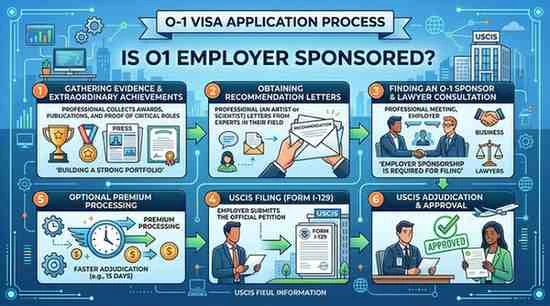
Step 1: Identify Your Petitioner Decide whether an employer, your own U.S. entity, or a U.S. agent will file your petition.
Step 2: Consult an Immigration Attorney While not legally required, working with an experienced immigration attorney dramatically increases the quality and persuasiveness of your petition.
Step 3: Gather Your Evidence Compile all documentation across the relevant O-1 criteria — awards, publications, media, salary data, letters, and membership records.
Step 4: Secure Recommendation Letters Reach out to credible experts in your field and work with your attorney to brief them on what their letters should address.
Step 5: Prepare Form I-129 Your attorney or petitioner completes USCIS Form I-129 with all required supporting documentation and the O Classification Supplement.
Step 6: For O-1B, Obtain Advisory Opinion If applicable, obtain the written advisory opinion from a relevant peer or labor organization.
Step 7: File the Petition with USCIS Submit Form I-129, all evidence, and the applicable filing fees to USCIS. Choose either regular or premium processing.
Step 8: Respond to RFE if Issued If USCIS issues a Request for Evidence (RFE), your attorney responds with additional supporting documentation within the deadline provided.
Step 9: Receive Approval Notice Upon approval, USCIS issues Form I-797 Notice of Action confirming the petition approval.
Step 10: Visa Stamp or Change of Status Apply for the O-1 visa stamp at a U.S. consulate abroad, or file for change of status if you are already inside the United States.
USCIS Form I-129 Explained
Form I-129, Petition for a Nonimmigrant Worker, is the central document in the O-1 application process. It is filed by the petitioner (not the beneficiary) and includes:
- Part 1 — Petitioner information (employer or agent details)
- Part 2 — Beneficiary information (your details)
- O Classification Supplement — Specific information about the nature of the O-1 engagement, including a description of the event or activity, the itinerary if an agent is filing, and the consultation waiver if applicable
- Supporting documentation — All evidence, letters, and exhibits
Common filing fees for Form I-129 vary and are subject to change. Check the current fee schedule directly on the USCIS website before filing.
Premium Processing and Timelines
Standard Processing
Standard O-1 petition processing times at USCIS can vary significantly depending on the service center and current workload. As of recent years, standard processing has ranged from two to six months, though this can fluctuate.
Premium Processing
USCIS offers premium processing for O-1 petitions, which guarantees a decision or Request for Evidence within 15 business days of receipt. Premium processing requires an additional fee (currently $2,805 as of 2025 — verify current fee on USCIS.gov) and is a worthwhile investment for applicants with time-sensitive employment start dates.
Overall Timeline from Start to Finish
- Evidence gathering and attorney preparation: four to eight weeks
- USCIS adjudication (premium): 15 business days after filing
- Consular appointment and visa issuance: two to eight weeks depending on country and consulate
O-1 Visa Costs and Attorney Fees
Understanding the full cost of an O-1 petition helps you plan appropriately.
USCIS Filing Fees:
- Form I-129 base filing fee: approximately $730 (verify current fee)
- Premium processing: approximately $2,805 additional (verify current fee)
- Asylum program fee may apply for certain petitioners
Attorney Fees:
- Immigration attorney fees for O-1 petitions typically range from $3,000 to $8,000 depending on case complexity, attorney experience, and the level of evidence gathering required.
Other Potential Costs:
- Translation of foreign documents
- Courier fees
- Consular visa application fee (MRV fee) — varies by country
- Document notarization and authentication
In total, a well-prepared O-1 petition with premium processing and attorney assistance typically costs between $6,000 and $12,000 in combined fees.
O-1 Visa Extensions and Renewals
The O-1 visa is initially granted for up to three years. After that, extensions of one year at a time can be filed in unlimited increments — provided you continue to have a valid petitioner and ongoing qualifying work in the United States.
Extensions are filed using the same Form I-129 and require updated evidence that your qualifying engagement or employment continues. Premium processing is available for extensions as well.
Unlike many other visa categories, the O-1 has no hard maximum stay limit. Professionals have maintained O-1 status for ten or more years while pursuing a green card or other longer-term immigration options.
O-1 Visa vs H-1B: Key Differences
The O-1 and H-1B are both employer-connected nonimmigrant work visas, but they differ significantly in eligibility, structure, and flexibility.
O-1 Visa Advantages Over H-1B
- No annual cap or lottery — you can apply at any time
- Available to a broader range of fields and industries
- Agent sponsorship allows work for multiple clients
- No degree requirement in the traditional sense
- Can be filed at any point during the year
- Unlimited extensions are possible
H-1B Advantages Over O-1
- Lower evidentiary bar — requires a degree and specialty occupation, not extraordinary ability
- More widely understood by HR departments at large corporations
- Dual intent recognized — explicitly permits immigrant intent (green card applications)
- Company sponsorship infrastructure is more established at large firms
For professionals with documented extraordinary achievements, the O-1 often provides a more reliable and flexible path than the H-1B lottery.
O-1 Visa to Green Card Pathways
The O-1 visa is a nonimmigrant visa, meaning it does not directly lead to permanent residency. However, many O-1 holders successfully transition to a green card through one of the following pathways:
EB-1A (Extraordinary Ability Green Card) This is the most natural transition for O-1 holders. The EB-1A uses similar evidence criteria and allows self-petition — meaning no employer sponsor is needed for the green card stage.
EB-1B (Outstanding Researcher or Professor) Available to researchers and academics sponsored by a qualifying employer.
EB-2 with National Interest Waiver (NIW) Professionals whose work is in the national interest of the United States can self-petition for a green card through the NIW, which is often a practical path for researchers, engineers, and entrepreneurs.
EB-2 or EB-3 with Employer Sponsorship Traditional employer-sponsored green card processes are also available to O-1 holders who transition to full-time employment.
Common O-1 Visa Mistakes to Avoid
- Filing without sufficient evidence — Submitting a thin petition without meeting at least three criteria is the most common reason for RFEs and denials.
- Using generic recommendation letters — Letters that simply praise your work without addressing extraordinary ability criteria are not helpful. Each letter should address specific criteria.
- Choosing the wrong category — Applying under O-1B when you should be under O-1A (or vice versa) creates problems with the evidentiary standards required.
- Petitioner problems — Using a petitioner who cannot clearly articulate what work you will perform or who lacks a legitimate U.S. business presence invites scrutiny.
- No itinerary for agent petitions — Agents filing on behalf of applicants with multiple engagements must include a complete itinerary. Omitting this is a common technical error.
- Missing the advisory opinion — O-1B petitions without the required advisory opinion will face delay or denial.
- Underestimating timeline — Applying too close to a start date without using premium processing can cause delays that affect employment.
- Not addressing RFEs properly — A poorly handled Request for Evidence can turn an approvable petition into a denial. Always work with an attorney on RFE responses.
Tips for Building a Strong O-1 Case
- Start early. Evidence gathering, letter writing, and legal preparation take time. Begin the process at least three to six months before you need the visa.
- Document everything. Keep records of every award, media mention, speaking invitation, judging role, and salary benchmark you encounter professionally.
- Build your professional profile proactively. Seek out peer review roles, conference speaking opportunities, and committee memberships that satisfy O-1 criteria before you apply.
- Work with an attorney who specializes in O-1 cases. Not all immigration attorneys have deep O-1 experience. Look for someone who has successfully handled cases in your specific field.
- Quantity plus quality in letters. Three to five strong, specific letters from credible third parties are more valuable than ten generic ones.
- Contextualize your achievements. It is not enough to list awards. You must explain why each achievement is nationally or internationally significant.
- Align your evidence to specific criteria. Each piece of evidence should be explicitly mapped to one or more of the O-1 criteria in your cover letter or legal brief.
Comparison Tables
Table 1: O-1 Visa vs H-1B Visa
| Feature | O-1 Visa | H-1B Visa |
|---|---|---|
| Eligibility Standard | Extraordinary ability | Bachelor’s degree + specialty occupation |
| Annual Cap | None | 85,000 per year |
| Lottery System | No | Yes |
| Employer Required | Yes (employer or agent) | Yes (employer only) |
| Agent Filing Allowed | Yes | No |
| Initial Duration | Up to 3 years | Up to 3 years |
| Extensions | Unlimited, 1 year at a time | Up to 6 years (with exceptions) |
| Premium Processing | Yes | Yes |
| Dual Intent | Not explicitly stated | Yes |
| Green Card Pathway | EB-1A, NIW, EB-2/3 | EB-2, EB-3 |
| Field Coverage | All fields | Specialty occupations only |
Table 2: O-1A vs O-1B
| Feature | O-1A | O-1B |
|---|---|---|
| Field | Science, education, business, athletics | Arts, motion picture, TV |
| Standard | Top of the field (extraordinary ability) | Substantially above ordinary (extraordinary achievement) |
| Criteria Count Needed | 3 of 8 criteria | Equivalent arts criteria |
| Advisory Opinion | Optional (recommended) | Usually required |
| Common Applicants | Engineers, researchers, athletes, founders | Actors, musicians, filmmakers, artists |
| Initial Period | Up to 3 years | Up to 3 years |
Table 3: Employer vs Agent Sponsorship
| Feature | Employer Sponsorship | Agent Sponsorship |
|---|---|---|
| Who Files | Specific U.S. employer | U.S. agent or management company |
| Best For | Single-employer roles | Freelancers, contractors, multi-client workers |
| Itinerary Required | Specific job description | Full itinerary of engagements |
| Work Flexibility | Limited to that employer | Multiple clients allowed |
| Change of Employer | New petition required | New petition or amendment needed |
| Common in | Tech, academia, healthcare, corporate | Arts, entertainment, consulting, startups |
Table 4: O-1 Processing Times
| Processing Type | Estimated Time | Additional Cost |
|---|---|---|
| Standard Processing | 2–6 months (varies) | Included in base fee |
| Premium Processing | 15 business days | ~$2,805 additional |
| Consular Processing | 2–8 weeks after approval | MRV fee (varies by country) |
| Change of Status | Concurrent with I-129 | No additional USCIS fee |
| RFE Response Window | 87 days typically | Attorney fees vary |
FAQ Section
What is an O-1 visa?
The O-1 visa is a U.S. nonimmigrant work visa for foreign nationals with extraordinary ability in science, education, business, athletics (O-1A), or extraordinary achievement in the arts or entertainment industry (O-1B). It allows qualified individuals to live and work in the United States temporarily.
Is the O-1 visa employer sponsored?
Is O-1 Employer Sponsored? Yes, the O-1 visa requires a U.S.-based petitioner. This can be a traditional employer, a U.S. agent, or a foreign employer acting through a U.S. agent. You cannot self-petition for an O-1 nonimmigrant visa as an individual.
Who qualifies for an O-1 visa?
You qualify if you can demonstrate extraordinary ability (O-1A) or extraordinary achievement (O-1B) by meeting at least three of the evidentiary criteria set by USCIS, such as awards, publications, media coverage, judging experience, original contributions, or high salary relative to peers.
How hard is it to get an O-1 visa?
The O-1 is achievable for professionals with strong, well-documented careers. It does not require a Nobel Prize or Olympic medal — but it does require verifiable recognition at a national or international level. With a well-prepared petition and qualified attorney, approval rates for strong cases are high.
How long does O-1 visa processing take?
Standard processing takes two to six months. Premium processing guarantees a USCIS decision within 15 business days. After USCIS approval, consular processing abroad typically takes an additional two to eight weeks.
What evidence is needed for an O-1 visa?
Evidence includes awards, published media coverage, recommendation letters, membership in exclusive professional organizations, scholarly publications, judging experience, critical role documentation, and high salary evidence — covering at least three of the USCIS criteria.
Can engineers qualify for an O-1 visa?
Yes. Engineers — especially those who have made significant open-source contributions, published technical papers, spoken at major conferences, filed patents, or held critical roles at well-known companies — can qualify under O-1A.
Can startup founders get an O-1 visa?
Yes. Founders can have their U.S.-incorporated company file the O-1 petition on their behalf, or use a U.S. agent. Evidence of significant media coverage, fundraising, and industry recognition supports the petition.
Is the O-1 visa better than the H-1B?
For professionals who qualify, the O-1 is often more attractive because it has no lottery, no cap, and allows agent filing for multi-employer flexibility. The H-1B has a lower evidentiary bar but comes with significant lottery uncertainty.
How many recommendation letters are needed for an O-1 visa?
There is no strict minimum, but most successful petitions include three to five strong recommendation letters from credible third-party experts who can speak specifically to your extraordinary ability.
Can I apply for an O-1 visa without awards?
Yes. Awards are just one of the eight O-1A criteria. You can qualify without awards if you satisfy three other criteria, such as scholarly publications, judging experience, original contributions of major significance, and employment in a critical role.
Can O-1 visa holders apply for a green card?
Yes. Many O-1 holders transition to permanent residency through the EB-1A (extraordinary ability green card, self-petition), EB-1B (outstanding researcher), or EB-2 with National Interest Waiver.
Can family members accompany O-1 visa holders?
Yes. Dependent spouses and unmarried children under 21 can apply for O-3 dependent visas. However, O-3 visa holders are not authorized to work in the United States.
What is Form I-129?
Form I-129, Petition for a Nonimmigrant Worker, is the primary USCIS form filed by the petitioner to request O-1 classification for the beneficiary. It includes an O Classification Supplement with details about the nature of the engagement.
How much does an O-1 visa cost?
Total costs including USCIS fees, premium processing, and attorney fees typically range from $6,000 to $12,000. The USCIS base filing fee alone is approximately $730, with premium processing adding roughly $2,805 (verify current fees at USCIS.gov).
Can multiple employers sponsor an O-1 visa?
Not directly — only one petitioner files the I-129. However, a U.S. agent can file a single petition listing multiple engagements or employers in the itinerary, effectively allowing you to work for more than one client under one petition.
Why does my Whirlpool filter light stay on after replacement?
The filter light does not reset automatically and must be manually reset after every replacement. Press and hold the filter reset button for three seconds after installing the new filter.
What are the chances of O-1 visa approval?
USCIS does not publish specific O-1 approval rate statistics. However, well-prepared petitions with strong evidence packages and attorney representation have significantly higher approval rates than inadequately documented ones. RFE rates can be reduced substantially with thorough initial preparation.
Can AI professionals qualify for an O-1 visa?
Yes, and AI has become one of the most active fields for O-1A petitions. AI researchers with cited publications, contributions to major open-source frameworks, media recognition as experts, and advisory roles at institutions or companies frequently qualify.
How do I extend my O-1 visa?
File a new Form I-129 before your current O-1 status expires. Include updated evidence of your continuing extraordinary work in the U.S. Extensions are granted in one-year increments with no maximum limit.
Conclusion
So, is O-1 employer sponsored? Yes — but in a much more flexible way than most applicants initially expect. The O-1 visa requires a U.S.-based petitioner, whether that is a traditional employer, a U.S. agent, or your own U.S.-incorporated company. Unlike the H-1B, which locks you to a single employer under a capped lottery system, the O-1 gives extraordinary talent the freedom to work across multiple engagements, extend status indefinitely, and build a natural pathway toward permanent residency.
The key to a successful O-1 petition lies in evidence, preparation, and choosing the right petitioner structure for your situation. Whether you are a software engineer with cited open-source contributions, a researcher with peer-reviewed publications, a founder with media recognition, or an artist with industry awards, the O-1 visa can be a realistic and highly rewarding option.
Start building your evidence portfolio now, consult a qualified immigration attorney, and approach the process with patience and precision. The O-1 visa is not just for Olympic champions and Nobel laureates — it is for the genuinely exceptional professionals at the top of their field.
Call to Action
Ready to start your O-1 visa journey?
Begin by documenting your achievements — awards, publications, media coverage, salary data, judging roles, and recommendation contacts. Then consult with a licensed immigration attorney who specializes in extraordinary ability petitions to evaluate your eligibility and build the strongest possible case.
Bookmark this guide as a reference throughout your O-1 process. Share it with fellow professionals, researchers, and founders who are exploring their U.S. immigration options.
Extraordinary ability opened doors for you professionally. Now let it open the door to the United States.
Related Reading: H-1B Visa Guide | EB-1A Extraordinary Ability Green Card | National Interest Waiver Explained | U.S. Work Visa Types Compared | Immigration for STEM Professionals