


What Is Law in Real Estate?
Quick Answer: Law in real estate is the body of legal rules, regulations, and principles that governs how property is owned, transferred, used, rented, and disputed. It covers everything from the contracts used to buy and sell homes to the rights of tenants in rental accommodation, the registration of land titles, and the regulations that determine how land can be developed.
Real estate law draws from multiple areas of legal practice — contract law, property law, land law, administrative law, tax law, and in some cases, criminal law when fraud or deception is involved. It operates at multiple levels: national legislation, regional or state-level regulations, and local zoning and planning rules can all apply to a single property transaction simultaneously.
For most people, real estate is the largest financial transaction of their lifetime. The legal framework surrounding it exists to provide certainty — to ensure that ownership is clearly defined, transactions are enforceable, rights are protected, and disputes can be resolved through recognized processes.
Why Real Estate Law Matters
The importance of real estate law is easy to underestimate until something goes wrong. Legal problems in property transactions can range from a disputed boundary line to a fraudulent title, an unenforceable lease, or a construction project that violates zoning rules. Each of these scenarios can result in significant financial loss, prolonged litigation, and in serious cases, the loss of the property itself.
Real estate law matters for several practical reasons.
It protects ownership. Legal registration of property ownership creates a public record that is legally recognized and enforceable. Without it, ownership claims are vulnerable to challenge.
It enforces agreements. Contracts for the sale, purchase, and rental of property are legally binding, meaning that parties who breach them can be held accountable through the courts.
It prevents fraud. Legal verification processes — title searches, land registry checks, identity verification — provide protection against property fraud, which remains a serious risk in many markets.
It provides dispute resolution. When property disputes arise — over boundaries, ownership, lease terms, or development rights — legal mechanisms exist to resolve them without resorting to self-help or violence.
It regulates land use. Zoning and planning laws determine what can be built where, protecting communities from incompatible development and ensuring orderly land use.
Property Ownership Rights Explained
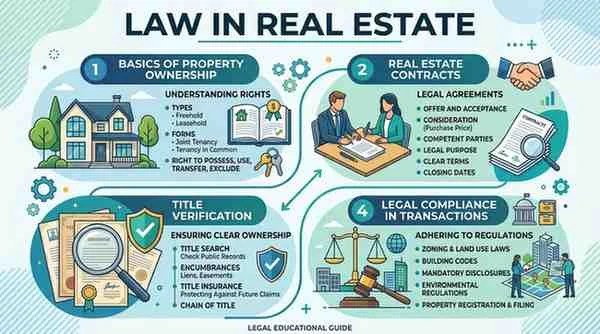
Ownership of real estate is not a single, uniform right — it is a bundle of rights that can be divided, shared, restricted, and transferred in various ways. Understanding the nature of property ownership is fundamental to understanding real estate law.
Freehold Ownership
Freehold ownership — also called fee simple ownership in many common law jurisdictions — is the most complete form of property ownership. The freehold owner owns the property and the land it stands on outright, with the right to use, modify, sell, rent, or bequeath it subject only to law and any registered encumbrances.
Leasehold Ownership
Leasehold ownership means that the owner holds the property for a fixed period under a lease from a freeholder or ground landlord. The leaseholder has the right to use and occupy the property during the lease term but does not own the underlying land. When the lease expires, ownership reverts to the freeholder unless renewed or extended. This form of ownership is common in apartments and some commercial properties in the United Kingdom, parts of Asia, and other markets.
Joint Ownership
Property can be owned jointly by two or more people. The two main forms of joint ownership in common law systems are joint tenancy (where surviving owners inherit the deceased owner’s share automatically) and tenancy in common (where each owner holds a defined share that can be passed through their estate independently).
Easements and Rights of Way
Ownership of property does not always mean exclusive use of every part of it. Easements are legal rights that allow third parties to use part of a property for a specific purpose — such as a right of way across land, or the right to run utility pipes beneath it. Easements are registered against the title and transfer with the property when it is sold.
Encumbrances and Charges
A mortgage or charge secured against a property is an encumbrance on ownership. The lender has a legal interest in the property that must be discharged before it can be sold free and clear. Other encumbrances may include covenants — legal obligations that run with the land and bind future owners — and restrictions on development or use.
Residential vs. Commercial Property Law
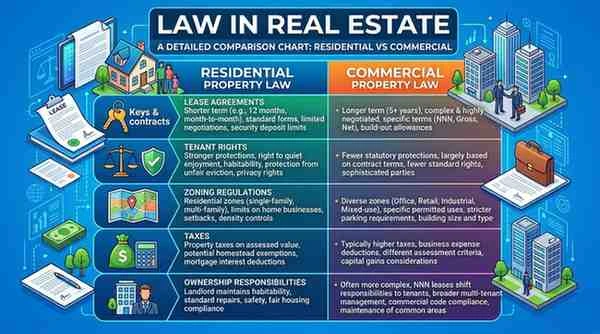
While many principles of property law apply to all real estate, residential and commercial property law have distinct characteristics that reflect the different nature of the transactions and the parties involved.
Residential Property Law
Residential property law governs the purchase, sale, and rental of homes and housing. It typically provides stronger consumer protections, particularly for buyers and tenants, reflecting the fact that homes are essential needs rather than purely financial assets.
Key characteristics of residential property law include mandatory disclosure requirements for sellers, regulated mortgage lending practices, rent control and tenant protection legislation, and specific legal processes for handling possession claims when tenants fail to pay rent or breach their agreements.
Commercial Property Law
Commercial property law governs offices, retail premises, industrial units, warehouses, and other non-residential properties. The parties involved — typically businesses and experienced investors — are generally presumed to have greater sophistication, so consumer protection provisions are less extensive.
Commercial leases are more complex and negotiable than residential tenancies. They typically involve longer terms, more detailed provisions for rent review, service charges, repairing obligations, and alienation (the right to assign or sublet the lease). Commercial property transactions also raise specific issues around VAT, stamp duty land tax, and planning permissions that are less common in purely residential dealings.
Real Estate Contracts and Agreements
A real estate contract is a legally binding agreement between two or more parties relating to property. Contracts are the foundation of every property transaction, from the purchase of a home to the lease of a commercial warehouse.
Key Elements of a Valid Real Estate Contract
For a real estate contract to be legally enforceable, it must contain certain essential elements.
There must be an offer — one party proposes specific terms. There must be acceptance — the other party agrees to those exact terms. There must be consideration — something of value exchanged by each party (typically money in exchange for the property or a right to use it). The parties must have legal capacity to contract — they must be of legal age and sound mind. And the subject matter must be legal.
Types of Real Estate Contracts
Purchase and Sale Agreement: The primary contract in a property transaction, setting out the agreed purchase price, deposit amount, conditions of sale, completion date, and what fixtures and fittings are included.
Option Agreement: Gives one party the right — but not the obligation — to purchase a property at an agreed price within a defined period. Often used by developers to secure a site while planning permission is pursued.
Lease Agreement: The contract governing the rental of a property, setting out the rent, the lease term, the obligations of both landlord and tenant, and the conditions under which the tenancy can be ended.
Mortgage Agreement: The legal contract between a borrower and a lender, giving the lender a security interest in the property in exchange for providing the purchase finance.
Joint Venture Agreement: Used when two or more parties co-invest in a property development or investment, defining their respective interests, contributions, and decision-making rights.
What Contracts Should Always Include
- Full legal names and addresses of all parties
- A clear description of the property by address and legal title reference
- The agreed price or rent and payment terms
- Conditions or contingencies (such as mortgage approval or satisfactory survey)
- Completion or handover dates
- Obligations of each party and remedies for breach
- Signatures of all parties, witnessed where required by law
Title Verification and Due Diligence
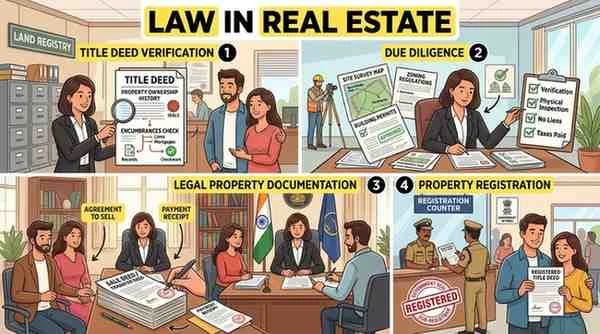
Quick Answer: Title verification is the process of checking that a seller has the legal right to sell a property, that the title is free from undisclosed encumbrances, and that there are no legal issues that could affect the buyer’s ownership after completion.
Due diligence in property transactions is the broader process of investigating a property before committing to purchase it, to identify legal, physical, financial, and planning risks.
What Title Verification Involves
Reviewing the title deeds or land registry entry to confirm ownership and identify any registered charges, restrictions, or covenants.
Conducting a search of the land register to check for encumbrances not mentioned by the seller.
Carrying out local authority searches to identify planning permissions, enforcement notices, road adoption schemes, and other matters that could affect the property’s value or use.
Verifying that there are no disputes or litigation pending in relation to the property.
Checking boundary maps against the physical boundaries of the property.
What Due Diligence Covers Beyond Title
- Physical condition of the property (building survey or inspection)
- Environmental issues (contamination, flood risk, ground stability)
- Planning history and any outstanding enforcement issues
- Service charge arrears on leasehold properties
- Outstanding building regulations approvals for works carried out
- Identity and financial standing of existing tenants (for investment purchases)
Skipping due diligence is one of the most common and costly mistakes in property transactions. Problems identified before exchange of contracts can be negotiated, resolved, or used to withdraw from the transaction. Problems discovered after completion become the buyer’s problem to solve, often at significant expense.
The Property Registration Process
Property registration is the legal process of recording ownership of land and buildings in a government or state-maintained register. It provides a publicly searchable record of who owns property, what charges are secured against it, and what rights and restrictions affect it.
Why Registration Matters
Registration protects ownership. A registered owner has a legally recognized and enforceable title to their property. Unregistered ownership is more vulnerable to fraud and can be more difficult to prove and defend in a dispute.
Registration provides transparency. Anyone can search the register to find out who owns a property, what mortgages are secured against it, and what rights affect it. This transparency is fundamental to a functioning property market.
The Typical Registration Process
- The transaction is completed — contracts are exchanged and the purchase price is paid
- The buyer’s solicitor or conveyancer prepares and submits the registration application
- Stamp duty or transfer tax is paid (in most jurisdictions)
- The land registry processes the application and updates the register
- The new owner receives confirmation of their registered title
- The title register is updated to show the new owner and any new mortgage
In many countries, first registration of previously unregistered land may require additional documentary evidence of ownership going back many years — title deeds, statutory declarations, and other historical documents.
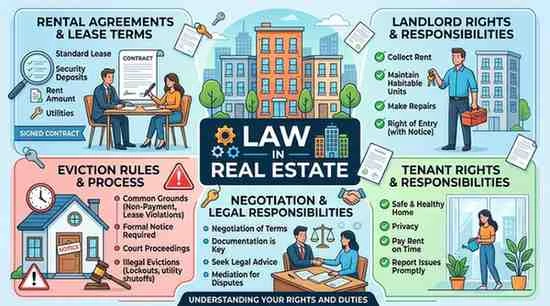
Landlord and Tenant Rights
The relationship between landlord and tenant is one of the most legally regulated areas of property law. This reflects both the importance of housing to individuals and communities, and the historical power imbalance between property owners and those who rent from them.
Landlord Rights
Landlords have the right to receive rent on time as agreed in the lease. They have the right to enter the property for inspections and repairs, subject to providing reasonable notice (typically 24 to 48 hours in most jurisdictions). They have the right to seek possession of the property when the tenancy ends or when the tenant is in breach of the agreement. And they have the right to recover their property in a reasonable condition, subject to fair wear and tear.
Tenant Rights
Tenants have the right to quiet enjoyment of the property — meaning the landlord cannot harass or interfere with their use of it. They have the right to a habitable, safe property maintained to the required standard. They have the right to privacy and to reasonable notice before the landlord enters. In many jurisdictions, they have the right to a written tenancy agreement and legally compliant deposit protection.
Security of Tenure
Many residential tenancy regimes provide tenants with security of tenure — the right to remain in the property beyond the initial fixed term unless the landlord can demonstrate legally recognized grounds for possession. These grounds typically include rent arrears, breach of tenancy conditions, and the landlord’s genuine intention to sell or occupy the property.
Deposit Protection
In many countries, residential tenants’ deposits must be held in a government-approved or regulated deposit protection scheme. This protects tenants from losing their deposit unfairly and provides an adjudication process for resolving deposit disputes at the end of the tenancy.
Lease Agreements Explained
A lease agreement is the legal contract that governs the relationship between a landlord and tenant. Whether for a studio apartment or a large commercial warehouse, the lease defines each party’s rights and obligations during the tenancy.
Key Clauses in Every Lease
Parties: The full legal names of landlord and tenant.
Property Description: A precise description of what is being let — including any communal areas, parking spaces, or storage.
Lease Term: The start date, end date, and any break clauses that allow early termination.
Rent: The amount, the payment frequency, the method of payment, and any provisions for rent review.
Deposit: The amount, how it is held, and the conditions for its return.
Repairs and Maintenance: Who is responsible for what — typically landlords maintain the structure and external fabric; tenants maintain internal fixtures and fittings and are responsible for keeping the property clean.
Permitted Use: What the property may be used for — critical in commercial leases where changes of use may require planning permission.
Subletting and Assignment: Whether the tenant can pass the lease to another party, and if so, under what conditions.
Termination: The conditions under which the lease can be ended by either party and the required notice periods.
Property Dispute Resolution Methods
Property disputes are among the most common and complex legal conflicts that individuals and businesses encounter. Understanding the available resolution mechanisms helps parties choose the most appropriate and cost-effective approach.
Negotiation
The simplest and often the fastest route to resolving a property dispute is direct negotiation between the parties, ideally with legal representation. Many disputes over boundary lines, lease terms, deposit deductions, and minor contractual disagreements can be resolved through negotiation without ever reaching a formal process.
Mediation
Mediation involves a neutral third party — the mediator — who helps the disputing parties reach a mutually acceptable resolution. The mediator does not make a decision; they facilitate discussion. Mediation is voluntary, confidential, and generally faster and less expensive than litigation. It is increasingly used in commercial lease disputes, boundary disputes, and co-ownership disagreements.
Arbitration
Arbitration is a more formal process where a neutral arbitrator — often a specialist in the relevant area of property law — hears both sides and makes a binding decision. Many commercial leases and development agreements include arbitration clauses that require disputes to be resolved this way rather than through court proceedings.
Litigation
Court proceedings are the last resort for property disputes that cannot be resolved by other means. Litigation is typically the most expensive and time-consuming option, but it provides a binding, enforceable judgment and is necessary for the most serious disputes — particularly those involving fraud, complex title issues, or large sums of money.
Specialist Tribunals
Many jurisdictions have specialist bodies for resolving property disputes outside the main court system. In England and Wales, the First-tier Tribunal (Property Chamber) handles residential tenancy disputes, leasehold enfranchisement, and rent disputes. In the United States, housing courts deal with landlord-tenant matters. These bodies are generally faster and less formal than the higher courts.
Zoning and Land Use Regulations
Zoning laws divide land into designated use categories — residential, commercial, industrial, agricultural, recreational — and specify what types of development and activity are permitted in each zone.
Zoning regulations affect property owners and investors in several important ways. They determine what a property can be used for. A building zoned for residential use cannot generally be converted to a factory or a supermarket without a formal change of use consent. They restrict the scale and type of development permitted. They protect property values by preventing incompatible neighboring uses. And they can create or destroy development value — land rezoned from agricultural to residential use can increase dramatically in value.
Before purchasing any property for development, conversion, or change of use, it is essential to check the applicable zoning regulations and confirm that the intended use is permitted. Planning permission or zoning variances, where available, can sometimes unlock additional uses — but the process involves time, cost, and risk.
Property Inheritance Laws
When a property owner dies, their real estate assets pass to new owners through the legal process of inheritance or succession. How this works depends on whether the deceased left a valid will, the inheritance laws of the relevant jurisdiction, and how the property was held.
Testate Succession (With a Will)
When someone dies leaving a valid will, their property passes to the beneficiaries named in the will, subject to the payment of any debts, taxes, and legal costs from the estate. The executor named in the will is responsible for managing the administration of the estate and transferring property to the rightful beneficiaries.
Intestate Succession (Without a Will)
When someone dies without a valid will, their property passes according to the jurisdiction’s intestacy rules. These rules typically prioritize spouses or civil partners, children, and then more distant relatives. The specific order of priority and the shares to which different relatives are entitled vary significantly between jurisdictions.
Inheritance and Co-Ownership
How jointly owned property passes on death depends on the form of co-ownership. In joint tenancy, the surviving co-owner or co-owners automatically inherit the deceased’s share, regardless of any will. In tenancy in common, the deceased’s share passes through their estate — either under the will or under intestacy rules.
Inheritance Tax and Duties
Many jurisdictions impose inheritance tax, estate duty, or similar levies on property inherited above a certain threshold. The rates, thresholds, and available reliefs vary enormously. Proper estate planning — potentially including trusts, lifetime gifts, and will drafting — can sometimes reduce the tax impact of inheritance, but specialist legal and tax advice is essential.
Real Estate Fraud Prevention
Property fraud is a serious and growing problem in many markets. It can take many forms — fraudulent identity theft to sell or mortgage a property without the owner’s knowledge, misrepresentation of title or planning status, undisclosed encumbrances, and outright fabrication of documents.
Common Types of Real Estate Fraud
Title fraud: A fraudster steals the identity of a property owner and transfers the title or takes out a mortgage without the real owner’s knowledge.
Seller misrepresentation: A seller conceals defects, boundary disputes, outstanding planning enforcement, or other material issues that would affect the buyer’s decision.
Rental fraud: A fraudster poses as a landlord and collects deposits and advance rent for properties they do not own or have no authority to let.
Development fraud: Developers take payments for properties that do not exist or are not built as described.
How to Protect Yourself
- Always use a licensed and regulated solicitor or conveyancer for property transactions
- Conduct comprehensive title searches and local authority searches before exchanging contracts
- Verify the identity of sellers and landlords independently
- Never pay deposits or purchase funds outside of formal legal arrangements
- Register newly purchased properties promptly
- Consider registering a restriction at the land registry to prevent unauthorized transfers of your property
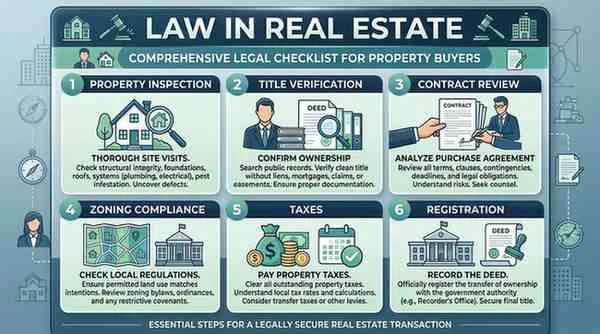
Legal Checklist Before Buying Property
Before exchanging contracts on any property purchase, the following legal steps should be completed or confirmed.
- Instruct a qualified solicitor or conveyancer to act on your behalf
- Confirm the seller’s legal identity and their authority to sell
- Review the draft contract and all title documentation
- Commission a full title search and land registry check
- Order all necessary local authority and environmental searches
- Review any planning permissions, building regulations approvals, and outstanding enforcement notices
- Review the boundary plan and confirm it matches the physical boundaries
- Check for any registered charges, covenants, or restrictions on the title
- Confirm the status of any existing tenants if buying a tenanted investment
- Review the management accounts and service charge history if buying a leasehold property
- Obtain and review a building survey (structural survey) from a qualified surveyor
- Confirm mortgage offer is in place and meets the lender’s requirements
- Check for any pending litigation relating to the property
- Confirm the completion date and all financial arrangements
- Review and sign the final contract before exchange
Common Real Estate Legal Mistakes
Many property problems arise not from bad luck but from avoidable legal errors. Being aware of the most common mistakes helps buyers, sellers, landlords, and tenants protect themselves.
Signing contracts without legal review. Never sign a real estate contract without having it reviewed by a qualified solicitor. Terms that seem straightforward can have serious legal implications.
Skipping due diligence to speed up a transaction. Pressure to move quickly is common in competitive property markets, but cutting corners on searches and surveys creates significant risk.
Failing to register ownership promptly. Delays in registration leave a window during which fraud or competing claims can arise.
Using informal tenancy agreements. Handwritten or downloaded template leases may fail to comply with current legal requirements, exposing landlords to legal challenges.
Ignoring zoning and planning restrictions. Purchasing property for a use that is not permitted under local planning or zoning law can result in enforcement action, financial loss, and potential litigation.
Not protecting rental deposits. In jurisdictions with mandatory deposit protection requirements, failure to comply can result in financial penalties for landlords.
Misunderstanding joint ownership rights. Co-owners who do not document their intended ownership shares in a deed of trust or cohabitation agreement can face complex legal disputes if the relationship breaks down.
When to Hire a Real Estate Lawyer
Not every property matter requires a lawyer, but there are situations where professional legal advice is not optional — it is essential.
You should always use a qualified real estate lawyer or conveyancer for any property purchase or sale, regardless of the property’s value or the apparent simplicity of the transaction.
You should seek specialist legal advice when purchasing commercial property, development land, or investment portfolios where the legal and tax complexity is significantly higher than a standard home purchase.
You need a lawyer immediately if you discover a problem with title, boundaries, planning history, or encumbrances during due diligence.
Legal representation is essential if you are involved in any property dispute — whether over a boundary, a lease, a deposit, or a development agreement.
You should take legal advice before signing any option agreement, joint venture agreement, or development contract where the obligations and financial exposure are significant.
Real Estate Taxes and Compliance
Property transactions and ownership involve a range of tax obligations that vary by jurisdiction. Understanding the main categories helps investors and owners plan effectively and remain compliant.
Transaction Taxes
Most jurisdictions impose a tax on the transfer of real estate. In the United Kingdom this is Stamp Duty Land Tax (SDLT). In the United States, transfer taxes vary by state and county. These taxes are typically calculated as a percentage of the purchase price, often on a sliding scale with higher rates applying to higher-value transactions.
Capital Gains Tax
When a property is sold for more than it was purchased for, the profit — or capital gain — may be subject to capital gains tax. The rate, calculation methodology, and available reliefs vary significantly. Primary residences are often exempt or benefit from reduced rates in many jurisdictions, while investment and commercial properties are more consistently taxed on gains.
Property or Council Tax
Most jurisdictions impose annual taxes on property ownership — called council tax, property tax, or rates depending on the country. These fund local government services and are typically assessed based on the value or size of the property.
Rental Income Tax
Rental income from property is generally subject to income tax. Landlords can typically deduct allowable expenses — mortgage interest (subject to limits in some jurisdictions), repairs, insurance, and management fees — before calculating the taxable profit.
VAT on Commercial Property
Commercial property transactions are subject to more complex VAT (Value Added Tax) treatment than residential transactions in many jurisdictions, with implications for both the sale and lease of commercial premises that require specialist tax advice.
Commercial Leasing Legal Considerations
Commercial leasing involves significantly more complexity than residential tenancy. The terms of a commercial lease are heavily negotiated between the parties and can create substantial long-term financial obligations.
Key Legal Issues in Commercial Leases
Lease length and break clauses. Commercial leases are often for 5, 10, 15, or 25 years. Break clauses allow either party to terminate early, but they are often conditional and must be exercised precisely according to the lease terms.
Rent review. Most commercial leases include provisions for periodic rent review — either to open market value, to an indexed rate, or a combination. The mechanism used significantly affects the tenant’s long-term rent liability.
Repairing obligations. A full repairing and insuring (FRI) lease places all repair and maintenance obligations on the tenant. This can represent a significant financial exposure, particularly in older buildings with deferred maintenance. A schedule of condition agreed at the start of the lease protects tenants from inheriting pre-existing defects.
Alienation. Commercial tenants often need the flexibility to assign or sublet their lease if their business circumstances change. The lease should clearly state whether this is permitted and on what terms.
Service charges. In multi-let buildings, tenants typically pay a service charge contribution covering the cost of managing and maintaining shared parts of the building. Service charge provisions should be carefully reviewed before the lease is signed.
Real Estate Investment Legal Risks
Property investment offers strong long-term returns for many investors, but it carries specific legal risks that must be understood and managed.
Title risk is the risk that the ownership of a property is disputed or defective. Title insurance can provide financial protection against some title risks but does not resolve the underlying issue.
Tenancy risk for investment properties includes the risk that tenants default on rent, cause damage, or refuse to vacate at the end of their lease. Understanding tenancy law and drafting robust lease agreements helps manage this risk.
Planning and development risk is particularly relevant for development investment. Changes to planning policy, refusal of planning permission, or unexpected environmental or archaeological discoveries can significantly affect the viability of development projects.
Regulatory risk includes the risk of changes to legislation — rent controls, tax treatment of rental income, energy efficiency requirements — that adversely affect the financial performance of an investment property.
Financing risk includes the risk that interest rate changes, changes in lender appetite, or breaches of loan covenants adversely affect an investor’s ability to hold or develop property.
Future Trends in Property Law and Digital Documentation
The legal framework for real estate is evolving in response to technological change, shifting social priorities, and the increasing internationalization of property investment.
Digital Title Registers and Blockchain
Several jurisdictions are exploring or implementing blockchain-based land registries that provide tamper-proof, real-time records of ownership and transactions. Digital title registers reduce fraud risk, speed up the transaction process, and reduce reliance on paper documentation.
Electronic Signatures and Digital Contracts
The COVID-19 pandemic accelerated the adoption of electronic signatures in real estate transactions. In many jurisdictions, property contracts can now be signed electronically, significantly speeding up the exchange process. Legal frameworks for electronic signatures are continuing to develop.
Smart Contracts
Smart contracts — self-executing computer programs coded on a blockchain — have the potential to automate certain steps in property transactions, such as the release of deposit funds on completion of agreed conditions. Widespread adoption in real estate remains limited but is growing.
Sustainability and Green Building Regulations
Environmental law is playing an increasingly significant role in property. Energy performance requirements for buildings are tightening in many jurisdictions. Minimum energy efficiency standards for rental properties are already law in some markets. Future-proofing investment portfolios against evolving environmental regulation is becoming a key legal concern for investors.
International Property Investment Regulations
As global investment in real estate grows, jurisdictions are implementing more sophisticated regulations governing foreign ownership of property, anti-money laundering compliance for property transactions, and beneficial ownership disclosure requirements. Compliance with these regulations is an increasingly important area of law in real estate.
Real Estate Law Comparison Tables
Residential vs. Commercial Property Law
| Factor | Residential Property | Commercial Property |
|---|---|---|
| Primary legislation | Housing and tenancy acts | Landlord and tenant acts (commercial) |
| Consumer protections | Strong (buyer/tenant focus) | Limited (business-to-business) |
| Lease flexibility | Low — largely prescribed | High — fully negotiable |
| Typical lease length | 6 months to 3 years | 3 to 25 years |
| Deposit protection | Usually legally mandated | Not typically regulated |
| Repair obligations | Landlord responsible for structure | Often fully on tenant (FRI) |
| Rent review | Rare or regulated | Common — market or indexed |
| VAT on transactions | Generally exempt | Complex, option to tax |
Types of Legal Property Documents
| Document | Purpose | When Required |
|---|---|---|
| Title deeds / Land register entry | Proof of ownership | All transactions |
| Purchase and sale agreement | Contract for sale | Purchase/sale |
| Mortgage deed | Security for lender | Mortgage-financed purchases |
| Lease agreement | Governs tenancy | All lettings |
| Deed of trust | Records co-ownership shares | Joint purchases |
| Power of attorney | Authority to act on another’s behalf | When owner cannot act personally |
| Survey / Valuation report | Physical and financial assessment | Before purchase |
| Planning permission | Authorization to develop or change use | Development and conversion |
| Building regulations certificate | Compliance with construction standards | Works carried out |
| Option agreement | Right to purchase within a set period | Development acquisitions |
Landlord vs. Tenant Responsibilities
| Responsibility | Landlord | Tenant |
|---|---|---|
| Structural repairs | Yes | No |
| Internal decoration | No (usually) | Yes |
| Appliance maintenance | Usually (if provided) | Day-to-day care |
| Garden maintenance | Varies | Often tenant |
| Utility payments | Usually not | Usually yes |
| Insurance (buildings) | Yes | No |
| Insurance (contents) | No | Yes |
| Deposit protection | Yes (legally required in many places) | N/A |
| Legal compliance of property | Yes | No |
| Rent payment | N/A | Yes |
Property Dispute Resolution Comparison
| Method | Speed | Cost | Binding? | Best For |
|---|---|---|---|---|
| Direct negotiation | Fast | Low | No (until agreement) | Minor disputes, preserving relationships |
| Mediation | Moderate | Low–Medium | No (until agreement signed) | Lease disputes, co-ownership, deposits |
| Arbitration | Moderate | Medium | Yes | Commercial lease disputes, development |
| Specialist tribunal | Moderate | Low | Yes | Residential tenancy, leasehold disputes |
| Court litigation | Slow | High | Yes | Fraud, title disputes, large claims |
Common Real Estate Investment Legal Risks
| Risk Type | Description | Mitigation Strategy |
|---|---|---|
| Title defect | Disputed or flawed ownership | Thorough title search, title insurance |
| Planning refusal | Intended use not permitted | Pre-application planning advice |
| Tenant default | Rent arrears or abandonment | Reference checking, robust lease, rent guarantee insurance |
| Environmental liability | Contamination or flood risk | Environmental searches and surveys |
| Regulatory change | New laws affecting rental income or use | Legal and tax advice, portfolio diversification |
| Financing risk | Rising rates, loan covenant breach | Conservative leverage, fixed-rate products |
| Co-ownership dispute | Disagreement between joint owners | Deed of trust, clear shareholder agreements |
Frequently Asked Questions
What is real estate law?
Real estate law is the body of legal rules and regulations that governs the ownership, use, transfer, and dispute of land and buildings. It covers property rights, contracts, title registration, landlord-tenant relationships, zoning and planning, inheritance, and taxes related to property. It is a broad field that intersects with contract law, tax law, planning law, and environmental law.
How does property law work?
Property law establishes who owns what, how ownership can be transferred, what rights come with ownership, and how disputes are resolved. In most countries, land ownership is recorded in a public register. Transactions are governed by legally binding contracts. Ownership can be restricted by mortgages, covenants, and easements. Disputes are resolved through negotiation, mediation, or court proceedings.
What legal documents are needed to buy property?
The key documents for a property purchase include the purchase and sale agreement (the main contract), title deeds or the land register entry, mortgage deed (if purchasing with finance), results of title searches and local authority searches, building survey report, planning and building regulations documents for any works carried out, and proof of identity for anti-money laundering compliance.
How do property ownership transfers work?
Ownership transfer begins with agreeing the terms of sale and signing a contract. The buyer then conducts due diligence — searches, surveys, title checks. On completion, the purchase price is paid and possession is transferred. The buyer’s lawyer submits a registration application to the land registry, and the register is updated to show the new owner.
What are landlord-tenant laws?
Landlord-tenant laws are the legislative framework governing the rental relationship between property owners and their tenants. They typically cover tenancy agreement requirements, deposit protection, repair and maintenance obligations, tenants’ right to quiet enjoyment, the grounds on which possession can be recovered, and the notice periods required for ending tenancies.
How can I verify property ownership?
Property ownership can be verified by searching the land register or title registry in the relevant jurisdiction. In most countries with a public register, anyone can obtain a copy of the title register for a small fee, showing the current registered owner, any mortgages or charges, and key rights and restrictions.
What is title verification in real estate?
Title verification is the process of checking that a seller has legal title to the property they are selling, that the title is free from undisclosed problems, and that there are no disputes or encumbrances that would adversely affect the buyer’s ownership. It is carried out by a solicitor or conveyancer as part of the conveyancing process.
What are common real estate disputes?
Common disputes include boundary disagreements between neighboring owners, landlord-tenant conflicts over rent, repairs, or possession, co-ownership disputes when joint owners disagree, planning and development disputes with local authorities, construction defect claims against builders or developers, and disputes over inheritance of property between family members.
How do real estate contracts protect buyers?
Contracts provide buyers with legally enforceable rights. If the seller fails to complete the sale, the buyer can seek a court order for specific performance or claim damages. Contracts can include conditions protecting buyers — such as a finance condition making the purchase contingent on mortgage approval, or an inspection condition allowing withdrawal if serious defects are found.
What is due diligence in property transactions?
Due diligence is the comprehensive pre-purchase investigation process through which a buyer identifies legal, physical, financial, and planning risks before committing to purchase. It includes title searches, local authority searches, building surveys, environmental checks, and review of planning history and any existing tenancy arrangements.
How do zoning laws affect property ownership?
Zoning laws determine what a property can be used for — residential, commercial, industrial, or other specific uses — and what development is permitted on it. They can prevent a buyer from using a property for their intended purpose and can make or break the value of development land. Checking zoning before purchasing is essential for any buyer with specific development or use intentions.
What legal protections do property buyers have?
Buyers are protected by contract law (enforceable agreements), title registration systems (public proof of ownership), mandatory disclosure requirements in many jurisdictions (requiring sellers to reveal known defects), consumer protection legislation for residential purchases, and legal remedies including damages and specific performance for breach of contract.
How can I avoid real estate fraud?
Always use a licensed and regulated legal professional for property transactions. Conduct independent title searches and never rely solely on the seller’s documents. Verify the identity of sellers and landlords independently. Never pay deposits or purchase funds outside of formal legal channels. Register ownership promptly after completion. In high-risk markets, consider title insurance.
What is commercial property law?
Commercial property law governs the ownership, leasing, development, and sale of non-residential property — offices, retail premises, industrial units, warehouses, and hotels. It is generally more complex than residential property law, with highly negotiated lease terms, more sophisticated tax considerations, and fewer consumer protections, as the parties involved are presumed to be commercially sophisticated.
When should I hire a real estate lawyer?
You should always hire a qualified real estate lawyer for any property purchase or sale, regardless of value. You should also seek specialist legal advice for commercial property transactions, investment acquisitions, development projects, any transaction where due diligence reveals problems, and any property dispute — whether over a lease, boundary, deposit, planning matter, or ownership claim.
What happens during property registration?
After a purchase is completed and the price is paid, the buyer’s solicitor submits a registration application to the land registry. Stamp duty or transfer tax is paid. The registry processes the application and updates the register to show the new owner and any new mortgage. The buyer receives confirmation of registration, establishing their legally recognized ownership.
How are property disputes resolved?
Property disputes can be resolved through direct negotiation between the parties, mediation with a neutral facilitator, arbitration where a binding decision is made by an appointed arbitrator, specialist tribunal proceedings, or court litigation. The appropriate process depends on the nature and seriousness of the dispute and whether the parties are willing to engage cooperatively.
What are tenant rights in rental agreements?
Tenants typically have the right to occupy the property peacefully without interference from the landlord, to a property maintained in a safe and habitable condition, to written documentation of the tenancy terms, to the return of their deposit at the end of the tenancy subject to any lawful deductions, and in many jurisdictions to protection from eviction without valid legal grounds and proper notice.
How do inheritance laws affect property ownership?
When a property owner dies, their property passes according to the terms of their will or, if they die without a valid will, under the jurisdiction’s intestacy rules. The process of transferring property through an estate — called probate or estate administration — can take months and involves the payment of any applicable inheritance taxes before the property is transferred to the beneficiaries.
What taxes apply to real estate transactions?
The main taxes in property transactions include stamp duty or transfer tax on the purchase, capital gains tax on the profit when selling an investment property, income tax on rental income from lettings, annual property or council tax, and potentially VAT on commercial property transactions. Rates and rules vary significantly by jurisdiction and individual circumstances.
Conclusion
Understanding law in real estate is not a luxury reserved for lawyers and large investors. It is a practical necessity for anyone who participates in property markets — whether buying a first home, renting out a property, developing a commercial site, or building an investment portfolio.
The legal framework that governs property is designed to protect everyone involved — to ensure that ownership is secure, transactions are enforceable, rights are clearly defined, and disputes can be fairly resolved. But those protections only work for you if you understand them and use them properly.
Skipping legal advice to save money on a property purchase is a false economy. Signing contracts without understanding their terms is a serious risk. Failing to verify title, ignoring planning restrictions, or neglecting landlord-tenant compliance can all lead to financial losses that far outweigh any legal fees saved.
The principles covered in this guide provide a strong foundation for understanding how real estate law works and why it matters. But every property transaction is unique, every jurisdiction has its own legal requirements, and the stakes are high enough that professional legal advice is always the right investment.
Real estate law is complex, but with the right knowledge and the right professional support, it works powerfully in your favour.
Protect Your Property Rights — Take Legal Action Today
Whether you are buying your first home, investing in commercial real estate, or navigating a landlord-tenant dispute, the right legal advice makes all the difference.
Here is what you should do right now:
- Identify a qualified, licensed real estate lawyer or conveyancer in your jurisdiction before you need one — not after a problem arises
- Before signing any property contract, have it reviewed by a legal professional who can explain your rights and obligations clearly
- Conduct full title verification and due diligence on any property you intend to purchase — never skip this step
- If you are a landlord, review your tenancy agreements and compliance obligations annually to ensure you meet current legal requirements
- If you are involved in a property dispute, seek legal advice early — the longer disputes run without professional guidance, the more expensive they typically become
- Register all property transactions promptly and keep your legal documentation organized and accessible
Your property is one of your most valuable assets. Give it the legal protection it deserves.
This article is for educational purposes only and does not constitute legal advice. Laws vary by jurisdiction. Always consult a qualified legal professional for advice specific to your situation.