


Introduction
When engineers and workshop professionals face tight spaces, awkward angles, or confined drilling environments, a standard drill simply cannot do the job. This is precisely where the winkelbohrspindel becomes one of the most valuable tools in any serious industrial setting. The term winkelbohrspindel is German and translates directly to angle drilling spindle in English. It describes a specialized drilling tool or attachment designed to redirect the drilling axis at an angle, most commonly 90 degrees, so that operators can work in locations where a conventional straight drill would be physically impossible to use.
Whether you are a mechanical engineer, a workshop technician, a manufacturing professional, or someone exploring industrial drilling solutions for the first time, this guide covers everything you need to understand about angle drilling spindles. How they work, what they are made of, where they are used, how to choose the right one, and how to maintain them for long-term performance.
What Is a Winkelbohrspindel?
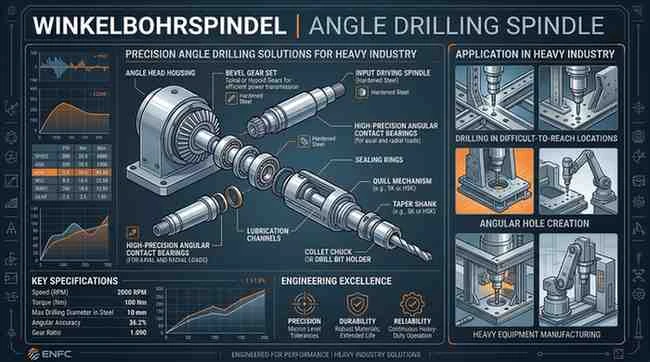
A winkelbohrspindel is a precision engineering tool or machine attachment that changes the direction of a drill’s rotational axis. In most standard drilling operations, the spindle and the drill bit operate along the same straight axis. The motor drives the spindle, the spindle holds the drill bit, and everything moves in one straight line.
An angle drilling spindle breaks that straight-line relationship. It introduces a gearbox or bevel gear system inside the head of the tool that redirects rotational force at a specified angle. The most common angle is 90 degrees, creating what is widely known as a right angle drill. However, winkelbohrspindel systems also exist at other angles depending on specific application requirements.
The result is a tool that can reach into corners, drill along walls, access the insides of narrow cavities, work inside automotive engine bays, reach into structural steel frameworks, and perform precision drilling in spaces where no standard drill could ever physically fit.
In German-speaking industrial markets, the term winkelbohrspindel is used broadly to describe both standalone right angle drilling machines and the spindle attachment components that convert existing drilling machines into angle drilling systems.
How Does a Winkelbohrspindel Work?
Understanding the mechanics of an angle drilling spindle helps you appreciate why it is so effective and why choosing the right one matters so much.
The Core Mechanical Principle
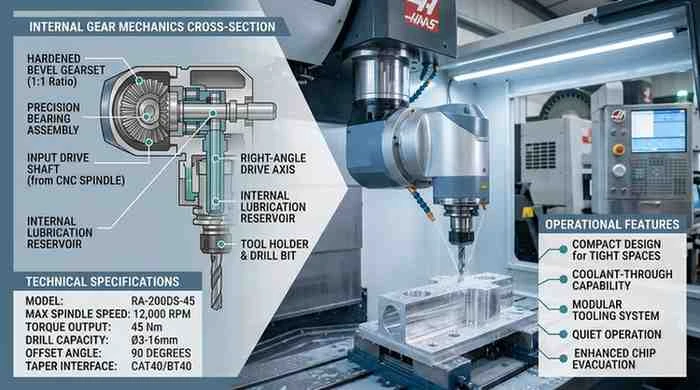
The fundamental operating principle of a winkelbohrspindel is power redirection through gearing. When the motor generates rotational force, that force travels along the input shaft. Inside the angle head, a set of bevel gears intercepts that rotation and redirects it at the chosen angle, typically 90 degrees.
Bevel gears are specifically designed to transmit rotational motion between shafts that are not parallel to each other. They mesh together at their conical surfaces and change the direction of rotation efficiently with minimal energy loss.
The redirected rotation exits through the output spindle, which holds the drill chuck and ultimately the drill bit. From the operator’s perspective, the drill bit spins exactly as it would in a straight drill. The only difference is the physical direction from which the drilling force arrives.
Key Internal Components
A well-engineered winkelbohrspindel contains several critical components that work together.
Input shaft: Connects to the driving motor or machine tool and receives the original rotational force.
Bevel gear set: The heart of the angle head. These precision-machined gears redirect rotational force from the input shaft to the output shaft at the specified angle. The quality of these gears determines the efficiency, torque capacity, and longevity of the entire tool.
Output spindle: The shaft that exits the angle head and holds the chuck or drill bit. It rotates under the redirected power from the bevel gears.
Housing: The rigid casing that contains all internal components, protects them from contamination, and provides the structural integrity needed to withstand drilling forces. Housing is typically made from hardened steel or cast aluminum depending on the application.
Bearings: High-quality bearings support both the input and output shafts, reducing friction and ensuring smooth operation under heavy loads.
Lubrication system: Most professional winkelbohrspindel systems use sealed lubrication or grease-packed bearings to maintain smooth gear operation over extended service periods.
Industrial Applications and Use Cases
The winkelbohrspindel is not a niche tool used in one or two specific industries. It is a versatile piece of equipment that appears across a remarkably wide range of professional environments.
Automotive Manufacturing and Repair
One of the highest-volume use cases for angle drilling spindles is automotive work. Engine bays are densely packed with components that leave very little room for standard tools. Drilling or driving fasteners in these spaces requires a tool that can approach the work from a completely different angle.
In automotive manufacturing plants, winkelbohrspindel attachments are integrated into assembly line power tools so that workers can reach fasteners and drill points along the underside and interior of vehicles without physically repositioning the car. In repair workshops, right angle drills allow mechanics to access components that would otherwise require significant disassembly to reach.
Structural Steel and Construction
Steel fabrication and construction work frequently involves drilling into structural members at locations where access is severely restricted. Floor joists, wall studs, steel framework connections, and confined ceiling spaces all present challenges that right angle drills handle with ease.
Electricians and plumbers working inside building structures rely heavily on right angle drilling tools when running conduit or pipes through structural framing where a straight drill would contact adjacent surfaces before reaching drilling depth.
Aerospace Engineering
Aerospace manufacturing demands extreme precision in every drilling operation. Aircraft fuselages, wing assemblies, and structural components involve thousands of fastener holes that must be drilled to exact specifications in exact locations. Many of these locations are inside assembled structures where straight drilling is impossible.
Angle drilling spindles used in aerospace applications are typically manufactured to the highest tolerance standards available, with extremely tight specifications for runout, gear backlash, and concentricity. The stakes of imprecise drilling in aerospace are far higher than in most other industries.
Woodworking and Furniture Manufacturing
Cabinet makers, furniture manufacturers, and finish carpenters regularly encounter situations where dowel holes, hinge mounting points, or connector fittings must be drilled in locations that a straight drill cannot reach. Right angle drills are standard equipment in professional woodworking shops for exactly this reason.
Heavy Industrial Manufacturing
In general heavy manufacturing, CNC machines and machining centers often use angle head attachments mounted on their spindles to perform multi-directional machining operations without repositioning the workpiece. This dramatically increases production efficiency because the machine can complete multiple operations in different directions without stopping to re-clamp the part.
Benefits of Using a Winkelbohrspindel
The advantages of angle drilling spindles go well beyond simply reaching tight spaces. Here is a clear breakdown of the genuine benefits they provide.
Access to confined spaces: The most obvious benefit. Right angle drills reach locations that are physically inaccessible to straight drilling tools.
Reduced workpiece repositioning: In machining applications, angle heads allow multiple operations in different directions without moving the part, saving significant setup time.
Improved ergonomics: In many situations, approaching a drilling point from a 90-degree angle is physically easier on the operator than trying to maneuver a straight drill into an awkward position.
Precision in difficult locations: Because angle drilling spindles are engineered tools rather than improvised solutions, they maintain drilling accuracy even in difficult access situations.
Versatility across materials: Quality angle drilling spindles work effectively across wood, aluminum, mild steel, stainless steel, and composite materials.
Integration with existing machinery: Spindle-type winkelbohrspindel attachments can be fitted to existing machine tools, dramatically expanding their capability without requiring entirely new equipment.
Winkelbohrspindel vs Standard Drilling Machine
Understanding the differences between an angle drilling spindle and a conventional drill helps professionals make better purchasing decisions.
Drilling Axis Direction
A standard drill operates along one fixed axis. The motor, spindle, and drill bit are all aligned in a single straight line. A winkelbohrspindel redirects that axis, allowing the drill bit to operate perpendicular or at another angle to the motor housing.
Access Capability
Standard drills require clear, unobstructed access along the entire length of the tool from behind the drill to the tip of the bit. Angle drills require only enough clearance for the much shorter angle head section and the bit itself.
Torque Characteristics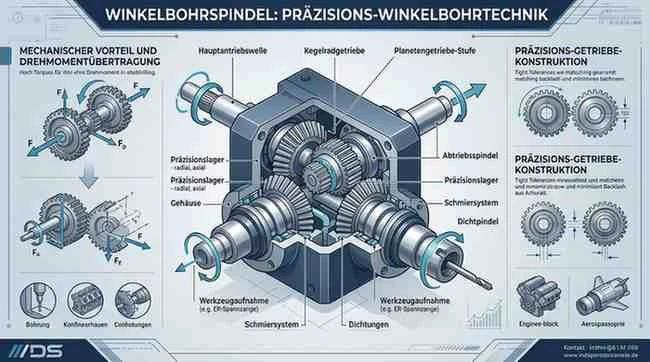
Because bevel gears introduce a gear ratio, angle drilling spindles can either increase or decrease torque relative to the input depending on how the gear set is designed. Some applications benefit from torque multiplication. Others prioritize speed over torque. Choosing the right gear ratio for your application matters.
Complexity and Maintenance
Standard drills are mechanically simpler and require less maintenance. Angle drilling spindles have additional components, particularly the bevel gear set and the additional set of bearings, that require attention over time. This is not a disadvantage but it is a consideration for anyone responsible for maintaining a fleet of tools.
Cost
Quality angle drilling spindles are more expensive than equivalent straight drills. The additional engineering required for the angle head and the precision required in manufacturing bevel gears contribute to higher costs. However, the productivity gains in applications where access is limited typically justify the investment quickly.
How to Choose the Right Angle Drilling Spindle
Selecting the correct winkelbohrspindel for your application requires evaluating several technical parameters carefully.
Angle of Operation
Most applications require a 90-degree right angle configuration. However, some specialized applications need other angles. Confirm your specific geometric requirements before purchasing.
Chuck Size and Drill Bit Compatibility
Different spindles accept different chuck sizes and therefore different ranges of drill bit diameters. Confirm that the spindle you are considering supports the bit sizes your work requires.
Torque Rating
Every winkelbohrspindel has a maximum torque rating that reflects how much rotational force it can handle before the gears risk damage. Match the torque rating to your application requirements. Underpowered tools wear out quickly under demanding conditions.
Speed Range
Some applications require high-speed drilling, such as when working with aluminum or wood. Others require lower speed with higher torque for heavy steel work. Check the RPM range of the angle head and confirm it suits your material and bit requirements.
Build Quality and Housing Material
For light workshop use, aluminum-housed angle heads are adequate and offer the advantage of low weight. For heavy industrial environments where the tool is subjected to continuous use, impacts, coolant exposure, and debris, steel housings are significantly more durable.
Compatibility with Your Existing Tools
If you are purchasing an angle head attachment rather than a standalone right angle drill, verify compatibility with your existing drill, CNC machine, or machining center spindle interface. Spindle interfaces are not universal and mismatches prevent proper tool mounting.
Lubrication and Sealing
In manufacturing environments where coolant, chips, or contamination are present, sealed angle heads with positive lubrication systems outperform simpler designs dramatically in terms of service life.
Brand and Support
For professional and industrial applications, purchasing from established manufacturers who provide spare parts, service documentation, and technical support is important. Tools from established manufacturers in Germany, Japan, and Switzerland tend to lead in precision engineering applications.
Maintenance and Safety Guidelines
Proper maintenance of a winkelbohrspindel directly affects both its performance and its service life. Here are the essential practices every operator should follow.
Regular Lubrication
Unless the angle head uses sealed, maintenance-free bearings and gear lubrication, periodic regreasing of the bevel gears and bearings is essential. Check the manufacturer’s documentation for recommended lubrication intervals and approved lubricant types. Using the wrong lubricant can damage seals and cause premature gear wear.
Inspection for Wear
Bevel gears experience wear over time, particularly under heavy loads. Listen for changes in operating noise such as increased whining, grinding, or irregular vibration. These sounds often indicate gear wear or bearing failure before catastrophic breakdown occurs. Early inspection and part replacement is far less expensive than emergency tool replacement.
Chuck and Bit Security
Before every drilling operation, confirm that the drill bit is properly secured in the chuck. Loose bits in angle drills present a higher safety risk than in standard drills because the operator’s body position relative to the bit is often less predictable.
Cleanliness After Use
Remove chips, coolant residue, and debris from the angle head after use. Accumulated contamination works its way into bearing areas over time and accelerates wear.
Operating Within Rated Limits
Never exceed the torque or speed ratings of your angle head. Operating beyond rated limits damages internal components quickly and creates unpredictable failure risks. If your application consistently pushes against the limits of your current tool, invest in a higher-rated model rather than risk equipment failure.
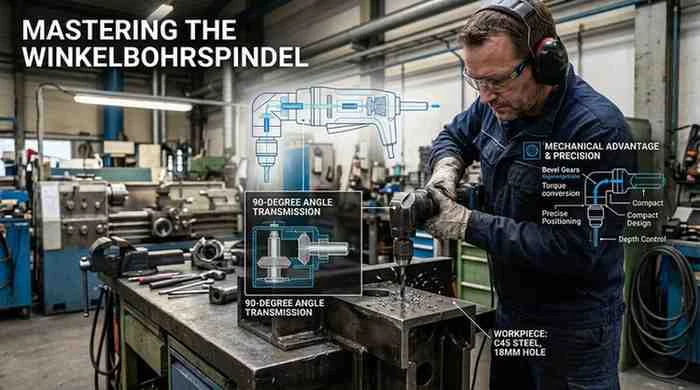
Personal Protective Equipment
Always wear appropriate eye protection when drilling. Angle drilling configurations sometimes direct chip ejection in unexpected directions relative to the operator’s position. Gloves, hearing protection in high-noise environments, and appropriate clothing are standard requirements.
Future Trends in Angle Drilling Spindle Technology
Industrial drilling technology continues to evolve and winkelbohrspindel systems are part of that evolution.
Integration with CNC and Robotic Systems
Modern manufacturing increasingly uses CNC machining centers and robotic arms for automated production. Angle head attachments designed specifically for robotic integration are a growing product category. These systems allow industrial robots to perform multi-directional drilling operations with high precision and without human intervention.
Smart Tooling and Sensor Integration
Advanced industrial angle heads are beginning to incorporate sensors that monitor torque, speed, temperature, and vibration in real time. This data feeds into manufacturing management systems that can detect early signs of tool wear, predict maintenance needs, and prevent unexpected downtime.
Lightweight High-Strength Materials
Advances in materials science are producing angle head housings that are lighter than aluminum while being as strong as steel. This matters in applications where tool weight affects operator fatigue or robot payload limits.
Improved Sealing Technologies
New sealing materials and designs are extending the service life of angle heads in environments where they are exposed to aggressive coolants, high-pressure washing, and abrasive contamination. Better sealing directly translates to lower maintenance costs and longer tool life.
Modular Angle Head Systems
Some manufacturers are developing modular angle head systems where a single input drive unit can accept multiple interchangeable angle heads at different angles and with different chuck configurations. This approach reduces the total number of tools required in a facility while expanding operational flexibility.
Pros and Cons of Winkelbohrspindel Systems
Like any engineering tool, angle drilling spindles have genuine strengths and real limitations. Understanding both helps professionals make better decisions.
Advantages
Access to physically restricted drilling locations is the primary and irreplaceable advantage. No other tool type provides this capability as effectively.
Reduced setup time in machining applications where multiple drilling directions are required on a single part.
Ergonomic benefit in many overhead and confined space drilling situations.
Wide compatibility with existing machinery through spindle attachment configurations.
Available across a broad range of sizes, torque ratings, and precision levels to suit virtually any application.
Limitations
Higher cost than equivalent straight drills due to additional engineering and precision manufacturing requirements.
Additional maintenance requirements associated with bevel gears and additional bearings.
Slightly reduced energy efficiency compared to straight drills because the gear redirection introduces some power loss.
Greater weight and size of the angle head relative to a straight drill nose, which can be a limiting factor in extremely confined spaces.
Learning curve for operators new to right angle drilling, particularly regarding chip ejection direction and tool reaction forces.
FAQ Section
What does winkelbohrspindel mean in English? Winkelbohrspindel is a German technical term that translates to angle drilling spindle in English. It describes a drilling tool or attachment that redirects the drilling axis at an angle, most commonly 90 degrees, to enable drilling in confined or restricted spaces.
What is the main purpose of an angle drilling spindle? The main purpose is to allow drilling operations in locations where a standard straight drill cannot physically fit. This includes corners, inside cavities, along walls, inside automotive engine bays, and within assembled structural components.
How does a winkelbohrspindel redirect drilling force? It uses a set of precision bevel gears inside the angle head to intercept rotational force from the input shaft and redirect it at the specified angle to the output spindle and drill bit.
What industries use angle drilling spindles most commonly? Automotive manufacturing, aerospace engineering, structural construction, heavy industrial manufacturing, woodworking, and CNC machining are among the most common industries that rely on winkelbohrspindel systems.
What angle do most winkelbohrspindel systems operate at? The most common angle is 90 degrees, creating a right angle drill. However, specialized angle heads are available at other angles for specific applications.
How do I choose the right winkelbohrspindel for my application? Evaluate the required drilling angle, chuck size and bit compatibility, torque rating, speed range, housing material, compatibility with your existing tools, and the level of sealing required for your working environment.
How often should a winkelbohrspindel be lubricated? Lubrication intervals depend on the specific model and usage intensity. Always follow the manufacturer’s recommendations. Heavy continuous use typically requires more frequent lubrication than occasional workshop use.
What are the signs that an angle drilling spindle needs maintenance? Increased operating noise, unusual vibration, reduced performance, excessive heat generation, and visible wear on the chuck or housing are all indicators that maintenance or inspection is needed.
Can angle drilling spindles be used with CNC machines? Yes. Spindle-type angle head attachments are specifically designed to mount on CNC machining center spindles and allow multi-directional machining without repositioning the workpiece.
Are winkelbohrspindel tools suitable for beginners? Standalone right angle drills are accessible to experienced DIY users and tradespeople. Spindle attachment systems for machine tools are professional equipment best used by trained machinists and engineers.
What is the typical service life of a quality angle drilling spindle? With proper maintenance, quality industrial angle heads last many years even in demanding environments. Service life varies significantly based on usage intensity, operating conditions, and maintenance discipline.
What safety precautions are important when using a winkelbohrspindel? Always secure the drill bit properly, wear eye protection, stay aware of chip ejection direction which may differ from a standard drill configuration, never exceed the tool’s rated torque or speed limits, and keep the angle head clean and properly lubricated.
Conclusion
The winkelbohrspindel represents one of the most genuinely practical and technically sophisticated solutions in modern industrial drilling. It solves a problem that is both simple in concept and enormously consequential in practice. When the work is in a location that a straight drill cannot reach, you need a tool that approaches the problem from a different angle, quite literally.
From automotive assembly lines to aerospace manufacturing floors, from woodworking shops to CNC machining centers, angle drilling spindles are quietly essential tools that enable work that would otherwise require costly disassembly, complex fixturing, or simply could not be done at all.
Understanding how they work, what differentiates a quality system from an inferior one, and how to maintain them properly allows engineers and workshop professionals to get maximum value from these tools over the longest possible service life.
As manufacturing technology continues to advance toward greater automation, smarter tooling, and more demanding precision requirements, the winkelbohrspindel will remain a core component of the industrial toolkit. Its fundamental mechanical principle, redirecting rotational force through bevel gears to reach otherwise inaccessible drilling locations, is as relevant today as it was when the first angle heads appeared in professional workshops decades ago.
If you found this guide useful, consider sharing it with colleagues in engineering or manufacturing who could benefit from a clear technical overview of angle drilling spindle systems. Exploring related guides on precision machining tools, workshop equipment maintenance, and industrial power tool selection will further strengthen your technical knowledge and help you make better equipment decisions for your professional environment.