

Most B2C businesses do not have a content problem. They have a consistency problem. You know you need to post regularly, write blogs, send emails, and show up on social media. But between running the actual business and serving real customers, content always ends up last on the list.
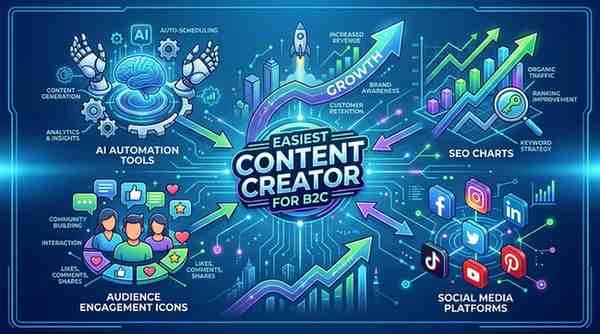
That is exactly why finding the easiest content creator for B2C is one of the most valuable things you can do for your marketing in 2026. The right tools remove the friction. They help you produce better content faster, stay consistent, and actually show up where your customers are looking.
In this guide, we are going to break down how content creation tools work, which ones are genuinely worth using, and how to build a simple workflow that produces real results for a B2C business of any size.
Why Content Creation Matters More Than Ever for B2C Businesses
Before diving into tools, it is worth understanding why content marketing has become non-negotiable for B2C brands.
Consumers today do significant research before making purchase decisions. They read reviews, watch comparison videos, scroll through social media, and search Google for answers. If your business is not showing up during that discovery phase, you are handing those customers to competitors who are.
Content marketing puts your brand in front of buyers at every stage of that journey. A well-written blog post answers a question they are already asking. A strong social media presence builds familiarity over time. An email campaign keeps past customers coming back.
The challenge is that doing all of this consistently takes time and skill — two things that are in short supply for most small and mid-size B2C teams. That is where content creation tools change the equation.
What Are Content Creation Tools?
Content creation tools are software platforms that help you produce, plan, schedule, optimize, and analyze marketing content. They range from AI writing assistants that draft blog posts in minutes to social media schedulers that post automatically across multiple platforms.
The best tools do not replace your creative thinking. They handle the repetitive, time-consuming parts of content production so you can focus on strategy, voice, and connecting with your audience.
Modern content creation tools typically cover these areas:
- Writing and copywriting assistance
- Graphic and visual design
- Social media scheduling and management
- SEO keyword research and optimization
- Email marketing and automation
- Content planning and editorial calendars
- Analytics and performance tracking
Together, these categories form a complete content workflow — from idea to publication to measurement.
How AI Content Creation Tools Work
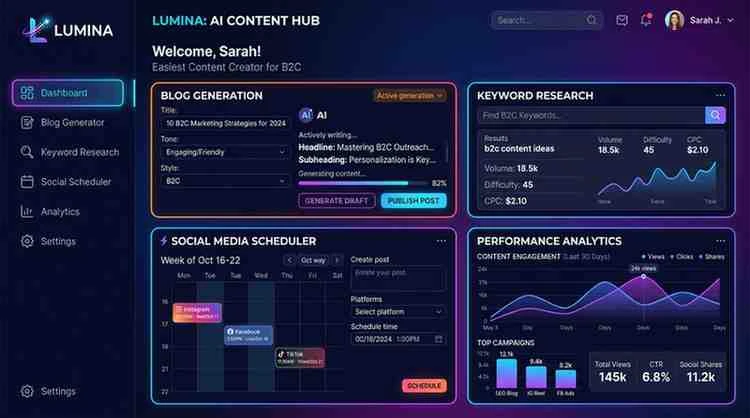
AI content tools have gone from novelty to necessity in a very short time. Understanding how they work helps you use them more effectively.
Most AI writing tools are built on large language models trained on enormous volumes of text. When you give the tool a prompt — a topic, a tone, a set of keywords, a target audience — it generates text based on patterns learned during training. The output is not perfect, but it is often a solid starting point that you can refine rather than writing from scratch.
For B2C content specifically, AI tools are genuinely useful for:
Blog drafts and outlines. Instead of staring at a blank page, you start with a structured draft and edit it into your brand voice.
Social media captions. AI can generate dozens of caption variations for a single post in seconds. You pick the one that fits.
Product descriptions. For e-commerce businesses with large catalogs, AI tools can generate consistent, SEO-optimized descriptions at scale.
Email subject lines. AI tools can A/B test and suggest subject line variations based on what has performed well in similar campaigns.
Content repurposing. A single blog post can be turned into social snippets, an email newsletter, a short video script, and a carousel graphic with the help of AI tools — all in the time it used to take to write just the blog.
The key principle: AI tools work best when you treat them as a first draft machine, not a finished product machine. Your judgment, brand voice, and customer knowledge are still what make content connect.
The Best Content Creation Tools for B2C Businesses in 2026
Here is a breakdown by category, focused on tools that are genuinely accessible for B2C teams — including small businesses and solo entrepreneurs.
AI Writing and Blog Tools
ChatGPT (OpenAI) remains one of the most flexible AI writing tools available. It can draft blog posts, brainstorm ideas, write email sequences, rewrite existing content, and adjust tone on command. The free tier is functional; the Plus subscription unlocks faster models and better quality output.
Claude (Anthropic) excels at longer-form writing and nuanced tone. It is particularly strong for content that needs to feel human and thoughtful rather than formulaic. Many marketers use it for articles, case studies, and email copy that needs a natural voice.
Jasper is purpose-built for marketing teams. It includes templates for ads, landing pages, emails, and social posts. It integrates with SEO tools and is worth considering for teams producing high volumes of content.
Copy.ai is beginner-friendly and includes a free plan, making it a good starting point for small B2C businesses testing AI writing for the first time.
Graphic Design Tools
Canva is the clear leader for non-designers. Its drag-and-drop interface, enormous template library, and brand kit feature make it easy to produce consistent, professional-looking graphics for social media, email headers, presentations, and ads. The free plan covers most needs; the Pro plan adds advanced features and a content scheduler.
Adobe Express offers similar functionality with stronger integration into the broader Adobe ecosystem. Useful if your team already uses Adobe products.
Social Media Scheduling and Management
Buffer and Later are both strong options for scheduling social media content across multiple platforms. Both offer content calendars, post scheduling, basic analytics, and free plans suitable for small businesses.
Hootsuite scales better for larger teams managing multiple accounts and needing more detailed reporting.
Metricool has become a favourite among independent marketers for its combination of scheduling, analytics, and competitor tracking in a single affordable platform.
SEO and Keyword Research Tools
Google Search Console is free and essential. It shows you which keywords your site ranks for, what pages get clicks, and where your organic visibility is growing or declining.
Ubersuggest offers keyword research, competitor analysis, and site auditing at a lower price point than enterprise tools. It is a strong choice for small B2C businesses starting to invest in SEO.
Ahrefs and Semrush are the industry standards for more serious SEO work. Both offer keyword tracking, backlink analysis, content gap identification, and SERP monitoring. They are premium investments, but the data quality is unmatched.
Email Marketing Platforms
Mailchimp remains the most accessible email marketing platform for beginners, with a generous free plan and simple automation features.
Klaviyo has become the preferred platform for e-commerce B2C businesses thanks to its deep integration with Shopify and its behavioral segmentation capabilities. It lets you send the right email to the right customer at exactly the right moment.
ConvertKit (now rebranded as Kit) is excellent for content creators and small B2C businesses that want to build and nurture an email audience.
Content Planning and Workflow
Notion and Trello both work well as content calendar tools. You can map out your entire editorial calendar, assign tasks, track deadlines, and store content briefs in one place.
Airtable offers more database-style flexibility for teams managing large content volumes across multiple channels.
A Simple B2C Content Strategy That Actually Works
Having great tools means nothing without a strategy behind them. Here is a lean, effective approach for B2C businesses that want results without overcomplicating things.
Know Your One Customer
Before you create any content, get clear on who you are talking to. Not a broad demographic — a specific person. What are they searching for? What problems keep them up at night? What language do they use to describe those problems? Every piece of content you create should feel like it was written for that person.
Build Around Search Intent
The most effective B2C content answers questions that your customers are already searching for. Use a keyword research tool to find what people in your niche are typing into Google. Then create content that answers those questions better than anything else on the first page.
This is how a small B2C business with limited budget can compete with larger brands — not by spending more on ads, but by being more helpful and more specific in their content.
The Content Multiplier Method
Producing content for every channel separately is exhausting. Instead, use a multiplier approach:
Start with one substantial piece — a blog post, a YouTube video, or a podcast episode. Then break it down into smaller pieces for each channel. A 1,500-word blog post becomes three LinkedIn posts, five tweet-sized tips, an email newsletter, and a short-form video script. One idea, seven pieces of content.
AI tools make this faster than ever. Paste your blog post into an AI writing tool, ask it to extract the key takeaways, and you have the foundation for every other piece in minutes.
Consistency Over Perfection
The biggest mistake B2C marketers make is waiting until their content is perfect before publishing. Consistent, good-enough content outperforms sporadic perfect content every time. Set a realistic publishing schedule — even if it is just one blog post and four social media posts per week — and stick to it.
Use your scheduling tools to batch and automate posting so that consistency does not require daily manual effort.

Real Examples: How B2C Businesses Use Content Tools to Grow
A small skincare brand used Canva and a simple social media scheduler to build a consistent Instagram presence. By posting daily product education content and skin care tips — all designed with a locked brand kit in Canva — they built a recognizable visual identity without a graphic designer. Within six months, organic reach had tripled.
A local fitness studio used an AI writing tool to produce 12 blog posts targeting local SEO keywords like “best HIIT classes in [city]” and “how to start working out after 40.” Those posts now drive consistent organic search traffic to their booking page, delivering new members without paid advertising.
An online home goods retailer implemented Klaviyo and built automated email sequences for abandoned carts, post-purchase follow-ups, and seasonal promotions. Email revenue doubled within four months, using content that was largely AI-assisted and required minimal ongoing maintenance.
These are not exceptional cases. They are normal outcomes when B2C businesses commit to a consistent content strategy backed by the right tools.
Pros and Cons: AI and Content Creation Tools for B2C
The Real Benefits
Content tools dramatically reduce the time and cost of producing marketing content. What once required a full-time content team can now be handled by a single motivated person with the right stack. AI writing tools remove blank-page paralysis. Design tools make professional visuals accessible to anyone. Scheduling tools ensure your content actually reaches your audience consistently.
Free and low-cost plans mean there are no barriers to entry. You can start building a serious content workflow for under $50 a month.
The Honest Limitations
AI writing tools produce generic content when given generic prompts. The quality of what comes out is directly tied to the quality of what you put in. Businesses that use AI to pump out content without human oversight tend to produce content that feels hollow and fails to rank.
Free plans on most tools have real limitations — reduced posting volumes, watermarks, restricted analytics. At some point, growing businesses need to invest in paid plans to unlock the features that actually move the needle.
Automation can also create a false sense of productivity. Scheduling 30 posts means nothing if the content does not connect with your audience. The tools amplify your strategy — they do not replace it.
Comparison: Free vs. Premium Content Tools
| Tool Category | Best Free Option | Best Premium Option | Key Upgrade Benefit |
|---|---|---|---|
| AI Writing | ChatGPT Free / Copy.ai | Jasper / Claude Pro | Better quality, longer outputs, team features |
| Graphic Design | Canva Free | Canva Pro | Brand kit, background remover, scheduler |
| Social Scheduling | Buffer Free | Hootsuite / Metricool | Multi-platform, analytics, team access |
| SEO Research | Google Search Console | Ahrefs / Semrush | Competitor data, keyword tracking, backlinks |
| Email Marketing | Mailchimp Free | Klaviyo | Behavioral segmentation, e-commerce triggers |
| Content Planning | Trello Free | Notion / Airtable | Database features, team workflows |
For most small B2C businesses just getting started, free tools are enough to build momentum. Upgrade selectively once you identify which channels are delivering the most value.
FAQ: Content Creation Tools for B2C
What are content creation tools?
Content creation tools are software platforms that help businesses produce, plan, optimize, and distribute marketing content. They include AI writing assistants, graphic design platforms, social media schedulers, SEO tools, and email marketing software.
What are the best free content marketing tools?
The best free options include Canva for design, ChatGPT for AI writing, Buffer for social scheduling, Google Search Console for SEO tracking, and Mailchimp for email marketing. Each has a functional free plan suitable for small B2C businesses.
How do AI content creation tools work?
AI content tools use large language models trained on vast amounts of text. You provide a prompt describing what you need, and the AI generates a draft. You then edit and refine it to match your brand voice and specific needs.
Which tools are best for SEO content writing?
For SEO-focused content, Ubersuggest or Ahrefs for keyword research combined with an AI writing tool like ChatGPT or Jasper gives you a strong workflow. Google Search Console is essential for tracking what is already working.
How can small businesses improve content marketing?
Start with keyword research to understand what your customers are searching for. Create content that answers those questions directly. Use free scheduling tools to post consistently. Repurpose each piece of content across multiple channels to maximize your output without multiplying your effort.
What are the best tools for social media content?
Canva for visuals, Buffer or Later for scheduling, and ChatGPT or Claude for caption writing covers the essential social media workflow for most B2C businesses.
How do content marketing tools improve SEO?
Content tools help you research the right keywords, create optimized content targeting those terms, track rankings over time, and identify gaps where competitors are outranking you. Consistent, well-optimized content production is one of the most reliable ways to grow organic search traffic.
What is the best AI writing tool for B2C marketers?
There is no single best tool — it depends on your needs. ChatGPT is the most flexible and widely used. Claude excels at natural, conversational long-form content. Jasper is the strongest option for dedicated marketing teams with high content volume.
Why are content creation tools important for businesses?
They reduce the time and cost of producing professional marketing content, enable consistency across channels, improve SEO visibility, and allow small teams to compete with larger businesses on a content level.

Conclusion: Start Simple, Stay Consistent, and Scale What Works
The easiest content creator for B2C is not a single tool — it is the right combination of tools built into a workflow you will actually use. Start with an AI writing tool to handle drafts, Canva to handle visuals, a scheduling tool to handle posting, and Google Search Console to track what is working. That four-tool stack costs almost nothing and covers the essentials.
Add SEO research tools and email marketing as your strategy matures. Upgrade to premium plans when specific features become genuine bottlenecks. Keep refining your prompts and content briefs so the AI output gets closer to your brand voice over time.
The businesses winning at B2C content marketing in 2026 are not the ones with the biggest budgets or the most tools. They are the ones publishing consistently, optimizing based on real data, and genuinely trying to be useful to their customers.
Pick your tools, build your workflow, and start today. The best content strategy is the one you actually execute.
Have a tool that has changed your content game? Share it in the comments. And if you found this guide useful, pass it on to a fellow marketer who is still doing everything manually.
For further reading: Google Search Central for SEO best practices, HubSpot’s State of Marketing Report for content strategy benchmarks, and the Content Marketing Institute for B2C research and case studies.