



Introduction
Nearly one in three construction projects faces significant delays — and a large share of those delays trace back to permit problems. Missed submissions, incomplete documentation, miscommunication with municipal authorities, or simply not knowing what approvals are required can stall a project for weeks or even months before a single brick is laid.
Permit management in construction is the structured process of identifying, applying for, tracking, and maintaining all licenses, approvals, and inspections required to legally build, renovate, or develop a property. It sounds administrative, but in practice it is one of the most critical operational functions in any construction project.
This guide breaks down everything contractors, project managers, developers, and architects need to know — from understanding the basics of the permit process to adopting modern digital tools that can dramatically cut approval times.
What Is Permit Management in Construction?
At its core, permit management in construction refers to the end-to-end coordination of regulatory approvals that a project must secure before, during, and after construction. These approvals ensure that the work complies with local building codes, zoning regulations, safety standards, and environmental requirements.
A permit is an official authorization issued by a government authority — typically a municipal or county building department — that confirms a proposed construction activity meets all applicable legal standards. Without the correct permits, construction work is illegal and can result in stop-work orders, fines, demolition orders, or significant liability exposure.
Permit management is not a single task. It is an ongoing process that spans the entire project lifecycle, from pre-design research through final occupancy approval.
Why Construction Permits Matter
Legal and Safety Compliance
Construction permits exist primarily to protect public safety. When a building department reviews a permit application, it is checking that the proposed structure will meet fire codes, structural standards, electrical safety rules, and health requirements. Skipping this process does not make those risks disappear — it simply removes the oversight designed to catch problems before they become disasters.
Financial Protection
Unpermitted work creates serious financial risk. Property owners can face fines that far exceed the original cost of obtaining the permit. Banks and insurers may refuse to cover unpermitted structures. When properties change hands, unpermitted additions or renovations can derail sales, trigger legal disputes, or force costly retrofits.
Project Timeline Integrity
Construction permit delays are one of the most common causes of project overruns. A single missing document or an incorrectly filed application can push back a project start by four to eight weeks. On large infrastructure or commercial projects, those delays compound quickly across multiple permit types.
Types of Permits Required in Construction Projects
Most construction projects require more than one permit. The specific approvals needed depend on the project type, location, and scope of work, but the most common categories include:
Building Permits — Required for new construction, additions, structural alterations, and major renovations. This is the foundational permit for almost any construction project.
Zoning Approvals — Confirm that the intended use of a property aligns with local land use regulations. A developer cannot build a commercial facility in a residentially zoned area without variance or rezoning approval.
Electrical Permits — Required when installing or modifying electrical systems, panels, or wiring.
Plumbing Permits — Cover the installation or modification of water supply lines, drainage systems, and gas piping.
Mechanical Permits — Apply to HVAC systems, ventilation, and other mechanical installations.
Grading and Excavation Permits — Required when significantly altering the land before construction begins.
Environmental Permits — Needed when projects affect wetlands, waterways, or protected habitats, or when they generate significant waste or runoff.
Utility Connection Permits — Cover connections to municipal water, sewer, gas, and electrical grids.
Demolition Permits — Required before tearing down an existing structure.
On large commercial or infrastructure projects, it is not unusual for a single site to require a dozen or more distinct permits from multiple agencies.

The Construction Permit Application Process
Step 1 — Pre-Application Research
Before submitting any documents, the project team must identify which permits are required and which authorities issue them. This involves researching local zoning codes, building regulations, environmental restrictions, and any special overlay districts that may apply.
Skipping this step is one of the most common mistakes in construction permit management. Discovering mid-application that an additional environmental review is required can add months to the timeline.
Step 2 — Document Preparation
Each permit application requires a specific set of documents. These typically include architectural drawings, structural engineering plans, site plans, mechanical and electrical drawings, soil reports, environmental assessments, and proof of property ownership or authorization to build.
Incomplete or inaccurate documentation is the single largest cause of permit rejection and resubmission cycles. Many experienced contractors use standardized document checklists tailored to each jurisdiction to reduce errors.
Step 3 — Submission
Applications are submitted to the relevant building department or regulatory authority. Most jurisdictions now offer online submission portals, though some still require in-person filing.
Large projects often involve parallel submissions to multiple agencies simultaneously. Coordinating these submissions requires careful tracking to ensure each application is complete and progressing on schedule.
Step 4 — Plan Review
Once submitted, applications go through a technical review process where building officials and engineers examine the documents for code compliance. This review can take anywhere from a few days to several months, depending on the jurisdiction, the complexity of the project, and the current workload of the reviewing authority.
Many jurisdictions offer expedited review for an additional fee — a worthwhile investment when timeline pressure is high.
Step 5 — Revisions and Resubmission
It is common for plan review to generate comments or correction requests. The project team must respond to these comments promptly and resubmit revised documents. Each resubmission cycle adds time, which is why getting the initial application right is so important.
Step 6 — Permit Issuance
Once the review authority is satisfied that the application meets all requirements, the permit is issued. Work cannot legally begin until this approval is in hand.
Step 7 — Inspections
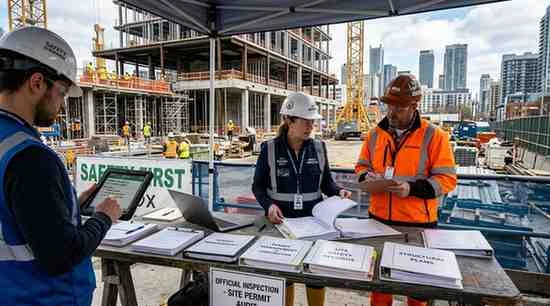
Construction permits are not simply a pre-construction formality. Most permits require scheduled inspections at key milestones — foundation poured, framing complete, electrical rough-in done, plumbing rough-in done, and so on. Each inspection must be passed before the next phase of work can proceed.
Missing or failing an inspection can trigger rework, re-inspection fees, and project delays.
Step 8 — Certificate of Occupancy
Once all inspections are passed and the project is complete, the building department issues a Certificate of Occupancy (CO) or final approval. This document certifies that the building meets all code requirements and is safe for use.
How Permit Delays Affect Project Timelines and Budgets
A permit delay is never just a paperwork inconvenience. The ripple effects across a construction project can be severe.
When a permit is delayed, construction crews are idle. Equipment sitting on site costs money in rental fees. Subcontractors booked for specific phases may move to other projects, leaving gaps in the schedule when permits finally arrive. Material deliveries scheduled around a construction start date may need to be rescheduled, sometimes at additional cost.
On a midsize commercial project, a four-week permit delay can translate to $50,000 or more in additional costs from idle labor, extended equipment rental, escalated material prices, and carrying costs on project financing.
These costs are almost entirely avoidable with disciplined construction permit management.

Real-World Examples
Case Study 1 — A Retail Development Stalled by Overlooked Zoning Approval
A retail developer in a mid-sized U.S. city submitted a complete building permit application for a mixed-use commercial property. The application was thorough — architectural drawings, structural plans, mechanical and electrical details were all included.
What the team missed was a required zoning variance for the proposed building height, which exceeded the local base zoning by eight feet. The building department rejected the application, triggering a six-week delay while the variance application was prepared, publicly noticed, and heard by the zoning board.
The delay cost the developer approximately $140,000 in financing costs and pushed the retail tenant’s planned opening back by nearly two months. A pre-application zoning review — a standard step that takes roughly two hours — would have caught the issue before the application was ever filed.
Case Study 2 — A General Contractor Cuts Permit Cycle Times by 35%
A regional general contractor managing multiple simultaneous commercial projects implemented a cloud-based permit tracking system after struggling with disorganized permit files, missed inspection deadlines, and inconsistent communication between project managers and municipal authorities.
Within eight months of deployment, the firm reduced average permit application-to-approval cycle times by 35%. Missed inspection appointments dropped to near zero. Project managers reported spending significantly less time on permit-related administrative work, freeing capacity for higher-value project management activities.
The key improvements were centralized document storage, automated deadline reminders, and a standardized application checklist library for the jurisdictions the firm most frequently worked in.
Traditional vs. Digital Permit Management
| Factor | Traditional (Paper/Manual) | Digital (Software-Based) |
|---|---|---|
| Document storage | Physical files, email chains | Cloud-based, searchable, version-controlled |
| Deadline tracking | Manual calendars, spreadsheets | Automated reminders and dashboards |
| Application status | Phone calls to building departments | Real-time tracking portals |
| Error rate | Higher — manual entry and assembly | Lower — standardized templates and checklists |
| Team collaboration | Fragmented across email and physical files | Centralized and accessible anywhere |
| Audit trail | Inconsistent | Complete and timestamped |
The case for digital permit management is strong for any firm managing more than a handful of concurrent projects. The upfront investment in software is typically recovered within one or two projects through avoided delays.
Construction Permit Management Software
A growing category of purpose-built software tools now addresses the specific needs of permit coordination in construction.
The best platforms offer permit application tracking across multiple jurisdictions, document management with version control, inspection scheduling with automated reminders, communication logs with authorities, compliance dashboards for project managers and executives, and integration with broader project management platforms.
Widely used options in the construction industry include Procore’s permit management module, PermitFlow, EnerGov (used by many municipal governments for online applications), and various project management platforms with permit tracking add-ons.
When evaluating permit management software, the most important factors are ease of use for field teams, integration with existing document and project management systems, the jurisdictions covered by the platform’s municipal connections, and the quality of reporting for compliance oversight.
Best Practices for Faster Construction Permit Approvals
Start early. Permit applications should be initiated as early as possible in the project lifecycle — ideally during the design development phase, not after construction documents are finalized.
Build relationships with local building departments. Experienced contractors develop working relationships with plan reviewers and inspection staff. These relationships facilitate faster communication when questions arise and can provide informal early feedback on applications before formal submission.
Use pre-application meetings. Many jurisdictions offer pre-application conferences where project teams can sit down with building officials to review proposed plans before formal submission. These meetings routinely catch issues that would otherwise trigger rejection and resubmission cycles.
Invest in complete applications. The single best way to accelerate permit approval is to submit complete, accurate, and well-organized applications the first time. Every comment cycle adds weeks.
Track every application actively. Do not assume a submitted application is progressing smoothly. Follow up regularly, respond to reviewer comments immediately, and escalate when review timelines are unreasonably extended.
Understand local code requirements. Building codes vary significantly between jurisdictions. Teams working in new markets should invest time in understanding local requirements before preparing applications.
Centralize documentation. All permit-related documents, correspondence, and approvals should be stored in a single organized system accessible to everyone who needs them.
The Role of Permit Compliance in Risk Management
Construction permit compliance is a core component of project risk management. Unpermitted work or permit violations create several categories of serious risk.
Legal risk — Violations can result in stop-work orders, fines, and in severe cases, criminal liability for contractors and property owners.
Insurance risk — Many property and liability insurance policies exclude coverage for unpermitted work. A loss event on a project with permit violations can leave all parties without coverage at exactly the moment they need it most.
Resale and financing risk — Properties with unpermitted improvements are difficult to sell and finance. Lenders and buyers routinely conduct permit history searches, and discovered violations can collapse transactions or trigger required remediation at the seller’s expense.
Reputational risk — Contractors known for permit problems have difficulty attracting clients, winning bids, and retaining subcontractors.
A disciplined approach to permit compliance management is not bureaucratic overhead. It is sound risk management.
Industry Trends: Where Permit Management Is Heading
Digital Government Portals
Municipalities across North America, Europe, and increasingly Asia and the Middle East are investing in online permit submission and tracking portals. The COVID-19 pandemic dramatically accelerated this transition, as in-person permit counters were forced to close. Many jurisdictions that shifted to digital submission during the pandemic have not returned to paper-based processes.
For construction firms, this shift means that the technical capacity to submit, track, and manage permits digitally is increasingly a baseline requirement rather than a competitive advantage.
Smart City Regulations
As cities grow smarter — integrating sensors, data analytics, and connected infrastructure — regulatory frameworks are evolving to address new construction types and requirements. Smart city projects often involve novel permit categories covering telecommunications infrastructure, energy management systems, autonomous vehicle accommodations, and integrated data networks.
Construction firms working in urban markets need to stay current with these evolving regulatory landscapes.
BIM Integration
Building Information Modeling (BIM) is increasingly being used to support permit applications. Several jurisdictions now accept or require BIM model submissions alongside traditional drawings. BIM-based applications can provide reviewers with richer, more verifiable information, which can accelerate plan review timelines.
Automation and AI
Emerging tools use artificial intelligence to analyze permit applications for completeness and likely compliance issues before submission, flag potential problems, and even automate portions of the application assembly process. While these tools are still maturing, early adopters report meaningful reductions in rejection rates.
FAQ: Permit Management in Construction
What is permit management in construction? Permit management in construction is the process of identifying, applying for, tracking, and maintaining all government approvals required to legally perform construction work. It covers everything from initial research on required permits through final inspections and certificates of occupancy.
Why are construction permits important? Construction permits are important for three primary reasons: they protect public safety by ensuring buildings meet code standards, they protect property owners from financial and legal liability, and they protect project timelines by providing a framework for compliant construction.
How long does construction permit approval take? Permit approval timelines vary widely by jurisdiction, project type, and application quality. Residential permits in straightforward jurisdictions may be approved in five to fifteen business days. Complex commercial or infrastructure projects may require six months or more for all required approvals. Incomplete applications and comment cycles add significant time to any review.

What documents are needed for construction permits? Most permit applications require architectural drawings, structural engineering plans, site plans, mechanical and electrical drawings, property documents, and proof of contractor licensing. Specific requirements vary by jurisdiction and permit type. Many jurisdictions publish detailed submittal requirement checklists on their websites.
How can construction permit delays be avoided? The most effective strategies for avoiding permit delays include starting the permit process early, conducting pre-application research, using pre-application meetings with building officials, submitting complete and accurate applications, tracking applications actively, and using digital permit management tools to maintain organized records and meet deadlines.
Why is permit compliance important in construction? Permit compliance protects contractors and property owners from legal, financial, insurance, and reputational risk. It also ensures that construction work meets the safety and quality standards that protect building occupants and the surrounding community.
How do construction permits affect project timelines? Permit delays are among the most common causes of construction timeline overruns. Delays in permit approval can idle crews, trigger rescheduling across the project, and compound into significant cost overruns. Disciplined permit management is one of the most effective ways to protect project schedule integrity.
What are the steps in the construction permit process? The key steps are: pre-application research, document preparation, application submission, plan review, revision and resubmission if required, permit issuance, scheduled construction inspections, and final certificate of occupancy.
Conclusion
Permit management in construction is not the most glamorous part of building. But it is one of the most consequential. Projects that handle permits well start on time, stay on budget, and avoid the legal and financial risks that come with non-compliance. Projects that manage permits poorly pay for it — sometimes for years.
The good news is that strong permit management is learnable and systematizable. The right combination of early planning, thorough documentation, active tracking, good relationships with local authorities, and modern digital tools can transform permit management from a source of frustration into a genuine competitive advantage.
If your team is still relying on spreadsheets and email chains to track permit applications across multiple active projects, now is the time to evaluate better systems. If your permit process consistently generates resubmissions or comment cycles, a pre-application meeting practice and a stronger document checklist can deliver fast, measurable improvements.
Construction moves fast. Your permits need to keep up. Start by auditing your current permit workflow, identifying your biggest sources of delay, and putting a plan in place to address them. The investment in better permit management pays back every single project.
Have experience with construction permit challenges — or strategies that have worked for your team? Share your insights with the construction community.