Introduction
It started as one simple daily word puzzle, and it quietly took over morning routines everywhere. Wordle — the game where you get six tries to guess a five-letter word — became a cultural moment. Millions of people started their days with it, shared their color-coded results on social media, and built genuine habits around a two-minute brain exercise.
Then The New York Times acquired it, and the puzzle ecosystem exploded. Developers everywhere asked the obvious question: what else can you do with this format? The answer, it turns out, is almost anything. Math, geography, music, food, movies, phrases — if you can guess it, someone has built a Wordle-style game around it.
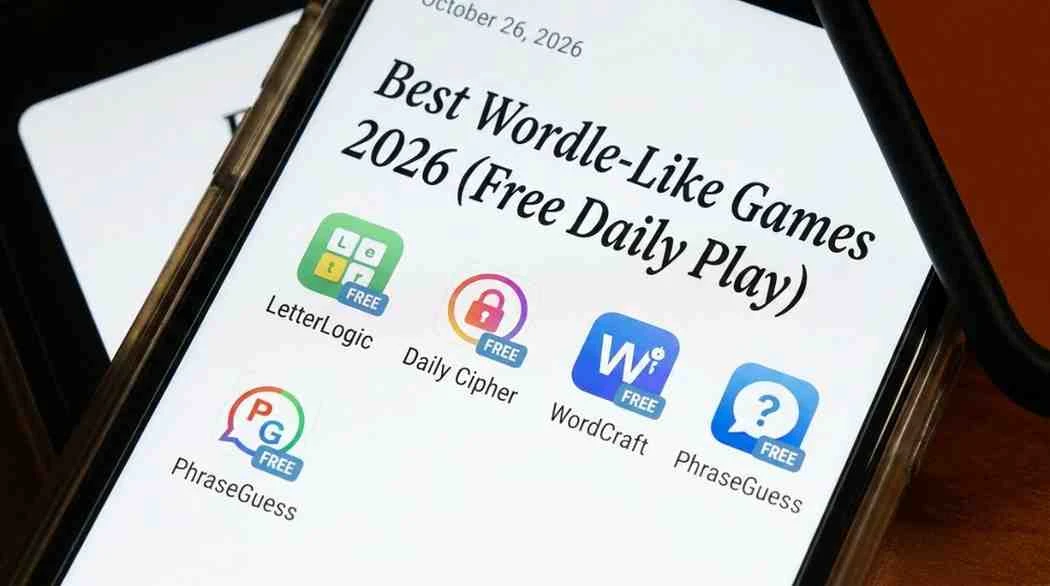
The result is a thriving universe of wordle like games free to play, refreshing every day, covering every interest and difficulty level. Whether you burned through the original in ninety seconds and want a real challenge, or you’re a casual player looking for a five-minute brain break, this guide covers everything worth playing right now.
Table of Contents
- What Are Wordle-Like Games?
- Why Daily Puzzle Games Became a Global Habit
- The Best Free Games Like Wordle Right Now
- Games Like Wordle But Harder
- Best Free Browser-Based Puzzle Games
- Multiplayer and Competitive Wordle Alternatives
- Educational Puzzle Games for Vocabulary Building
- Games That Go Beyond Words: Math, Music, and Geography
- Quordle vs Wordle vs Connections: A Head-to-Head Comparison
- Daily Puzzle Games for Adults
- Puzzle Games for Beginners
- Free vs Paid Word Puzzle Games
- How Puzzle Games Benefit Your Brain
- Tips to Get Better at Daily Word Puzzles
- Trending Puzzle Games in 2026
- Comparison Tables
- FAQ
- Conclusion
What Are Wordle-Like Games?
Wordle-like games are daily puzzle challenges built around the same core mechanic that made Wordle famous: you make a guess, you get color-coded feedback, and you use that feedback to narrow down the correct answer. Green means right letter, right place. Yellow means right letter, wrong place. Gray means the letter isn’t in the answer at all.
That simple feedback loop — guess, learn, refine — is satisfying in a way that’s almost hard to explain. It rewards logical thinking, pattern recognition, and vocabulary without ever feeling like homework. You can usually finish in under five minutes, which is precisely why it fits so naturally into a morning routine.
What makes the broader ecosystem interesting is how creatively developers have stretched that format. Some games use the same mechanic but multiply the boards — instead of one word, you’re solving two, four, or eight simultaneously. Others replace words with math equations, song clips, country shapes, or even food trivia. The feedback system stays familiar; the subject matter changes everything.
Quick Answer: Wordle-like games are free daily puzzle games that use color-coded guessing mechanics to challenge players across words, numbers, geography, music, and more. Most refresh every 24 hours and take under five minutes to complete.
Why Daily Puzzle Games Became a Global Habit
Wordle didn’t just become popular — it became a ritual. Clinical psychologist Kelli Dunlap of the American University Game Lab has described this phenomenon well, noting that puzzles feel like “productive play.” You’re doing something that genuinely requires thought, but it doesn’t feel like effort. The “one and done” structure means there’s no guilt spiral of playing for hours — you do your puzzle, you feel good about it, and you get on with your day.
The social sharing element amplified everything. Posting your Wordle result — those grids of green and yellow squares — became a way of saying “I did something smart today, and here’s the proof without spoiling anything.” It created a shared daily experience that connected people across time zones and demographics.
Once the habit was established, players naturally wanted more. One puzzle a day was never going to be enough for the truly hooked. That demand created the enormous variety of alternatives that exists today.
The Best Free Games Like Wordle Right Now
Quordle
Quordle is the gold standard of Wordle escalation. Instead of one five-letter word, you’re solving four simultaneously. Every guess you type appears in all four grids at once, meaning you can’t focus exclusively on cracking one board — every guess is spending your limited attempts across all of them.
You get nine guesses to solve all four words. It sounds slightly more generous than Wordle’s six, until you’re actually playing and realize you’re tracking four separate patterns at once. It’s genuinely harder, and it’s genuinely more satisfying to solve. Quordle is now hosted by Merriam-Webster, includes both easy and hard modes, and offers a practice mode for warming up before the daily challenge.
Best for: Wordle veterans who want a real difficulty step-up.
NYT Connections
Connections was developed by The New York Times and has arguably become as popular as Wordle itself. The game presents you with sixteen words that must be sorted into four groups of four, each sharing a hidden theme. Categories are color-coded by difficulty from yellow (easy) to purple (very tricky), and the purple groups are notorious for wordplay, double meanings, and the kind of lateral thinking that makes you groan and laugh at the same time.
You’re allowed four mistakes before the game ends. It tests vocabulary, cultural knowledge, and abstract pattern recognition in a way that Wordle doesn’t. If you enjoy Wordle’s word-focused brain teasing, Connections scratches a slightly different but equally satisfying itch.
Best for: Players who enjoy category puzzles and wordplay over spelling mechanics.
Waffle
Waffle gives you a full grid of letters already placed — the catch is most of them are in the wrong positions. You’re trying to solve six words, three going across and three going down, by dragging and swapping letters into the correct spots. You only have fifteen swaps to complete the entire puzzle, which forces you to think several moves ahead.
It’s cleverly designed. Unlike Wordle, where you start from zero information, Waffle gives you everything — but rearranged. The constraint is moves, not guesses.
Best for: Players who enjoy spatial reasoning and a crossword-meets-Wordle hybrid.
Contexto
Contexto takes a completely different approach. Instead of letter-placement feedback, the game rates each guess by how semantically close it is to the target word. Guess a word that’s conceptually related to the answer and your number goes down. Guess something unrelated and your number climbs. You have unlimited guesses — the challenge is narrowing your semantic field efficiently.
It rewards lateral thinking and word association skills rather than spelling logic, making it a refreshing break from the standard format.
Best for: Players interested in meaning-based word association rather than letter patterns.
Semantle
Related to Contexto in spirit, Semantle uses word embedding technology to score your guesses by how closely they relate to the target word in meaning. It’s harder, more abstract, and often takes many more guesses than the typical Wordle. Some players find it meditative; others find it maddeningly vague. Either way, it exercises a different part of your linguistic brain.
Best for: Linguistically curious players who enjoy semantics puzzles.
Nerdle
Nerdle applies the Wordle feedback system to math equations. You’re guessing an eight-character calculation — numbers and operators — where the answer is a true equation. Green means right position, magenta means present but misplaced, black means absent. The catch: unlike math class, order matters, so 10+20=30 and 20+10=30 are treated as different answers.
If you’ve ever felt left out of the Wordle conversation because word puzzles aren’t your strength, Nerdle gives you the same daily ritual through a completely different skill set.
Best for: Math enthusiasts, students, and logic puzzle lovers.
Absurdle
Absurdle flips the script entirely. There’s no pre-set answer — the game’s algorithm actively works against you, shifting the secret word as you guess to maximize the number of tries it takes you. It won’t contradict your previous guesses, so it can’t cheat outright, but it will pick the answer that fits your guesses while remaining as far from a solution as possible. It’s adversarial Wordle, and it’s wildly different from anything else on this list.
Best for: Puzzle enthusiasts who want a genuine intellectual challenge with no end in sight.
Dordle
Dordle sits between Wordle and Quordle in difficulty — you’re solving two five-letter words at once using seven guesses. It’s accessible enough for players who find Quordle overwhelming but offers a genuine step up from Wordle’s single-board format. A solid middle ground for anyone building up their daily puzzle stamina.
Best for: Wordle players ready for their first multi-board challenge.
Octordle
If Quordle wasn’t enough, Octordle takes the multi-board concept to its natural extreme: eight words, thirteen guesses, all simultaneously. It’s genuinely difficult, requires efficient early guesses to gather maximum information quickly, and is deeply rewarding to complete. Even experienced Quordle players will find Octordle humbling.
Best for: Hardcore daily puzzle players who treat the daily challenge as a skill competition.
Games Like Wordle But Harder
If the standard Wordle has become too easy for your morning routine, here’s a quick guide to difficulty escalation:
- Dordle — Two boards, seven guesses. Gentle step up.
- Quordle — Four boards, nine guesses. Moderate challenge.
- Octordle — Eight boards, thirteen guesses. Serious difficulty.
- Absurdle — Adversarial AI, no set word. Conceptually harder than any fixed puzzle.
- NYT Connections (Purple tier) — The hardest single-category groupings in casual daily gaming.
- Semantle — No letter hints, pure semantic distance. Unpredictable difficulty.
The common thread among the hardest games is information overload — either too many boards to track, or too little structural feedback to work with.
Best Free Browser-Based Puzzle Games
All of the following are playable directly in your browser with no download, no account, and no payment:
- Wordle (nytimes.com) — The original. Free to play daily.
- Quordle (merriam-webster.com) — Four-board word puzzle.
- Connections (nytimes.com) — Group sixteen words into four categories.
- Nerdle (nerdlegame.com) — Math-based daily equation puzzle.
- Waffle (wafflegame.net) — Crossword-meets-letter-swap daily puzzle.
- Contexto (contexto.me) — Semantic word distance guessing, unlimited attempts.
- Absurdle (qntm.org/absurdle) — Adversarial Wordle with shifting answers.
- Globle (globle-game.com) — Guess the mystery country, with color feedback for proximity.
- Worldle — Geography puzzle where you guess a country from its silhouette.
None of these require anything beyond a browser. They’re ideal for a quick puzzle break at a desk or on mobile.
Multiplayer and Competitive Wordle Alternatives
Squabble
Squabble is battle royale Wordle. You compete against other players in real time, solving your own Wordle puzzle while your health slowly drains. Solve letters correctly to buy yourself time; fail to keep up and you’re eliminated. It brings urgency and competition to what is normally a solitary activity.
Hello Wordl
Hello Wordl allows players to challenge each other by sharing custom puzzle links, letting you set a specific word for a friend to solve. It also lets you adjust word length from four to eleven letters, which makes it both more accessible and potentially much harder than standard Wordle.
NYT Connections
While not multiplayer in real time, Connections creates a natural social dynamic — everyone plays the same puzzle each day, results are shareable, and the community discussion around the day’s trickiest purple group is its own entertainment.
Educational Puzzle Games for Vocabulary Building
Daily puzzle games aren’t just entertaining — they’re one of the most low-friction ways to expand your vocabulary and sharpen language skills. Here’s how specific games serve different educational goals:
- Wordle — Reinforces five-letter word recall and spelling patterns
- Connections — Builds vocabulary through categorical and thematic associations
- Semantle — Develops awareness of word meaning relationships
- Contexto — Encourages lateral thinking about word associations
- Quordle — Trains multi-variable tracking and deductive reasoning
- Phrazle — Extends challenge to full phrases, testing idiom familiarity
None of these feel like educational tools — they feel like games. That’s precisely what makes them effective. You’re exercising your vocabulary because you want to win, not because someone told you to.
Games That Go Beyond Words: Math, Music, and Geography
The Wordle format has proven adaptable to almost any domain of knowledge:
Math
- Nerdle — Guess the equation using numbers and operators
- Mathler — Given the answer, find the equation that produces it
Geography
- Globle — Guess a mystery country; color feedback shows proximity
- Worldle — Identify a country from its silhouette
Music
- Heardle — Identify a song from progressively longer audio clips (original version no longer active in all regions; spiritual successors exist)
Food
- Phoodle — Wordle with culinary vocabulary, plus food facts after each reveal
Pop Culture
- Framed — Guess a movie from a single still image, with new frames revealed after each wrong guess
- Episode — TV show version of Framed
Fandoms
- Star Wordle — Star Wars vocabulary only
- Lordle of the Rings — Tolkien vocabulary only
The shared mechanic means the learning curve for any of these is essentially zero if you’ve played Wordle before. The knowledge domain changes; the feedback loop stays identical.
Quordle vs Wordle vs Connections: A Head-to-Head Comparison
These three games represent three distinct approaches to the daily puzzle format, and many players include all three in their daily routine.
Wordle is pure and focused. One word, six guesses, five minutes, done. It’s the benchmark everything else is measured against.
Quordle takes Wordle’s mechanics and multiplies them by four. It rewards the same logical deduction skills but demands significantly more cognitive juggling. If Wordle is a sprint, Quordle is a relay race where you’re running all four legs yourself.
Connections ditches the guessing mechanic entirely in favor of categorical thinking. There are no letters, no grids, no color-coded positions. Instead, you’re finding hidden patterns between sixteen words, using knowledge of language, culture, and wordplay. It’s the most social of the three — the purple category reveals have their own community moment every day.
Together, these three games cover a well-rounded daily puzzle workout: spelling logic, multi-variable deduction, and categorical pattern recognition.
Daily Puzzle Games for Adults
Adults looking to build a sustainable daily puzzle habit should consider mixing game types rather than playing the same format repeatedly. A balanced daily stack might look like:
- Wordle (5 min) — Pure word puzzle to start the day
- Connections (5 min) — Categorical grouping challenge
- Quordle (10 min) — Extended multi-board deduction
- Nerdle (5 min) — Math-based logic puzzle for variety
- Contexto (variable) — Semantic word association, open-ended
That’s roughly twenty-five minutes of active mental engagement spread across four different cognitive skills: spelling, categorization, multi-tracking, and semantic reasoning. Most puzzle game platforms are completely free for this core daily experience.
Puzzle Games for Beginners
If you’re new to daily puzzle games, the best entry points are those that teach you the mechanics organically without frustrating you early:
- Wordle — The easiest starting point. Six guesses, clear feedback, forgiving difficulty.
- Connections — Accessible at the yellow and green tiers; purple categories can wait.
- Dordle — The gentlest step up after Wordle. Two boards, seven guesses.
- Contexto — Unlimited guesses mean you can never “lose,” just improve.
- Phoodle — Fun, accessible, and comes with facts after each puzzle.
Avoid starting with Octordle or Absurdle. Both are rewarding but will be deeply confusing until you’ve built up your puzzle instincts through easier games first.
Free vs Paid Word Puzzle Games
The good news for puzzle players is that the vast majority of the best games in this space are entirely free to play daily.
Completely free:
- Wordle (NYT — free daily)
- Quordle (Merriam-Webster — free)
- Nerdle — free
- Waffle — free
- Contexto — free
- Absurdle — free
- Globle — free
- Dordle — free
Free with premium options:
- NYT Connections — free, though NYT Games subscription unlocks access to archives and additional games
- NYT Spelling Bee — limited free play; full game requires NYT Games subscription
- Quordle — free daily puzzle; additional weekly puzzles available after completing daily
Paid / subscription:
- NYT Letter Boxed — behind the NYT Games subscription
- Some archived puzzles on various platforms require accounts or subscriptions
For virtually all casual players, the free tier of available games is more than sufficient. You could fill a full daily puzzle routine with zero cost and never run out of options.
How Puzzle Games Benefit Your Brain
The research on puzzle games and cognitive benefits is genuinely encouraging, though it’s worth being precise about what it says. Daily word puzzles won’t make you a genius, but they do represent consistent, low-effort mental exercise with measurable returns.
Regular engagement with word games supports vocabulary maintenance and growth. Working through Contexto or Semantle, where you need to think about word meaning relationships, exercises semantic memory in a way that passive reading often doesn’t.
Multi-board games like Quordle actively train working memory — the cognitive function responsible for holding and manipulating multiple pieces of information simultaneously. Tracking four grids worth of letter feedback without writing anything down is a genuine mental exercise.
Puzzle games with streak systems add a mild behavioral component: the motivation to maintain a winning streak helps build consistency, and consistency in any mental practice tends to produce compounding returns over time.
Perhaps most valuably, daily puzzles are an accessible, low-barrier form of engaged thinking. The habit itself — taking five to twenty minutes each day for a focused cognitive challenge — is probably more beneficial than any single game mechanic.
Tips to Get Better at Daily Word Puzzles
Getting better at Wordle-style games is largely about improving your opening strategy and information efficiency.
For word-based games:
- Open with high-entropy words that cover common letters. Words like CRANE, STARE, AUDIO, or SLATE eliminate and confirm many letters quickly.
- Avoid repeating letters in your early guesses unless you have strong reason to.
- On harder modes, don’t guess confirmed letters in different positions — commit to using confirmed letters in known-good positions.
- Build a mental list of common five-letter word patterns. Words ending in -IGHT, -OUND, -TION are frequent.
For Quordle and multi-board games:
- Your first two to three guesses should be pure information gathering. Worry about solving individual boards after you’ve mapped the letter landscape.
- Solve the board where you have the most confirmed information first, freeing up mental focus.
For Connections:
- Start with categories you’re most confident about. Locking in an easy yellow group first eliminates words that might otherwise confuse harder groups.
- Watch out for red herrings — the purple tier is specifically designed to feature words that look like they belong to an obvious group but don’t.
General:
- Play consistently. Puzzle intuition builds with repetition. Players who’ve done two hundred Wordles genuinely spot patterns faster than beginners.
- Don’t treat streaks as the primary goal — prioritizing streak preservation often leads to conservative, suboptimal guessing strategies.
Trending Puzzle Games in 2026
The puzzle game ecosystem keeps evolving. A few games gaining traction in 2026 include:
Hunch — A Wordle-like with significantly elevated difficulty, added to PC Gamer’s recommendations in April 2026 specifically for players who find standard Wordle too easy.
Squeezy — A letter-rearrangement puzzle where visible words need to be squeezed and repositioned to reveal the hidden target word. No attempt cap, making it one of the more relaxed options.
Crosswordle — Shows you the completed color grid from a finished Wordle game and asks you to reconstruct the sequence of guesses that produced it. Reverse-engineering a puzzle is a surprisingly different cognitive experience.
Mosait — A daily visual puzzle replacing letters with images, using a sliding tile format across three rounds of decreasing time. Exercises spatial reasoning rather than vocabulary.
The trend in 2026 continues to push toward visual formats, niche knowledge domains, and escalating difficulty options for long-term players. The core daily puzzle habit established by Wordle shows no sign of slowing down.
Comparison Tables
Top Free Wordle-Like Games at a Glance
| Game | Style | Difficulty | Daily Puzzle | Browser | Free | Best For |
|---|---|---|---|---|---|---|
| Wordle | Word guessing | Easy–Medium | Yes | Yes | Yes | Beginners, daily habit |
| Quordle | 4-board word | Hard | Yes | Yes | Yes | Wordle veterans |
| Dordle | 2-board word | Medium | Yes | Yes | Yes | Step-up from Wordle |
| Octordle | 8-board word | Very Hard | Yes | Yes | Yes | Hardcore players |
| Connections | Category grouping | Medium–Hard | Yes | Yes | Free (core) | Cultural knowledge fans |
| Nerdle | Math equations | Medium | Yes | Yes | Yes | Math/logic lovers |
| Waffle | Letter swapping | Medium | Yes | Yes | Yes | Crossword fans |
| Contexto | Semantic guessing | Variable | Yes | Yes | Yes | Language enthusiasts |
| Semantle | Semantic distance | Hard | Yes | Yes | Yes | Linguistics fans |
| Absurdle | Adversarial word | Very Hard | No (unlimited) | Yes | Yes | Challenge seekers |
| Globle | Country guessing | Easy–Medium | Yes | Yes | Yes | Geography fans |
Difficulty Comparison: Wordle Alternatives
| Game | Boards | Guesses | Extra Challenge | Relative Difficulty |
|---|---|---|---|---|
| Wordle | 1 | 6 | None | ★★☆☆☆ |
| Dordle | 2 | 7 | Dual tracking | ★★★☆☆ |
| Quordle | 4 | 9 | Quad tracking | ★★★★☆ |
| Octordle | 8 | 13 | Eight-board tracking | ★★★★★ |
| Absurdle | 1 (shifting) | Unlimited | Adversarial AI | ★★★★★ |
| Connections (Purple) | N/A | 4 mistakes | Wordplay traps | ★★★★☆ |
| Nerdle | 1 | 6 | Math equations | ★★★☆☆ |
| Semantle | 1 | Unlimited | No letter hints | ★★★★☆ |
FAQ
What are the best games like Wordle? The standout free options are Quordle (four-board challenge), NYT Connections (category grouping), Nerdle (math equations), Waffle (letter swapping), and Contexto (semantic guessing). Each one takes the core appeal of Wordle and applies it to a different mechanic.
What games are similar to Wordle? Any game using color-coded feedback to help you narrow down a hidden answer counts as Wordle-like. Dordle, Quordle, Octordle, Absurdle, and Hello Wordl all use the same mechanics with variations in board count and rules.
Are there free games like Wordle? Almost all of them are free. Quordle, Nerdle, Waffle, Contexto, Dordle, Octordle, Absurdle, and Globle all require no payment, no account, and no download.
What are the best daily puzzle games? For a well-rounded daily stack: Wordle (word puzzle), Connections (category puzzle), Nerdle (math puzzle), and Quordle (multi-board challenge). Together they cover vocabulary, cultural knowledge, logic, and multi-variable deduction.
Which puzzle games improve vocabulary? Wordle, Connections, Semantle, and Contexto all actively exercise vocabulary, though in different ways. Wordle reinforces spelling patterns; Connections builds categorical word knowledge; Semantle and Contexto develop semantic awareness — understanding how words relate in meaning.
What are the most addictive word games online? Quordle consistently ranks highest for addictiveness because the difficulty spike is significant but manageable. NYT Connections is closely behind due to its share-worthy results and community dynamic. Absurdle has a dedicated hardcore following.
Are there multiplayer games like Wordle? Yes. Squabble is a real-time battle royale version. Hello Wordl lets you create and share custom puzzles with friends. NYT Connections and Wordle create natural social experiences through daily shared puzzles even without live multiplayer.
What is Phrazle? Phrazle is a Wordle variant where the answer is a full phrase rather than a single word. You guess the phrase letter by letter, receiving standard Wordle-style color feedback. It’s significantly harder than Wordle because of the additional length and complexity.
What are the best browser puzzle games? Every game on this list is browser-based. Top picks for pure browser playability: Wordle, Quordle, Connections, Nerdle, Waffle, and Contexto. All load instantly with no setup.
What games are trending after Wordle? In 2026, Hunch (elevated difficulty Wordle-like), Squeezy (letter rearrangement), and Crosswordle (reverse-engineering puzzle guesses) are gaining visibility. NYT Connections has arguably surpassed Wordle in social media traction.
Are puzzle games good for the brain? Yes, with appropriate expectations. Daily word puzzles support vocabulary maintenance, working memory (especially multi-board games), and consistent cognitive engagement. They’re a low-effort, high-consistency form of mental exercise rather than a dramatic brain-training intervention.
What are the best free daily word games? For a purely free daily routine: Wordle (nytimes.com), Quordle (merriam-webster.com), Connections (nytimes.com), Nerdle, Waffle, and Contexto. No subscriptions needed for the core daily experience.
What are the hardest games like Wordle? Octordle (eight simultaneous boards) and Absurdle (adversarial AI that shifts answers) are the hardest structural challenges. For content difficulty, the purple tier of NYT Connections and Semantle’s semantic-only feedback create unique cognitive challenges.
Can you unlock Battlefield 6 skins without paying? That question belongs in a different article — but for puzzle games, yes, you can unlock almost all content without paying.
Do Wordle games have mobile apps? Many do. Wordle plays well in mobile browsers, and Quordle, Nerdle, and Connections are all mobile-optimized. Dedicated apps vary by game.
What is the Wordle battle pass equivalent? Unlike many games, Wordle-style puzzle games don’t use battle passes or progression systems. The reward is the daily completion and your streak — which is arguably more satisfying than a cosmetic unlock.
Conclusion
The Wordle formula cracked something fundamental about what makes a daily habit stick. It’s short, it’s satisfying, it’s social without being demanding, and it makes you feel genuinely clever when you get it right. That combination is hard to replicate — but the games on this list come remarkably close, and several of them arguably improve on the original in specific ways.
Whether you want wordle like games free for a morning brain warm-up, a competitive multi-board challenge, a math-based alternative, or a geography puzzle, there’s a daily game built for exactly what you’re looking for. Most require nothing more than a browser and two minutes of your time.
The best approach is to build a small daily stack — three or four games that cover different cognitive skills — and play consistently. Puzzle intuition compounds with practice, streaks become their own motivation, and before long you’ll have your own twenty-minute morning ritual that’s both entertaining and genuinely good for you.
Start Your Daily Puzzle Habit Today
You don’t need to jump into all of these at once. Start with Wordle if you haven’t already, then add Connections once that feels comfortable. When you’re ready for a real challenge, try Quordle. If you’re a numbers person, open Nerdle in a separate tab.
Bookmark this page and revisit it when you’re ready to add something new to your routine. The puzzle ecosystem keeps growing — Hunch launched in April 2026 and more games are in development. The daily puzzle habit you build routine will have plenty of new challenges to meet it.
Note: Game availability and features may change over time. All games listed as free were accessible at no cost as of May 2026. Specific URLs and platform integrations may vary.