


What Is English Tuition for Secondary Students?
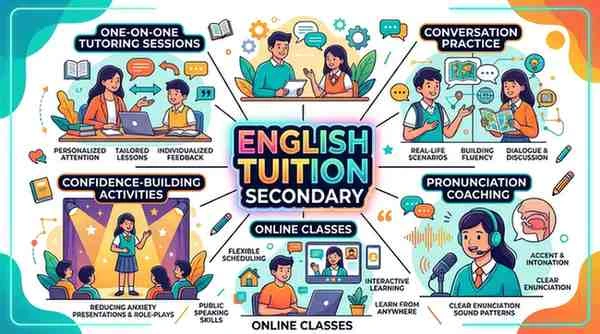
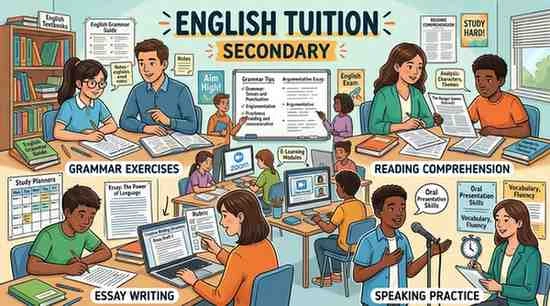
Quick Answer: English tuition for secondary students is structured, supplementary English language instruction provided outside the regular school day. It may focus on grammar, writing, reading comprehension, spoken communication, exam preparation, or a combination of all these areas, tailored to the student’s individual needs and academic goals.
Secondary school is the stage where English demands become genuinely complex. Students are no longer just learning to read and write — they are expected to analyze literary texts, construct persuasive arguments, write formal academic essays, give confident oral presentations, and perform under exam conditions. Many students find that classroom instruction, delivered to a group of twenty or thirty, simply cannot address the specific gaps in their understanding.
That is where secondary English tuition fills the gap. A good tutor works with the student individually — diagnosing their weak points, adapting lessons to match their learning style, and providing the kind of detailed, personalized feedback that transforms average students into confident, capable English users.
Tuition can take place in person, online, one-to-one, or in small groups. It can be delivered weekly throughout the school year, intensively before exams, or on a needs-basis when a student is struggling with a particular skill or assignment. The format matters less than the quality of the teaching and the consistency of the student’s engagement.
Why Secondary Students Need English Tuition
Secondary students face English demands that are significantly more challenging than primary level, and the consequences of underperforming are more serious. Exam results at this stage affect university applications, scholarship eligibility, and career pathways. Yet many students enter secondary school without the solid language foundations they need to thrive.
Academic Pressure Increases
Secondary school English is academically demanding. Students are expected to read complex texts, understand nuanced language, write extended essays with clear structure and argument, and demonstrate sophisticated vocabulary use. These are skills that develop over time, but many students lack the foundations or the confidence to develop them independently.
Classroom Limitations
In a typical secondary classroom, a teacher may be managing twenty-five to thirty students at different levels of ability. Personalised attention is difficult to provide consistently. Weaker students can fall behind without ever fully understanding where they went wrong, and that confusion compounds over time.
Building Confidence
Many secondary students who struggle with English develop a negative relationship with the subject. They avoid writing tasks, stay silent during discussions, and approach exams with anxiety rather than confidence. A patient, skilled tutor working one-to-one can rebuild that confidence gradually, showing students that improvement is genuinely achievable.
Competitive Academic Environment
In markets where university entry is highly competitive, strong English results are not just expected — they are essential. Students need not only to pass but to demonstrate genuine mastery of the language, particularly in written assessment and oral components.
Benefits of Hiring an English Tutor
The benefits of secondary English tuition extend well beyond improved grades, though better academic performance is certainly a common and measurable outcome for students who engage consistently.
Personalized Attention
The single greatest advantage of private tuition is that instruction is calibrated to the individual student. The tutor identifies what the student does not know, adjusts the pace of lessons to match their learning speed, and spends time on the areas that matter most for that particular student’s progress.
Faster Skill Development
With focused, targeted teaching, students often develop skills more quickly than in a classroom setting. A tutor who spots a consistent grammatical error can correct it, explain it, and reinforce the correct form over several sessions — something a classroom teacher may never have time to address directly.
Immediate Feedback
In tuition sessions, feedback is immediate and specific. When a student makes an error, the tutor explains exactly what went wrong and how to correct it. This is far more effective for learning than receiving a grade on homework days after the work was completed.
Flexible Scheduling
Tuition can be scheduled around school, extracurricular activities, and family commitments. Online options in particular offer significant flexibility, allowing students to access high-quality teaching regardless of their location or schedule.
Academic and Life Skills
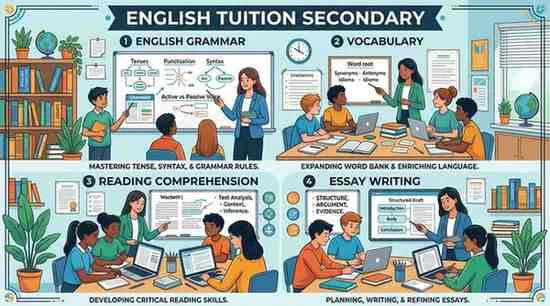
Good English tuition does not just teach grammar rules and essay structure. It develops critical thinking, the ability to construct and express complex ideas, communication confidence, and reading habits — all skills that benefit students well beyond the classroom.
Online vs. Offline English Tuition
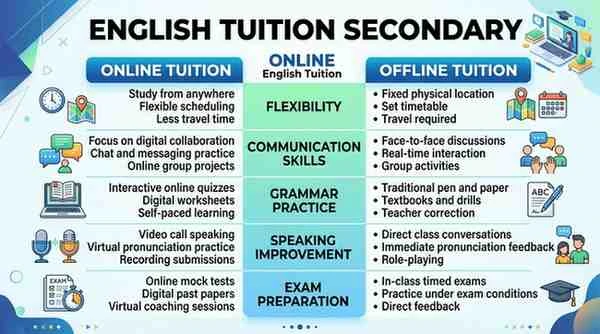
The choice between online and in-person tuition depends on the student’s learning preferences, access to qualified tutors, budget, and schedule. Both approaches have genuine advantages, and many students move between them at different stages.
Online English Tuition
Online tuition has expanded enormously and now offers access to highly qualified tutors across the world. Lessons typically take place via video call, with shared digital whiteboards, document collaboration, and screen sharing enabling interactive, structured sessions.
The main advantages of online tuition are flexibility, broader tutor choice, and often lower cost due to reduced travel time. Students who are self-disciplined and comfortable with technology generally thrive in online environments.
In-Person English Tuition
Face-to-face tuition offers the immediate physical presence that some students find more engaging and motivating. Non-verbal communication, physical materials, and the social dynamic of being in the same room can support deeper engagement for certain learners, particularly younger secondary students or those with attention challenges.
Which Is Better?
The honest answer is that neither format is universally superior. The quality of the tutor, the consistency of the sessions, and the motivation of the student have far greater impact on learning outcomes than whether the lesson happens in a room or on a screen.
Grammar Improvement Strategies
Grammar is the structural foundation of English. Students who have a shaky grasp of grammar make errors that undermine the clarity and credibility of their writing, even when their ideas are strong.
Understand Before Memorizing
Effective grammar teaching starts with understanding why rules exist, not just memorizing them. A student who understands why a comma splice is an error will avoid it more reliably than one who has simply been told not to join sentences with a comma.
Focus on High-Frequency Errors
Rather than trying to address all grammar topics at once, a skilled tutor identifies the specific errors a student makes most frequently and targets those first. For many secondary students, high-impact areas include subject-verb agreement, tense consistency, punctuation (particularly commas, semicolons, and apostrophes), and sentence structure variety.
Practice in Context
Grammar exercises in isolation help students recognize rules. Grammar practice embedded in real writing — editing their own essays, rewriting sample sentences, crafting paragraphs from scratch — cements those rules in working memory and transfers them to exam and assignment contexts.
Regular, Short Practice Sessions
Grammar improvement happens through repeated, spaced practice rather than marathon study sessions. Short, focused grammar exercises three or four times per week are more effective than a single long session once a week.
English Writing Skills Development
Writing is the skill that most secondary English assessments prioritize, and it is also the skill that requires the most sustained, structured development.
The Components of Strong Writing
Strong secondary school writing combines several distinct sub-skills: planning and organization, argument and analysis, vocabulary and expression, grammar and punctuation, and adaptation of tone and register to purpose and audience.
Planning Before Writing
One of the most impactful habits a tutor can instill in a secondary student is the practice of planning before writing. Even a brief five-minute plan — a clear thesis, three or four main points, supporting evidence — produces more coherent, better-structured writing than diving straight in.
Building Academic Vocabulary
Secondary students who use varied, precise vocabulary are rewarded in assessments. Tutors can help students build subject-specific vocabulary systematically, teaching not just new words but how and when to use them appropriately in academic writing.
Editing as a Writing Skill
Many students treat writing as a one-step process — write it and submit it. Tutors can teach the habit of reviewing and editing work: checking argument coherence, cutting redundant phrases, varying sentence structure, and correcting errors. This skill pays dividends across every subject, not just English.
Reading Comprehension Techniques
Reading comprehension is often underestimated as a learnable skill. Many students believe they either understand a text or they do not, without realizing that comprehension is a set of active strategies that can be taught and practised.
Active Reading Strategies
Active reading means engaging with a text rather than passively moving eyes across the page. Key active reading strategies include annotating the text, identifying the main argument or narrative purpose, noting evidence and examples, questioning the author’s choices, and summarizing key points after each section.
Inference and Analysis
Secondary English assessments increasingly demand inference — the ability to read between the lines and understand what a text implies rather than what it states directly. Tutors can teach students to recognize inference signals in texts and to practise making evidence-based interpretations.
Dealing with Unfamiliar Vocabulary
Secondary students frequently encounter unfamiliar words in comprehension texts. Tutors can teach effective strategies for working out meaning from context — using surrounding sentences, recognizing root words and prefixes, and understanding that partial understanding of a word is often enough to answer comprehension questions accurately.
Reading Widely
Beyond exam preparation, students who read broadly — novels, newspapers, magazines, non-fiction — develop stronger vocabulary, more sophisticated sentence awareness, and better spelling naturally. Tutors can encourage and guide wider reading as part of a holistic English development program.
Spoken English and Communication Training
Oral communication is assessed formally in many secondary English curricula — through presentations, debates, discussions, and oral examinations — and it is a skill that matters enormously in higher education and the workplace.
Building Confidence in Speaking
Many secondary students are more anxious about speaking English than writing it, particularly if English is not their first language. Tutors create a supportive, low-pressure environment where students can practise speaking without fear of judgment, building confidence gradually through repeated exposure.
Clarity and Structure in Oral Communication
Spoken English is not just about pronunciation — it is about communicating ideas clearly and effectively. Tutors help students structure spoken responses with a clear opening, supporting points, and a conclusion, mirroring the skills they develop in written work.
Pronunciation and Intonation
For students learning English as a second language, pronunciation and intonation can significantly affect how well they are understood. Tutors work on problem sounds specific to the student’s first language, natural stress and rhythm patterns, and the intonation patterns that help convey meaning in spoken English.
Oral Exam Preparation
Structured preparation for oral assessments — practising typical question formats, recording and reviewing spoken responses, working on fluency and response speed — gives students a meaningful advantage in oral components of secondary English exams.
Exam Preparation Tips for Secondary Students
Exam preparation is one of the most common reasons families invest in secondary English tuition, and it is an area where targeted tuition can make a particularly visible difference.
Understand the Exam Format
Students who understand exactly how their exam is structured — how many sections there are, what types of questions appear, how marks are allocated, and how much time is available — are far better prepared than those who sit exams without this knowledge. Tutors ensure students know the format inside out.
Practice Under Timed Conditions
Exam performance requires not just knowledge but the ability to deploy that knowledge under time pressure. Regular timed practice — full exam papers or individual sections — helps students develop pace, prioritize questions effectively, and manage exam anxiety.
Learn Mark Schemes
Understanding what examiners are looking for — the specific criteria that earn marks in each type of question — is enormously powerful for exam performance. Tutors who are familiar with the relevant curriculum and mark schemes teach students to write and respond with these criteria in mind.
Review Past Papers Thoroughly
Past examination papers are among the most valuable revision resources available. Working through them systematically — not just completing them but analyzing what went well and what did not — builds a detailed understanding of the exam’s demands and identifies recurring areas of weakness.
Focused Revision Plans
Rather than vague revision, effective exam preparation follows a structured plan that allocates time to each component of the exam, schedules regular practice, and builds toward peak performance on the day of the exam itself.
Personalized One-on-One Tutoring Benefits
One-to-one tuition is the most intensive and targeted form of secondary English support, and the evidence for its effectiveness is strong.
In a one-to-one session, every minute of teaching time is focused on the individual student. There is no waiting for others to finish, no reluctance to ask questions for fear of looking slow, and no chance for confusion to go unnoticed.
Tutors in one-to-one settings develop a detailed understanding of their student’s thinking patterns, common errors, areas of strength, and motivational triggers. This depth of understanding allows truly personalized instruction that is not possible in any group setting.
For students who are anxious, have specific learning differences, or have fallen significantly behind their peer group, one-to-one tuition provides the psychological safety and academic scaffolding that accelerates genuine progress.
IELTS and TOEFL Preparation Support
For secondary students planning to study at English-medium universities — particularly internationally — examinations like IELTS and TOEFL are a significant milestone. These exams test all four language skills: reading, writing, listening, and speaking, across academic and general contexts.
What IELTS and TOEFL Tuition Covers
Targeted IELTS and TOEFL preparation with a qualified tutor covers the specific format and scoring criteria of each exam, strategies for each component, vocabulary development appropriate to academic language, writing task practice (including academic essays and reports), and speaking practice using the format of the speaking test.
Setting Realistic Target Scores
Tutors who specialize in IELTS and TOEFL preparation help students understand the score bands, identify realistic targets based on current performance, and build a preparation timeline that allows steady improvement before the exam date.
Common Student Weaknesses in IELTS
The writing component is the most common area of weakness in IELTS. Students struggle with task response (answering what is actually asked), coherence and cohesion (organizing ideas logically), and the requirement to write in a formal, impersonal academic register. Experienced tutors target these areas specifically.
English Homework and Assignment Help
Regular homework and assignment support is a practical dimension of secondary English tuition that many families find immediately useful, even if longer-term skill development is the bigger goal.
Tutors can help students understand what an assignment requires before they begin, provide feedback on drafts, correct errors with explanations rather than just corrections, and help students understand why their work was graded as it was.
It is important that homework help is genuinely educational — the goal is for students to develop skills, not for tutors to complete work on their behalf. Good homework support teaches students to work independently by understanding what is expected and how to achieve it.
Best Learning Methods for English Fluency
Fluency in English — the ability to use the language naturally, accurately, and with confidence across a range of contexts — develops through a combination of input, practice, feedback, and real-world use.
Comprehensible Input
Language acquisition research consistently shows that learners develop fluency most effectively when they receive large amounts of comprehensible input — listening and reading material that is slightly above their current level but understandable in context. Tutors can curate appropriate reading and listening materials for each student.
Output Practice
Producing language — speaking and writing — activates and consolidates learning in ways that passive input cannot. Regular speaking practice (even short daily conversations), journaling in English, and structured writing tasks all accelerate fluency development.
Spaced Repetition for Vocabulary
Vocabulary is one of the most important factors in overall English proficiency. Spaced repetition — revisiting words at gradually increasing intervals — is the most evidence-backed method for building durable vocabulary knowledge. Tutors can recommend appropriate tools and integrate vocabulary building into each session.
Immersive Language Use
Students who find ways to engage with English beyond their tuition sessions — watching films or series in English, reading books they enjoy, following English-language social media — develop fluency faster than those who only engage with English during formal learning.
How Tutors Improve Pronunciation
Pronunciation is a specific area where a skilled tutor adds significant value, particularly for students who speak English as a second or third language.
Effective pronunciation teaching is targeted rather than general. A tutor assesses the specific sounds a student finds difficult — often those that do not exist in their first language — and uses focused exercises to address them.
Beyond individual sounds, tutors work on word stress (which syllable in a word is emphasized), sentence stress (which words in a sentence carry the most emphasis), and intonation patterns that convey meaning and emotion in spoken English.
Regular recording and playback — listening to oneself speak — is one of the most effective methods for improving pronunciation awareness. Tutors use this technique to help students hear the difference between their current pronunciation and the target model.
Interactive Online English Learning Tools
The range of digital tools available to support secondary English learning has expanded dramatically. Used well, these tools complement tuition and extend learning beyond formal sessions.
Grammar and Writing Tools
Platforms like Grammarly, Hemingway Editor, and QuillBot provide immediate feedback on grammar, style, and clarity. While no tool replaces human feedback, they help students identify patterns in their errors and develop greater self-editing awareness.
Vocabulary Building Apps
Apps using spaced repetition — such as Anki, Quizlet, or vocabulary.com — make systematic vocabulary building more engaging and more effective. Students can build custom word lists aligned to their exam vocabulary requirements.
Reading Platforms
Online reading platforms like Newsela (which offers leveled reading on current events) and CommonLit (which provides literary texts with integrated comprehension support) extend students’ reading practice outside lesson time.
Speaking Practice Tools
Platforms designed for English speaking practice — including AI-driven conversation apps and language exchange platforms — give students additional speaking opportunities between tuition sessions.
Choosing the Right English Tutor
Selecting the right tutor is one of the most important decisions in the tuition process. A good match in terms of teaching style, personality, and expertise makes a significant difference to the pace and depth of a student’s progress.
Qualifications and Experience
Look for tutors with relevant qualifications — a degree in English, education, or linguistics — and demonstrable experience teaching at secondary level. For specialist support (IELTS, literature, academic writing), look for tutors with specific expertise in that area.
Subject and Curriculum Knowledge
The tutor should have solid knowledge of the specific curriculum and examination board the student is working with. English courses vary significantly between countries and exam boards, and a tutor who knows the specific requirements gives students a meaningful advantage.
Teaching Style
Different students respond to different teaching styles. Some thrive with a structured, systematic approach; others prefer a more conversational, exploratory style. Initial trial sessions help both student and family assess whether the tutor’s approach is a good fit.
Availability and Reliability
Consistent, regular sessions drive progress. A tutor who is available at times that fit the student’s schedule and who shows up reliably and prepared is more valuable than a highly credentialed tutor who is difficult to schedule or inconsistent in their delivery.
Trial Sessions
Most reputable tutors offer a trial session before a commitment is made. Use this opportunity to assess how the tutor engages with the student, whether they explain clearly, and whether the student feels comfortable and motivated.
Common Mistakes Secondary Students Make in English
Understanding common errors helps students and tutors target the most impactful areas for improvement.
Inconsistent tense use. Switching between past and present tense mid-essay is one of the most frequent writing errors in secondary English. It disrupts coherence and reduces the clarity of an argument.
Weak essay structure. Many students write paragraphs that contain multiple unconnected points rather than developing a single idea with evidence and analysis. Learning to write focused, well-structured paragraphs dramatically improves essay quality.
Over-reliance on simple vocabulary. Secondary students often default to safe, simple word choices. Developing academic and literary vocabulary broadens the range of expression available and improves the quality and precision of writing.
Poor apostrophe use. Apostrophe errors — particularly confusion between “its” (possessive) and “it’s” (it is) — are remarkably common and easily corrected with targeted instruction.
Writing without reading the question carefully. Exam candidates frequently lose marks not because they cannot write, but because they answer a different question from the one asked. Teaching students to analyze question wording carefully is one of the highest-impact interventions a tutor can make.
Not proofreading. Students who submit writing without rereading it miss simple errors that are easily corrected. Developing the discipline to proofread is a habit that pays continuous dividends.
Study Plans for Secondary English Success
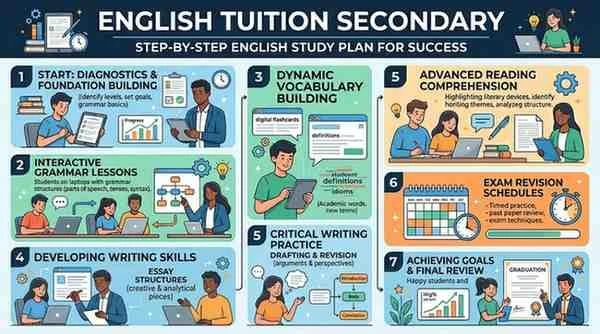
A structured study plan makes the difference between vague improvement intentions and systematic progress. The following is a sample weekly framework for a secondary student working to improve across all areas of English.
Sample Weekly Study Plan
Monday — 30 minutes: Read one article or book chapter. Write a three-sentence summary.
Tuesday — 20 minutes: Grammar focus exercise. Review one grammar topic, complete practice questions, check answers.
Wednesday — 45 minutes: Tuition session — focused on the area of current priority (writing, comprehension, or speaking).
Thursday — 30 minutes: Vocabulary review. Add five new words to a vocabulary list, review the previous week’s words using spaced repetition.
Friday — 30 minutes: Writing practice. Write one paragraph on a given topic, using the current week’s vocabulary and applying the grammar rule studied on Tuesday.
Weekend — 45–60 minutes: Complete a timed reading comprehension or essay question from a past paper. Review the mark scheme and self-assess.
This kind of structured, consistent approach — combined with quality tuition — is what produces reliable, sustained improvement in secondary English.
Future Trends in Online English Education
The landscape of English language learning is changing rapidly, driven by advances in technology, the globalization of education, and the growing demand for flexible, personalized learning experiences.
Personalized Learning at Scale
Adaptive learning technology — software that adjusts the difficulty and focus of content based on the learner’s performance — is making it increasingly possible to deliver personalized instruction at scale. These tools are not yet a replacement for skilled human tutors, but they are becoming powerful supplements.
Live Online Tutoring Growth
The shift to online tutoring accelerated dramatically in recent years and shows no sign of reversing. Students and families who discovered online tuition during periods of school closure have largely continued to use it, attracted by its convenience and the broader choice of tutors it provides.
Video and Podcast Learning
Short-form educational video content on platforms like YouTube has become a significant supplementary resource for language learners. Grammar explainers, vocabulary lessons, reading strategy guides, and exam preparation content are freely available and widely used by secondary students.
Global Learning Communities
Online language learning communities — forums, Discord servers, language exchange apps — are creating new opportunities for students to practice English in authentic communicative contexts, beyond the formal tuition session.
AI and Digital Learning in English Tutoring
Artificial intelligence is beginning to reshape English language learning in practical ways that are already visible in the tools available to secondary students and their tutors.
AI Writing Assistance
AI writing tools provide immediate grammar and style feedback that helps students develop self-editing skills. While these tools should supplement rather than replace human instruction, they are useful for building error-awareness between tuition sessions.
AI-Powered Speaking Practice
Conversational AI apps allow students to practice spoken English outside lesson hours, getting feedback on fluency, pronunciation, and vocabulary use. These tools are not yet at the level of a skilled human tutor, but they provide additional speaking opportunities that accelerate fluency development.
Automated Progress Tracking
Digital learning platforms increasingly offer detailed analytics on student performance — tracking vocabulary acquisition, grammar accuracy, reading speed, and comprehension scores over time. This data helps tutors identify persistent areas of weakness and measure the impact of their teaching more precisely.
The Role of Human Tutors in an AI World
It is worth being clear: AI tools are enhancing English learning, not replacing skilled human tutors. The emotional intelligence, adaptive reasoning, and deep subject knowledge of an experienced tutor — the ability to read a student’s confidence, motivate them through difficulty, and explain a concept six different ways until it lands — remain beyond the reach of current AI systems.
English Tuition Comparison Tables
Online vs. In-Person English Tuition
| Factor | Online Tuition | In-Person Tuition |
|---|---|---|
| Tutor choice | Very wide — global access | Limited to local area |
| Flexibility | High — flexible scheduling | Moderate — travel required |
| Cost | Generally lower | Can be higher with travel |
| Technology required | Yes — device and internet | No — physical space only |
| Student engagement | Good for self-directed learners | Better for younger/anxious students |
| Resources shared | Digital (documents, screens) | Physical (books, worksheets) |
| Session recording | Easily available | Possible but less common |
| Best for | Motivated, tech-comfortable students | Younger students, those needing structure |
One-on-One vs. Group English Tuition
| Factor | One-on-One Tuition | Small Group Tuition |
|---|---|---|
| Personalization | Very high | Moderate |
| Cost per student | Higher | Lower |
| Pace control | Fully student-led | Shared pace |
| Peer interaction | None | Present |
| Feedback | Immediate and specific | Shared and general |
| Progress speed | Faster for most students | Slower but more affordable |
| Motivation source | Tutor-student relationship | Peer group dynamic |
| Best for | Students with specific gaps | Students needing affordable support |
Grammar-Focused vs. Speaking-Focused Tuition
| Factor | Grammar-Focused | Speaking-Focused |
|---|---|---|
| Primary skill developed | Writing and accuracy | Communication and confidence |
| Assessment relevance | High for written exams | High for oral exams and IELTS speaking |
| Practice type | Written exercises, editing | Conversation, presentations, debate |
| Progress measurement | Error reduction in writing | Fluency, clarity, and confidence improvement |
| Best for | Students with weak written accuracy | Students needing oral confidence |
| Time to see improvement | 4–8 weeks consistent practice | 4–6 weeks consistent practice |
English Learning Apps vs. Private Tutors
| Factor | Learning Apps | Private Tutor |
|---|---|---|
| Personalization | Low–moderate (adaptive) | Very high |
| Cost | Low to free | Moderate to high |
| Availability | Anytime | Scheduled sessions |
| Feedback quality | Automated | Expert, nuanced |
| Motivation support | Gamification only | Personal, relational |
| Suitable for exam prep | Limited | Excellent |
| Best use | Vocabulary, grammar drills | Comprehensive skill development |
| Replaces tuition? | No — supplements only | Primary learning source |
Beginner vs. Advanced Secondary English Programs
| Factor | Beginner Program | Advanced Program |
|---|---|---|
| Focus areas | Basic grammar, vocabulary, reading | Essay writing, analysis, exam technique |
| Session content | Foundational structures, pronunciation | Critical thinking, sophisticated expression |
| Resources used | Simplified texts, graded readers | Literature, past papers, academic articles |
| Exam preparation | Foundation-level exams | Higher-level, IELTS, A-levels |
| Progress pace | Gradual — foundation building | Faster — building on existing skills |
| Tutor experience needed | Patient, foundational expertise | Curriculum specialist, exam expertise |
Frequently Asked Questions
What does an English tutor do?
An English tutor works with a student individually or in small groups to develop their English language skills. This includes teaching grammar, improving writing structure and expression, developing reading comprehension strategies, building spoken communication confidence, and preparing for specific exams. A good tutor assesses where the student currently is, identifies their gaps and goals, and designs lessons accordingly.
How can an English tutor improve fluency?
Tutors improve fluency by providing structured speaking practice, immediate feedback on errors, vocabulary building exercises, and regular reading and listening activities. Fluency develops through consistent, meaningful language use — and a tutor creates the conditions for that practice to happen in a focused, supportive environment. Improvement depends on the frequency of sessions and the student’s practice between them.
What is the best online English tutor?
There is no single “best” online English tutor — the right tutor depends on the student’s level, goals, curriculum, and learning style. When choosing an online tutor, look for relevant qualifications, experience with secondary school curricula, positive reviews from previous students, and the ability to demonstrate a teaching approach that matches the student’s needs. A trial session is the most reliable way to assess fit.
How much does English tutoring cost?
Tuition costs vary widely by location, tutor experience, format (online or in-person), and session length. Online tuition is generally more affordable than in-person. Rates also vary internationally — tutors in high-demand markets typically charge more. The most important consideration is value: consistent, quality tuition from a good match tutor delivers far more return than cheaper, inconsistent support.
Are online English tutors effective?
Yes, online English tutoring is highly effective when both the tutor and student engage seriously with the sessions. Research and practical experience consistently show that the quality of the teaching relationship and the consistency of sessions matter far more than whether lessons are delivered online or in person. Many students have achieved excellent results through fully online tuition programs.
How do I choose an English tutor?
Start by identifying your student’s specific needs — is it grammar, writing, speaking, exam preparation, or overall improvement? Then look for english tuition secondary with relevant qualifications and experience in those areas. Request a trial session, assess how the tutor engages with the student, and check whether they have familiarity with the relevant curriculum and examination requirements.
What are the benefits of private English tutoring?
Private English tutoring offers personalized instruction, immediate feedback, flexible pacing, and consistent focus on the student’s specific weaknesses. It builds confidence alongside skills, and the student-tutor relationship motivates regular engagement. For secondary students facing competitive exams, private tuition provides a targeted, efficient route to meaningful improvement.
Can English tutors help with IELTS preparation?
Yes. Tutors who specialize in IELTS preparation are highly valuable for secondary students aiming to study abroad or at English-medium universities. They cover all four skills tested in IELTS — reading, writing, listening, and speaking — with specific attention to the exam’s format, scoring criteria, and strategies for each component.
How long does it take to improve English speaking?
Meaningful improvement in English speaking typically becomes noticeable after four to eight weeks of consistent, regular practice. However, the timeline varies significantly depending on the student’s starting level, how frequently they practise, whether they engage with English outside sessions, and the specific aspect of speaking being developed. Fluency and confidence are developed over months, not days.
What skills can an English tutor teach?
An English tutor can teach grammar and punctuation, essay planning and writing, reading comprehension strategies, vocabulary development, spoken communication and presentation, pronunciation and intonation, critical analysis of texts, exam technique, and academic writing skills. The mix depends on the student’s goals and the curriculum they are following.
Do English tutors help adults and kids?
Yes. English tutors work with learners across all ages — from young children developing foundational literacy to adults preparing for professional qualifications or improving workplace communication skills. Secondary school students fall between these groups and benefit from tutors who understand adolescent learning needs and the specific demands of secondary curricula.
How do online English lessons work?
Online English lessons typically take place via a video call platform such as Zoom, Google Meet, or a dedicated tutoring platform. The tutor and student can share screens, collaborate on digital documents, use virtual whiteboards, and share resources. Sessions are usually 45 to 60 minutes and are planned around the student’s current goals and recent progress.
What is the difference between English coaching and tutoring?
Tutoring typically focuses on academic skills — grammar, writing, reading comprehension, and exam preparation — tied to a specific curriculum. Coaching in the English context often refers to communication skills development more broadly, such as business communication, presentation skills, or professional spoken English, rather than academic language skills. The terms are used interchangeably in some contexts.
Can an English tutor improve grammar?
Yes, improving grammar is one of the most specific and measurable outcomes of English tuition. A good tutor identifies the student’s recurring grammatical errors, teaches the underlying rules, and uses targeted practice to correct them. Consistent grammar improvement typically becomes visible in writing within four to six weeks of focused work.
What should I expect from English tutoring sessions?
A well-structured tuition session begins with a brief review of previous work or recent school assignments, moves to the main focus of the session (which might be grammar, writing, reading, or speaking practice), includes feedback and explanation during exercises, and ends with a clear summary of what was covered and what to practise before the next session. The student should leave each session understanding something they did not understand before.
Are one-on-one English lessons better?
One-to-one lessons provide the highest level of personalization and are generally the most effective format for students with specific gaps or goals. However, they are also the most expensive option. For students who benefit from peer interaction or whose families are working within a tighter budget, small group tuition can also produce strong results, particularly when the group level is well-matched.
How often should I take English tutoring classes?
Most secondary students benefit from one to two sessions per week for ongoing skill development. During intensive exam preparation periods, two to three sessions per week may be appropriate. The key is consistency — weekly sessions maintained over months produce far better outcomes than irregular, intensive short bursts.
Can tutors help with business English?
Yes, tutors who specialize in business English tuition secondary can help professionals and older secondary students develop workplace communication skills, including formal email writing, presentation delivery, meeting participation, and professional vocabulary. Business English tuition is distinct from academic English tuition and requires a tutor with relevant professional communication expertise.
What are the best platforms for English tutoring?
Popular platforms for online English tutoring include iTalki, Preply, TutorMe, Wyzant, and Superprof, among many others. Each platform has different pricing structures, tutor vetting processes, and target learner groups. For secondary students, it is also worth considering specialist tutoring agencies that focus specifically on academic English support and curriculum-aligned tutoring.
How do tutors improve English pronunciation?
Tutors improve pronunciation by first assessing the specific sounds and patterns the student finds difficult, often linked to their first language phonology. They use targeted listening and speaking exercises, model the target sounds themselves, provide immediate feedback during speaking practice, and use recording and playback so students can hear their own pronunciation. Progress in pronunciation requires regular, focused practice over several weeks.
Conclusion
English is not just a school subject — it is the primary tool through which secondary students demonstrate their intelligence, communicate their ideas, and engage with the wider world. For students who are struggling, falling behind, or simply aiming to perform at their best in a competitive academic environment, English tuition for secondary students offers a structured, personalized path to genuine and lasting improvement.
The benefits go well beyond exam results, though those matter enormously. Students who develop strong English skills gain confidence in their voice, clarity in their thinking, and a foundation for academic and professional success that serves them for life.
Whether through one-to-one private tuition, online lessons with a specialist tutor, or a carefully structured combination of formal sessions and independent practice, the right support makes a measurable difference. But it requires consistency — from the student, the tutor, and the family — and realistic expectations about the timeline for improvement.
The students who progress most rapidly are those who engage actively with every session, practice between lessons, read widely, and approach English as a skill worth investing in rather than a hurdle to get past. With the right tutor and the right mindset, significant improvement is achievable — not overnight, but reliably and sustainably over time.
Start Your Secondary English Tuition Journey Today
Whether you are a student looking to improve your exam performance, a parent seeking the right support for your child, or an educator exploring tuition options for secondary students, taking action now puts improvement ahead of schedule.
Here are your next steps:
- Identify the specific areas where the student needs the most support — writing, grammar, speaking, reading comprehension, or exam preparation
- Decide whether online or in-person tuition is the better fit for the student’s learning style and schedule
- Research tutors with relevant qualifications, secondary school curriculum experience, and strong reviews
- Book a trial session to assess whether the tutor’s style and approach is a good match for the student
- Set a consistent weekly schedule — one to two sessions per week is a strong starting point
- Establish a study routine between sessions using the weekly study plan framework in this guide
The right tuition, consistently applied, transforms English from a source of stress and uncertainty into a genuine strength. Start today — and watch the improvement follow.
Note: English tuition outcomes depend on a range of factors including student engagement, consistency of sessions, teaching quality, and independent practice. This article is for educational guidance only and does not guarantee specific academic results.